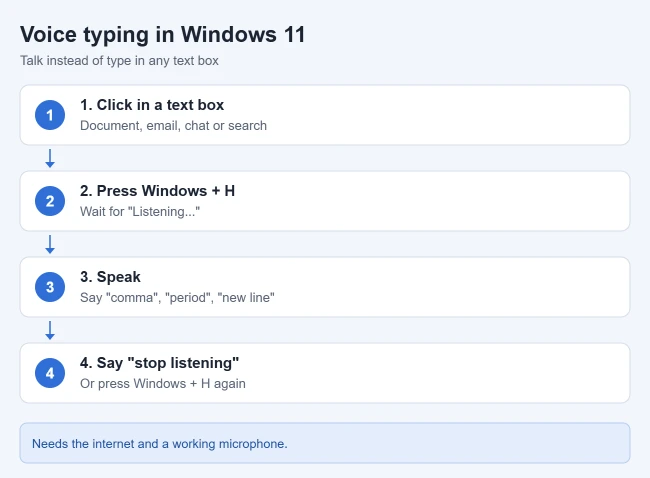
To use voice typing in Windows 11, click in any text box and press Windows key + H. A small voice typing bar opens and starts listening. Speak, and your words appear as text. Say “stop listening,” press Windows key + H again, or select the microphone button to stop.
This guide covers starting and stopping voice typing, punctuation and editing commands, the settings on the voice typing bar, changing the language, Fluid dictation on Copilot+ PCs, Voice access for offline use, and fixes when it won’t start. Steps follow Microsoft’s voice typing guide, checked October 1, 2026. Voice typing is built into every edition of Windows 11, so there’s nothing to install.
Before You Start
- An internet connection. Microsoft says voice typing uses online speech recognition powered by Azure Speech services.
- A working microphone, either built in or plugged in.
- Your cursor in a text box, such as a Word document, an email, a chat or a search box.
Start Voice Typing
- Click where you want the text to go. Result: the cursor blinks in the text box.
- Press Windows key + H. On a touchscreen, you can tap the microphone button on the touch keyboard instead. Result: the voice typing bar opens on screen.
- Wait for the Listening… alert, then speak at a normal pace. Result: your words appear in the text box as you talk.
- Say punctuation out loud, like “comma” or “period,” unless automatic punctuation is on (see Settings below).
Stop Voice Typing
- Say “stop listening,” “stop dictation” or “pause voice typing.”
- Select the microphone button on the voice typing bar.
- Press Windows key + H again.
Microsoft notes that voice typing suppresses sound from your speakers, such as Narrator or a video, so it only types what you say. If the screen reader started by accident, you can turn off Narrator in Windows 11 with a shortcut or in Settings.
Voice Typing Commands
These are Microsoft’s commands for English (United States):
- “Delete that,” “erase that” or “scratch that” removes the last word or phrase you said. If text is selected, it deletes the selection.
- “Select that” selects the last thing you said.
- “Undo that” or “revert” undoes the last change.
- “Press Enter,” “press Backspace,” “press Tab” and “press Space” act like the keys.
- “New line” starts a new line, and “new paragraph” starts a new paragraph.
Punctuation you can say
Say “comma,” “period,” “question mark,” “exclamation mark,” “colon,” “semicolon,” “open quotes,” “close quotes,” “hyphen,” “dollar sign,” “at sign,” “open parentheses,” or “close parentheses” to insert that symbol. Microsoft’s full list also includes math signs, currency symbols, and “smiley face” for :).
Voice Typing Settings

Select the gear icon on the voice typing bar to change these settings:
- Voice typing launcher: shows a small microphone button whenever you click in a text box, so you don’t need the shortcut.
- Automatic punctuation: adds periods, commas and question marks based on how you speak.
- Filter profanity: blocks or allows swear words in your text.
- Default microphone: chooses which microphone voice typing uses.
- Wait time before acting: sets how long voice typing waits before carrying out a command, which helps if you speak slowly.
Press Windows key + Alt + H to move through the voice typing bar with your keyboard.
Change the Voice Typing Language
Voice typing supports more than 40 languages and uses your current input language. To switch, select the language switcher on the taskbar or press Windows key + Space. To add a language:
- Open Settings > Time & language > Language & region.
- Next to Preferred languages, select Add a language.
- Search for the language, select Next, then install it. Result: the language appears in the switcher. Microsoft says the optional speech features aren’t required for voice typing.
For more on switching input languages, see how to change the keyboard layout in Windows 11.
Fluid Dictation on Copilot+ PCs
On Copilot+ PCs, Microsoft’s Fluid dictation fixes grammar, punctuation and filler words as you speak, using small language models on the device. It’s on by default in English locales once the model finishes downloading; until then, the option looks dimmed in voice typing settings. Say “undo that” or press Ctrl + Z to restore what you actually said. It turns off automatically in password and PIN fields.
Need It Offline? Try Voice Access
Voice typing needs the internet, but Voice access uses on-device speech recognition and works without a connection. It’s available in Windows 11 version 22H2 and later and also lets you open apps, click buttons and control your PC by voice. Microsoft says it replaced Windows Speech Recognition starting in September 2024. Turn it on in Settings > Accessibility > Speech.
If Voice Typing Doesn’t Work
- Nothing happens when you press Windows key + H: click inside a text box first. The shortcut only works where you can type.
- It says it can’t connect: check your internet connection. Voice typing doesn’t work offline.
- It doesn’t hear you: make sure microphone access is on in Settings > Privacy & security > Microphone, and pick the right mic under Default microphone in voice typing settings.
- Punctuation keeps appearing (or never does): toggle Automatic punctuation in voice typing settings.
- Wrong language: press Windows key + Space to switch the input language before you start.
Frequently Asked Questions
Is voice typing free?
Yes. It’s built into Windows 11 Home and Pro and works in almost any app that accepts typed text.
Does voice typing need the internet?
Yes. Microsoft says it uses online speech recognition. Use Voice access if you need to dictate offline.
Is voice typing the same as dictation in Word?
No. Word’s Dictate button is a Microsoft 365 feature inside Office apps. Windows voice typing works across Windows, including in browsers, email and chat apps.
Which languages work?
More than 40, including several versions of English, Spanish, French, Portuguese and Chinese. Microsoft lists them all on its voice typing page.

Matthew Burleigh is the founder, head writer, and editor of Solve Your Tech, which he launched in 2012. He has written technology tutorials since 2008 and worked in IT since 2003, including small-business support, IT management, and consulting. He holds Bachelor’s and Master’s degrees in Computer Science from Arizona State University.
Matthew writes practical guides for Windows, iPhone and iPad, Microsoft Office, Outlook, Google apps, and Android. Solve Your Tech’s guides are tested on current devices or checked against official product documentation, with clear steps, sources, and update dates.
Read more about Matthew and how Solve Your Tech writes and updates its guides, or report a correction.