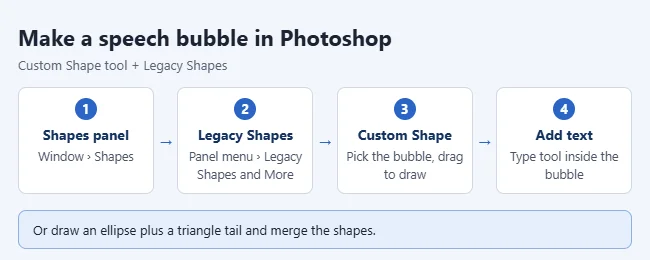
To create a speech bubble in Photoshop, open Window > Shapes, choose Legacy Shapes and More from the panel menu, and pick a shape from the Talk Bubbles folder. Then select the Custom Shape tool and drag on the canvas to draw it. Add your words with the Horizontal Type tool by clicking inside the bubble.
That is the shortest route. The rest of this guide explains each step, shows how to change the color and outline, and covers drawing your own bubble when none of the built-in shapes fit.
What you need before you start
These steps are written for the current desktop version of Photoshop on Windows and Mac, and they follow Adobe’s current help pages. The Legacy Shapes and More set was introduced with Photoshop 2020. In older versions, including CS5, the bubble shapes sit in the Custom Shape picker instead, which is covered in the troubleshooting section below.
- An open document or photo to put the bubble on.
- The Layers panel visible (Window > Layers), so you can see the new shape and text layers.
- A rough idea of where the speaker is, so the tail of the bubble can point at them.
A speech bubble drawn this way is a shape layer. That means it is a vector object: its edges stay smooth, and you can resize it as often as you like without losing quality. Nothing here changes the pixels of your photo, because the bubble and its text sit on their own layers. If the photo already has words on it that you want gone first, see how to remove text from a picture in Photoshop.
Draw a speech bubble with a custom shape
- Choose Window > Shapes to open the Shapes panel.
- Click the menu icon (three lines) in the upper-right corner of the panel and select Legacy Shapes and More. A new folder with that name is added to the bottom of the panel. You only need to do this once.
- Expand Legacy Shapes and More, then All Legacy Default Shapes, then Talk Bubbles. Click the bubble you want.
- Select the Custom Shape tool from the shapes tool group in the toolbar. It shares a button with the Rectangle tool, so click and hold that button to see it.
- In the options bar at the top, make sure the mode menu on the left is set to Shape. If it is set to Path, you get an empty outline with no fill.
- Drag on the canvas to draw the bubble. Hold Shift while you drag to keep its proportions.
- Release the mouse. A new shape layer appears in the Layers panel.
Adobe covers these steps in Add legacy custom shapes and Draw custom shapes. Once the legacy set is loaded, you can also pick a bubble from the Shape menu in the options bar without opening the Shapes panel again.
Change the fill color and outline
A classic comic bubble is white with a black outline. In Photoshop, the inside color is the Fill and the outline is the Stroke. To put a border around a selected area that is not a shape, see how to outline a selection in Photoshop.
- Select the bubble’s shape layer in the Layers panel and keep a shape tool active.
- Click Fill in the options bar and choose a color. You can pick a solid color, a gradient, or a pattern. For other ways to use one, see how to add a pattern in Photoshop.
- Click Stroke and choose the outline color.
- Set the stroke width, and open the stroke options if you want a dashed or dotted line instead of a solid one.
The same Fill and Stroke controls also appear in the Properties panel and in the Contextual Task Bar (Window > Contextual Task Bar), as described in Adobe’s Modify fill and stroke for shapes. For an outline-only bubble, set the fill to no color and keep the stroke.
Add text inside the bubble
- Select the Horizontal Type tool (T).
- Move the pointer inside the bubble until the type cursor is enclosed in a circle. That cursor means the text will be kept inside the shape.
- Click and type. The lines wrap to the outline of the bubble.
- Click the Commit icon (the check mark) in the options bar to finish.
This is Adobe’s text inside shapes method. If the pointer shows a wavy line instead of a circle, it is sitting on the edge of the shape, and the text would run along the outline. Move it toward the middle before you click.
Some people prefer text that is not tied to the shape, so they can place it freely. To do that, click on an empty part of the canvas away from the bubble, type the words, commit, and then drag the text over the bubble with the Move tool. To style the words either way, see how to change font in Photoshop.
Move, resize, or flip the bubble
- Move: select the shape layer, choose the Move tool, and drag the bubble.
- Resize: choose Edit > Free Transform Path, or press Ctrl+T (Windows) or Command+T (Mac), then drag the handles.
- Flip the tail: choose Edit > Transform Path > Flip Horizontal so the tail points the other way. Flip the bubble before you add text inside it, or use separate text, so the words are not mirrored along with the shape.
- Make a second bubble: right-click the shape layer in the Layers panel and choose Duplicate Layer, then move the copy.
To line up the bubble and a separate text layer precisely, see how to center a layer. To reuse the bubble in a different picture, copy the layer to another image in Photoshop.
Make your own bubble instead
The built-in shapes have fixed tails. If you need the tail in a specific place, build the bubble from two simple shapes.
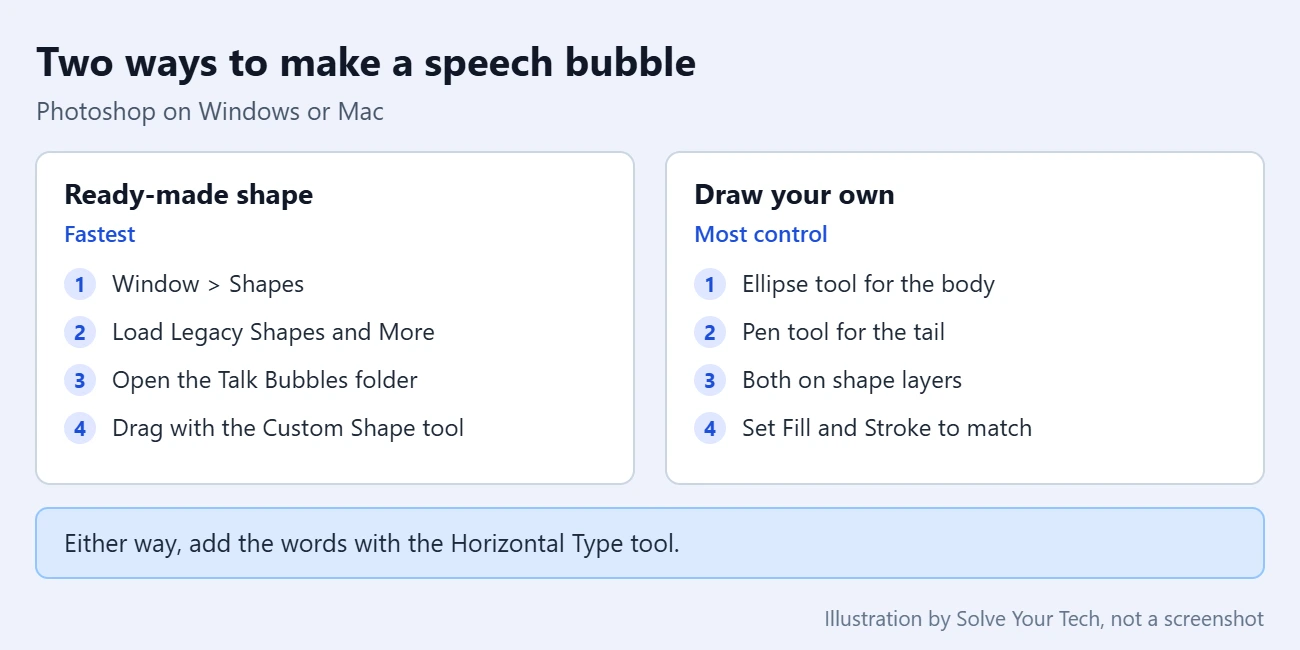
- Select the Ellipse tool from the shapes tool group, set the mode to Shape, and drag an oval for the body of the bubble.
- Set the fill to white and turn the stroke off for now.
- Draw the tail on its own shape layer. Use the Pen tool in Shape mode and click three points to make a narrow triangle, or use the Polygon tool with the number of sides set to 3. Overlap the wide end with the oval and point the tip at the speaker.
- Give the tail the same fill color as the oval.
- Select both shape layers in the Layers panel, right-click one of them, and look for Merge Shapes to combine them into a single shape. The exact name and position of this command can differ between Photoshop versions.
- Add the stroke to the combined shape so one continuous outline runs around the body and the tail.
Want to use your bubble again later? Select its path in Window > Paths, choose Edit > Define Custom Shape, and give it a name. It then shows up in the custom shape picker like the built-in shapes.
Check the result and undo mistakes
When everything worked, the Layers panel shows a shape layer for the bubble and a type layer above it, and your photo layer is unchanged. Click the eye icon next to either layer to hide it and confirm that the picture underneath is intact.
To back out of the last change, press Ctrl+Z (Windows) or Command+Z (Mac). To remove the bubble completely, select its shape layer and the text layer, then press Delete. If you save the file as a Photoshop document (PSD), the layers are kept, so the bubble and the wording can still be edited the next time you open it.
Troubleshooting
- There are no bubble shapes in the Shapes panel. The legacy set is not loaded yet. Open the panel menu and choose Legacy Shapes and More, then scroll to the bottom of the panel.
- There is no Shapes panel in the Window menu. You are probably using a version older than Photoshop 2020. Select the Custom Shape tool, open the Shape picker in the options bar, click the gear icon, and choose the Talk Bubbles category.
- The bubble is only a thin outline with no color. The tool mode is set to Path. Undo, switch the mode menu in the options bar to Shape, and draw it again.
- The bubble was painted onto the photo layer. The mode is set to Pixels, which draws directly on the selected layer. Undo and switch to Shape.
- The text does not stay inside the bubble. You clicked outside the shape, or the bubble’s layer was not selected. Select the shape layer and click only when the cursor is enclosed in a circle.
- Some words are missing. The text is too long for the shape. Shorten it, reduce the font size, or enlarge the bubble.
- The bubble looks stretched. Draw it again while holding Shift.
Tips for readable bubbles
- Keep the text short and leave some space between the words and the outline.
- Point the tail at the speaker’s mouth or head, and keep it clear of faces.
- Use the same fill, stroke width, and font for every bubble in one image.
- Name the layers, for example Bubble 1 and Text 1, when an image has several speakers.
Frequently asked questions
Where did the speech bubble shape go?
In Photoshop 2020 and newer, the older shapes moved to the Legacy Shapes and More set in the Shapes panel. Load it once and the Talk Bubbles shapes appear in the Shapes panel and in the Custom Shape picker. The same set includes arrow shapes, which are covered in how to draw a straight line or arrow in Photoshop.
How do I make a thought bubble?
Look through the Talk Bubbles folder in the legacy shapes for a cloud-style bubble first. If none suits the picture, draw a cloud from several overlapping circles with the Ellipse tool, add two or three small circles leading toward the character, and give them all the same fill and stroke.
Can I change the bubble’s color after I draw it?
Yes. Select the shape layer, choose any shape tool, and pick a new color from Fill or Stroke in the options bar or the Properties panel. Because the bubble is a shape layer, the change applies immediately and can be repeated as often as you like.
Will resizing the bubble make it blurry?
No. Objects made with the shape tools are vector objects, so Adobe notes that you can resize and transform them repeatedly without losing image quality. That only stops being true if you rasterize the layer, which turns it into pixels.
Can I add more than one speech bubble to a picture?
Yes. Each bubble is its own shape layer, so you can draw another one, or duplicate an existing bubble with Duplicate Layer and flip it for a second speaker. Each bubble gets its own text.
Next step
Draw one bubble from the Talk Bubbles folder, set a white fill and black stroke, and type a short line inside it. Once that works, try the ellipse-and-tail method for a bubble whose tail points exactly where you need it.

Matthew Burleigh has been writing tech tutorials since 2008. His writing has appeared on dozens of different websites and been read hundreds of millions of times.
After receiving his Bachelor’s and Master’s degrees in Computer Science he spent several years working in IT management for small businesses. However, he now works full time writing content online and creating websites.
His main writing topics include iPhones, Microsoft Office, Google Apps, Android, and Photoshop, but he has also written about many other tech topics as well.