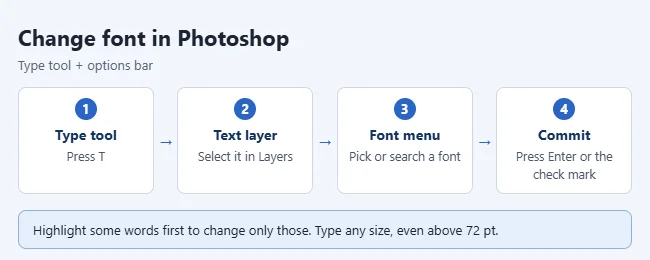
To change the font in Photoshop, select the Horizontal Type tool, click the text layer in the Layers panel, and choose a new font from the font menu in the options bar at the top of the window. With the layer selected and nothing highlighted, every character on that layer changes. To change only a few words, highlight them first.
These steps follow Adobe’s current Photoshop help for desktop (Windows and Mac), including Search for and apply font styles. The basic Type tool steps also match older versions such as Photoshop CS5, but the font filters and some newer panels do not exist there. You need an editable text layer, which Adobe calls a type layer; it shows a T thumbnail in the Layers panel.
Change the font of a whole text layer
This is the shortest route when all of the text on a layer should use the same font.
- Select the Horizontal Type tool in the toolbar, or press T. The options bar across the top of the window switches to text settings. The Vertical Type tool works too.
- Click the text layer in the Layers panel. Do not click inside the text on the canvas yet, so that nothing is highlighted.
- Click the font box in the options bar. Adobe labels it Search and select fonts. Type the name of a font, or click the down arrow beside the box to scroll through the list. Typing narrows the list as you go, which is faster than scrolling.
- Select a font. The text on the canvas changes right away.
- Open the style menu next to the font box to pick a variant such as Bold or Italic. The choices depend on the font, and some fonts have only one style.
If the options bar is not on screen, choose Window > Options. The text settings only appear there while a Type tool is active.
A long font list is slow to scroll. In current versions of Photoshop, the font menu has filters at the top. Adobe’s help page describes these choices:
- Your fonts and More fonts, which switch between fonts you already have and additional ones.
- Show Adobe Fonts, which limits the list to fonts from Adobe’s font service.
- Show Variable Fonts, which lists fonts with adjustable weight.
- Show favorite fonts, which lists fonts you have marked as favorites. Click the star beside a font name to add it.
- Show similar fonts, which lists fonts that look like the one currently selected.
There is also a class filter that narrows the list to one kind of typeface, such as serif or script. Variants such as Regular, Italic, Bold, and Bold Italic are grouped under one menu item, so you may need to expand a font name to see them. If the previews in the list are too small to judge, choose Type > Font Preview Size and pick a larger size.

Change the font for only some of the text
Photoshop applies a font to whatever is selected. To give one word or one line a different font, you have to highlight those characters first. Highlighting puts the layer into edit mode, which means the change is not final until you commit it.
- Select the Horizontal Type tool and click inside the text on the canvas. You can also double-click the text with the Move tool, or double-click the T thumbnail in the Layers panel, which opens the layer with all of its characters selected.
- Select the characters you want to change. Drag across them, or use Adobe’s click shortcuts: double-click a word, triple-click a line, or click four times to select a paragraph. Click at one point and Shift-click at another to select everything between them.
- Choose a font and style in the options bar. Only the highlighted characters change.
- Commit the edit. Click the Commit button (the check mark) in the options bar, select a different tool, click another layer in the Layers panel, or click an empty spot on the canvas once the pointer turns back into a normal arrow.

To back out instead, click the Cancel button next to the check mark. Be careful with the Esc key. Current versions treat Esc as a commit key by default. It only cancels if you turn off Use Esc key to commit text in Edit > Preferences > Type on Windows or Photoshop > Settings > Type on a Mac (named Preferences in older versions).
Adobe’s Edit text page lists every way to select, commit, and cancel. Not sure where that window is? Here’s how to open and change Photoshop preferences.
Change the font on several text layers at once
If a design has many separate text layers, you do not need to change them one at a time.
- Select the Horizontal Type tool.
- Hold Ctrl on Windows or Command on a Mac and click each type layer in the Layers panel. To select a run of layers that sit next to each other, click the first one and Shift-click the last.
- Click the down arrow beside the font box in the options bar and select a font.
All of the selected layers switch to the new font. Adobe covers this in Change the font across multiple layers. In a busy file, the filter at the top of the Layers panel can show only type layers, which makes them easier to pick out. Check each layer afterward, because a font with wider letters can push text off the canvas or into other objects.
If the same look repeats across a project, a character style saves time. Choose Window > Character Styles, select some text that already has the font you want, and choose Create new character style from the panel menu. Click the style to apply it to other text. When you later edit the style, every piece of text that uses it updates.
Use the Character panel instead of the options bar
The Character panel holds the same font and style menus, plus more settings in one place. Choose Window > Character to open it. With a type layer selected in the Layers panel, you can pick a font here without clicking into the text at all. You can format characters from four places: the Character panel, the Type tool options bar, the Properties panel, and the Contextual Task Bar, which is the small floating bar that appears near a selection in recent versions.
The panel is useful when you want to adjust more than the font:
- Size. Pick a value from Set font size or type your own number and press Enter. You are not limited to the sizes in the menu, and you can type a unit after the number, such as px or in. Typing a size gives an exact value; stretching the layer with Free Transform scales it instead.
- Color. Click the color box and choose a color in the Color Picker. If you changed the color of highlighted letters, the new color shows once you deselect them.
- All caps, small caps, underline, and strikethrough. These are buttons in the panel or in the Type options of the Properties panel.
- Faux styles. If a font has no real bold or italic version, the Character panel menu offers Faux Bold and Faux Italic, which simulate the style.
Variable fonts have one more control. After you select text that uses one, select the Variable font settings icon in the Character section of the Properties panel and drag the Weight slider.
Check the result and undo it if needed
To confirm the change, select the text layer with the Type tool active and read the font box in the options bar. It shows the name of the font on that layer. If the layer mixes more than one font, highlight a word to see which font that word uses.
To reverse a font change, press Ctrl + Z on Windows or Command + Z on a Mac, or choose Edit > Undo. Press it again to step back further. File > Revert goes back to the last saved version of the file, so it also discards every other unsaved edit. Only use it if that is what you want.
A different font usually takes up a different amount of room. If the text is no longer in the middle of the image, you can center the text layer in Photoshop again.
If the font won’t change
- The layer is not a type layer. Look for the T thumbnail in the Layers panel. Text that has been rasterized (converted to pixels) is a picture of letters. After rasterization you can no longer edit the text or change fonts. The same is true after Layer > Type > Convert to Shape. You would have to remove it and type it again.
- The text is part of a photo or a flattened file. A JPEG or screenshot has no type layers at all. Remove the old words first with these Photoshop text removal steps, then add new text.
- Only part of the text changed. Some characters were highlighted. Commit the edit, select the layer in the Layers panel without highlighting anything, and choose the font again.
- You changed the wrong layer. Check which layer is highlighted in the Layers panel before you pick a font, then undo and try again.
- The options bar or panels are missing. Choose Window > Options. If everything is hidden, press Tab, which hides and shows all panels. You can also reset the workspace or check how to exit full screen mode in Photoshop.
- Photoshop says a font is missing. This happens when a file uses a font that is not on your computer. When you are online, Photoshop activates missing fonts from Adobe Fonts automatically and shows a blue sync icon on the layer while it does. For other fonts, choose Type > Manage Missing Fonts and replace the font with the default or with one already used in the document. The Replace missing fonts help page describes each choice.
- The image mode does not allow type layers. Bitmap, Indexed Color, and Multichannel modes rasterize text instead of keeping it editable. Check Image > Mode.
- The font you want is not in the list. Photoshop can only show fonts that are available on your computer or through Adobe Fonts. Use the More fonts filter to browse additional fonts, or install the font on your computer and look for it again.
On a Windows PC, install the font in Windows 11 first, then close and reopen Photoshop so the new font appears in the font menu.
Warning: filters and painting tools need a rasterized layer, and Photoshop warns you before it rasterizes. Duplicate the type layer first so you keep one copy whose font you can still change.
Frequently asked questions
How do I change the font of all the text on a layer?
Select the Horizontal Type tool, click the type layer in the Layers panel without highlighting any characters, and pick a font from the font menu in the options bar. Every character on that layer changes.
Why did only one word change font?
That word was highlighted. Photoshop applies a font to the selected characters only. Commit the edit, select the layer in the Layers panel, and choose the font again to apply it to everything.
Can I set a default font for new text?
Photoshop uses the font that is selected in the options bar when you start a new text layer, so pick a font with the Type tool before you click on the canvas. In Creative Cloud versions, Adobe also offers Type > Save Default Type Styles, and Type > Load Default Type Styles brings those settings back.
Can I identify a font that is in a picture?
Photoshop can suggest close matches. Adobe’s steps are to draw a box around the text with the Rectangular Marquee tool, choose Type > Match Font, and pick from the list of similar fonts. It finds lookalikes and does not make the text in the picture editable.
Do these steps work in Photoshop CS5 and other old versions?
The Type tool, the font menu in the options bar, and the Character panel have been part of Photoshop for a long time, so the basic steps apply. Adobe’s current help pages only describe recent versions, so the font filters, the Contextual Task Bar, the Properties panel type options, and the Esc key behavior may be missing or different in an older copy.
Does changing the font lower the quality of the text?
No. Type layers use vector outlines instead of pixels, so the text stays sharp when you change the font or resize it. Quality only becomes fixed once the layer is rasterized.
Next step
Once the font looks right, you can build on it. To add an outline, apply a Stroke layer style, which keeps the text editable. The steps for outlining a selection in Photoshop cover it. Adding dialogue to a photo? Add a Photoshop speech bubble.

Matthew Burleigh is the founder, head writer, and editor of Solve Your Tech, which he launched in 2012. He has written technology tutorials since 2008 and worked in IT since 2003, including small-business support, IT management, and consulting. He holds Bachelor’s and Master’s degrees in Computer Science from Arizona State University.
Matthew writes practical guides for Windows, iPhone and iPad, Microsoft Office, Outlook, Google apps, and Android. Solve Your Tech’s guides are checked step by step against the device or app maker’s own documentation and tested on his own devices whenever he has the hardware or software, with clear steps, sources, and update dates.
Read more about Matthew and how Solve Your Tech writes and updates its guides, or report a correction.