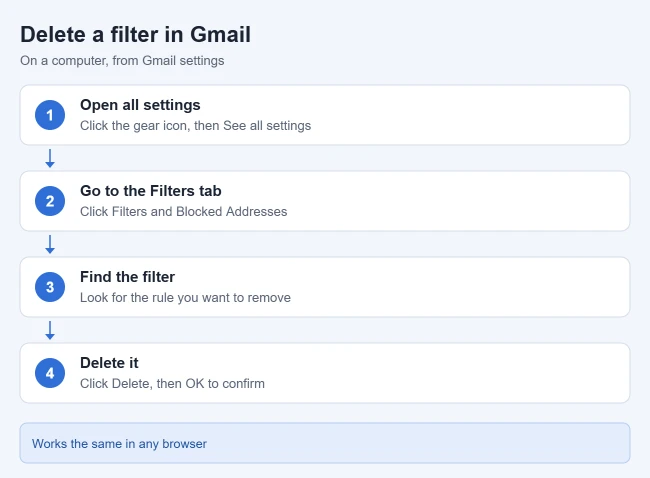
To delete a filter in Gmail, open Gmail on a computer, click Settings (the gear icon) > See all settings, and go to the Filters and Blocked Addresses tab. Find the filter, click Delete, then click OK. New emails that match it will no longer be sorted, labeled, forwarded or archived automatically.
This covers Gmail in a web browser on Windows, Mac or Chromebook, for personal Gmail and Google Workspace accounts, and follows Google’s Gmail Help article Create rules to filter your emails. The Gmail app on iPhone, iPad and Android doesn’t show filter settings, but filters you change on a computer apply to mail in the app too.
Before you delete: what a filter is and what changes
A Gmail filter is a saved rule. It has two halves: the criteria (who sent the email, words in the subject, whether it has an attachment) and the actions Gmail takes on matching mail, such as Skip the Inbox (Archive it), Apply the label, Mark as read, Forward it or Delete it.
Deleting a filter removes the rule only. It doesn’t delete emails, labels or contacts, and it doesn’t undo anything the filter already did. Gmail has no undo for a deleted filter, so if you might want it again, export it first (see the backup section below).
How to delete a filter in Gmail
- Open Gmail in a web browser on your computer.
- In the top right, click Settings (the gear icon). The Quick settings panel opens.
- Click See all settings.
- Click the Filters and Blocked Addresses tab. Your filters are listed, each with its criteria on the left (for example, from:(news@example.com)) and its actions next to it.
- Find the filter you want to remove.
- Click Delete to the right of that filter.
- Click OK in the confirmation box.
The filter disappears from the list and stops acting on incoming mail right away.
Delete several filters at once
- On the Filters and Blocked Addresses tab, check the box next to each filter you want to remove.
- Click Delete at the bottom of the filter list.
- Click OK to confirm.
Find the right filter in a long list
Gmail doesn’t sort or search the filter list, and it can hold many rules (Google’s Gmail API documentation sets the maximum at 1,000 filters per account). Press Ctrl+F on Windows or Chromebook, or Command+F on Mac, and type the sender’s address, a domain or the label name. Your browser highlights the matching filter on the page.
If two filters look alike, read the actions as well as the criteria. A rule that says Skip Inbox, Apply label “Receipts” is a different filter from one that only applies the label.
What happens to emails a filter already moved
Emails a filter already handled stay where the filter put them. Here’s how to bring them back:
| What the filter did | Where the emails are now | How to get them back |
|---|---|---|
| Skip the Inbox (Archive it) | All Mail | Search for them, select them, and click Move to Inbox |
| Apply the label | The label, and the inbox too unless the filter also archived them | Open the label and remove it, or leave it as is |
| Delete it | Trash, for up to 30 days | In Trash, select them, click Move to, and choose Inbox |
| Mark as read | Wherever they landed | Select them and click Mark as unread |
| Forward it | Already sent to the other address | Can’t be unsent |

Google says in its Trash help page that deleted messages stay in Trash for 30 days, then are removed for good. If a “Delete it” filter has been running for longer than that, older matching mail is gone.
To find the affected emails quickly, copy the filter’s criteria from the filter list into the Gmail search box before you delete it, then click Search.
How to edit a Gmail filter instead
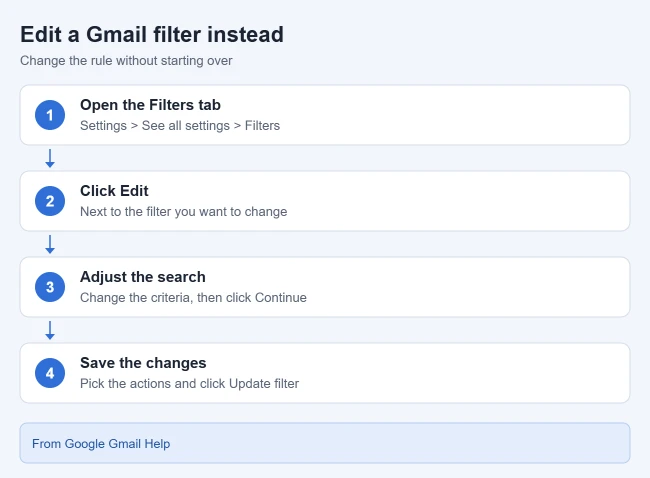
If a filter catches too much, or misses messages, editing it is often better than deleting it and starting over.
- Go to Settings > See all settings > Filters and Blocked Addresses.
- Click Edit next to the filter. The search criteria box opens with the filter’s current settings.
- Change the criteria, such as the From, Subject or Has the words fields.
- Click Continue. The list of actions opens.
- Check or uncheck the actions, such as Skip the Inbox, Apply the label, Mark as read or Forward it.
- Click Update filter.
The edited filter applies its new rules to email that arrives from now on.
Common edits
- Add another sender: in the From field, join addresses with OR, such as alice@example.com OR bob@example.com. Listing two addresses without OR makes the filter look for both at once, which usually matches nothing.
- Stop a filter from hiding mail but keep the label: uncheck Skip the Inbox (Archive it) and leave Apply the label checked.
- Stop forwarding: uncheck Forward it. Forwarding filters only act on new mail.
- Exclude a sender: in Has the words, add a minus sign before the term, such as -from:boss@example.com.
Before you save, click Search in the criteria box to preview which emails match. If the search doesn’t show the emails you expect, the filter won’t catch them either.
Back up your filters before you delete them
Google lets you export filters as a file, so you can restore them later or copy them to another account. To save your messages as well, back up Gmail separately.
- On the Filters and Blocked Addresses tab, check the box next to the filters you want to save.
- At the bottom of the page, click Export. Gmail downloads an .xml file, which you can edit in a text editor.
- To restore later, click Import filters at the bottom of the same tab.
- Click Choose File and select the .xml file.
- Click Open file, check the filters you want, then click Create filters.
The imported filters show up in your list and start working on new mail. The file is a snapshot, so export again after you change your filters.
How to create a new filter
- In the Gmail search box at the top, click Show search options (the sliders icon).
- Enter your criteria, such as an address in From or a word in Subject.
- Click Create filter at the bottom of the search window. The list of actions opens.
- Choose what you’d like the filter to do.
- To sort mail you already have, check Also apply filter to matching conversations.
- Click Create filter.
Click Search before step 3 to check which emails match.
You can also check the box next to an email, click More (three dots), and choose Filter messages like these. Gmail fills in the sender for you. Two common uses are automatically forwarding emails in Gmail and sorting mail into folders (labels).
Removing a blocked sender
Blocked addresses appear on the same tab, below your filters. According to Google, mail from a blocked sender goes to Spam. To undo it, check the box next to the address and click Unblock selected addresses; future emails from that sender go to your inbox. To block someone in the first place, follow the steps for blocking an email address in Gmail.
Blocking an email address doesn’t stop invitations in Google Chat. For those, you can block chat requests from strangers in Google Chat.
Mail is still being sorted after you deleted the filter
- Another filter matches. Use Ctrl+F or Command+F on the filter list to search for the sender or label. Filters with overlapping criteria can both act on the same email.
- The sender is blocked. Check the blocked addresses at the bottom of the same tab.
- Gmail’s spam filter caught it. That isn’t one of your filters. Open the email in Spam and click Report not spam.
- An inbox category moved it. Promotions, Social and Updates tabs sort mail on their own. Drag the email to the Primary tab, or turn categories off in Settings > See all settings > Inbox.
- Mail is still being forwarded. Account-wide forwarding is a separate setting. Go to Settings > See all settings > Forwarding and POP/IMAP, click Disable forwarding, then Save Changes.
- You’re signed in to a different account. Filters belong to one Gmail account. Check the profile picture at the top right.
- It’s a work or school account. Your administrator can set mail rules that don’t appear in your filter list. Ask them if mail keeps moving after you’ve removed all your own filters.
If a filter matches on subject words, keep in mind that changing the subject line in Gmail can make replies stop matching.
Frequently asked questions
Can I delete a Gmail filter on my phone?
Not in the Gmail app. It doesn’t include the Filters and Blocked Addresses settings, and Google’s filter instructions are for Gmail on a computer. Use Gmail in a web browser on a computer to delete or edit filters.
Will deleting a filter delete my emails?
No. Deleting a filter only removes the rule. Your emails and labels stay in your account.
Can I get a deleted filter back?
Only if you exported it first. Import the .xml file from Import filters, or recreate the filter by hand.
Do edited filters change emails I already have?
No. An edit only affects new mail. To apply a rule to older messages, create a new filter and check Also apply filter to matching conversations.
Why are emails still skipping my inbox after I deleted the filter?
Messages a filter already moved won’t return to the inbox on their own. Check for another filter with similar criteria and your blocked addresses, then move the old emails back from All Mail.
If you’re cleaning up Gmail settings, you might also want to set up an out-of-office reply in Gmail.

Matthew Burleigh is the founder, head writer, and editor of Solve Your Tech, which he launched in 2012. He has written technology tutorials since 2008 and worked in IT since 2003, including small-business support, IT management, and consulting. He holds Bachelor’s and Master’s degrees in Computer Science from Arizona State University.
Matthew writes practical guides for Windows, iPhone and iPad, Microsoft Office, Outlook, Google apps, and Android. Solve Your Tech’s guides are checked step by step against the device or app maker’s own documentation and tested on his own devices whenever he has the hardware or software, with clear steps, sources, and update dates.
Read more about Matthew and how Solve Your Tech writes and updates its guides, or report a correction.