To check your iPhone location history, open Maps, tap Places on the card at the bottom of the screen, then tap Visited Places. That list shows the places your iPhone has recorded, grouped by date, and you can open All Visits to see everything.
These steps cover iPhones running iOS 27 and iOS 26, the versions that include Visited Places in Apple Maps. On older iOS versions there is no Visited Places list, and the Settings screen described below is the only built-in location history control.
Where Your iPhone Keeps Location History
“Location history” can mean a few different things on an iPhone. This table shows what each feature records, so you can go straight to the one you need.
| Feature | What it shows | Where to find it |
|---|---|---|
| Visited Places | A list of places you have been, with dates | Maps > Places > Visited Places |
| Significant Locations & Routes | Nothing you can browse; it powers Visited Places and suggestions | Settings > Privacy & Security > Location Services > System Services |
| Find My | Your device’s current or last known location only | Find My app or iCloud.com |
| Photos Map | Where your photos and videos were taken | Photos > Map collection |
| Google Maps Timeline | A day-by-day record, if you turned it on in Google Maps | Google Maps > your profile picture > Your Timeline |
Settings That Record Your Locations
Your iPhone only records places while these settings are on. If any of them was off, the history for that period does not exist and cannot be filled in later.
- Location Services is on in Settings > Privacy & Security > Location Services.
- Significant Locations & Routes is on. It is in System Services at the bottom of the Location Services screen, and it is on by default.
- Visited Places is on for Maps. Go to Settings > Apps > Maps > Location and check the Visited Places switch.
Apple notes that Visited Places isn’t available in every country or region. If you don’t see it anywhere in Maps, that may be the reason.
How to View Visited Places in Apple Maps
- Open the Maps app. The map opens with a search card at the bottom.
- Swipe up on the card, then tap Places. You see your saved places, guides, and other lists.
- Tap Visited Places. Maps shows your recent visits, grouped by date, category, and city.
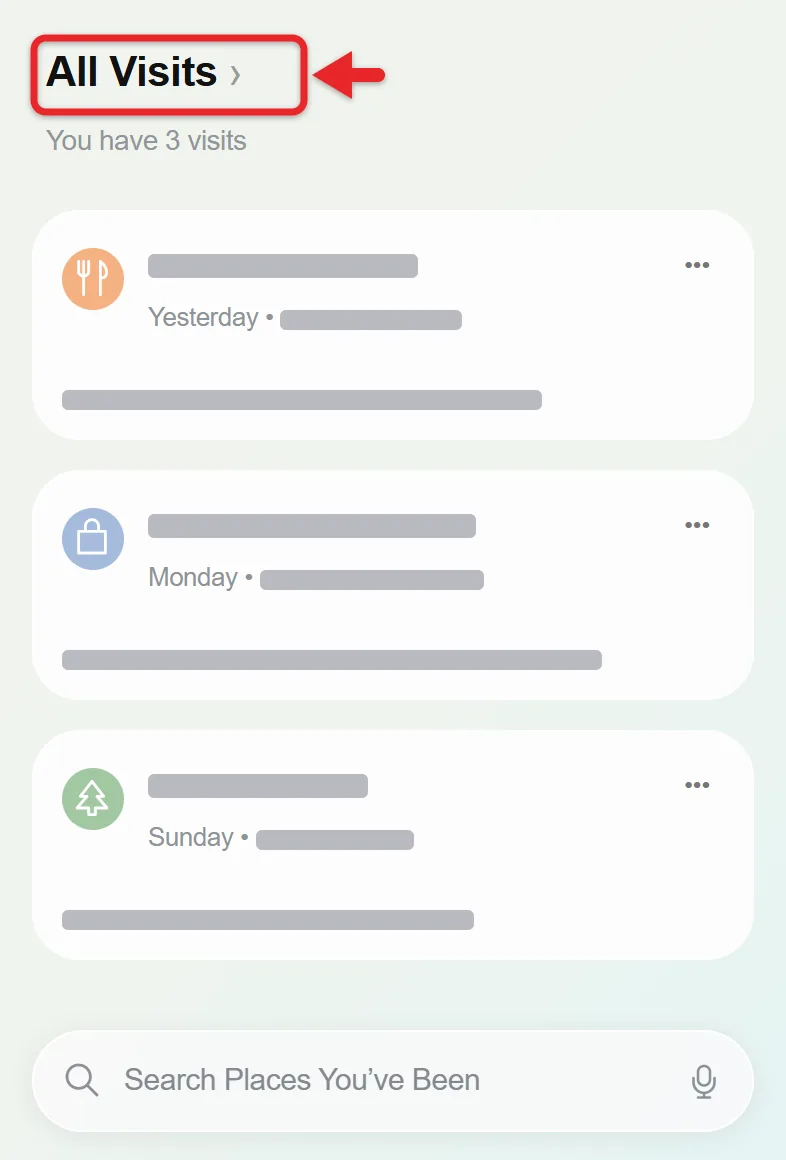
- Tap All Visits to see the full list, or use the search field to find a specific place.
- Tap a visit to open its place card, where you can see the address and get directions.
If you just turned the feature on, the list may be empty for a while. Maps adds places as you visit them; it can’t go back and add trips from before the feature was on.
Remove one visit
Tap the More button (three dots) next to the visit and choose Remove. The same menu lets you share the place. Apple’s Visited Places guide lists the current options.
Change how long Maps keeps visits
Scroll to the bottom of the Visited Places list and tap Keep Visits. You can choose how long visits are saved, such as 3 months, 1 year, or forever. When you pick a shorter period, older visits are deleted and can’t be recovered.
Clear all Visited Places
- Scroll to the bottom of the Visited Places list.
- Tap Clear History.
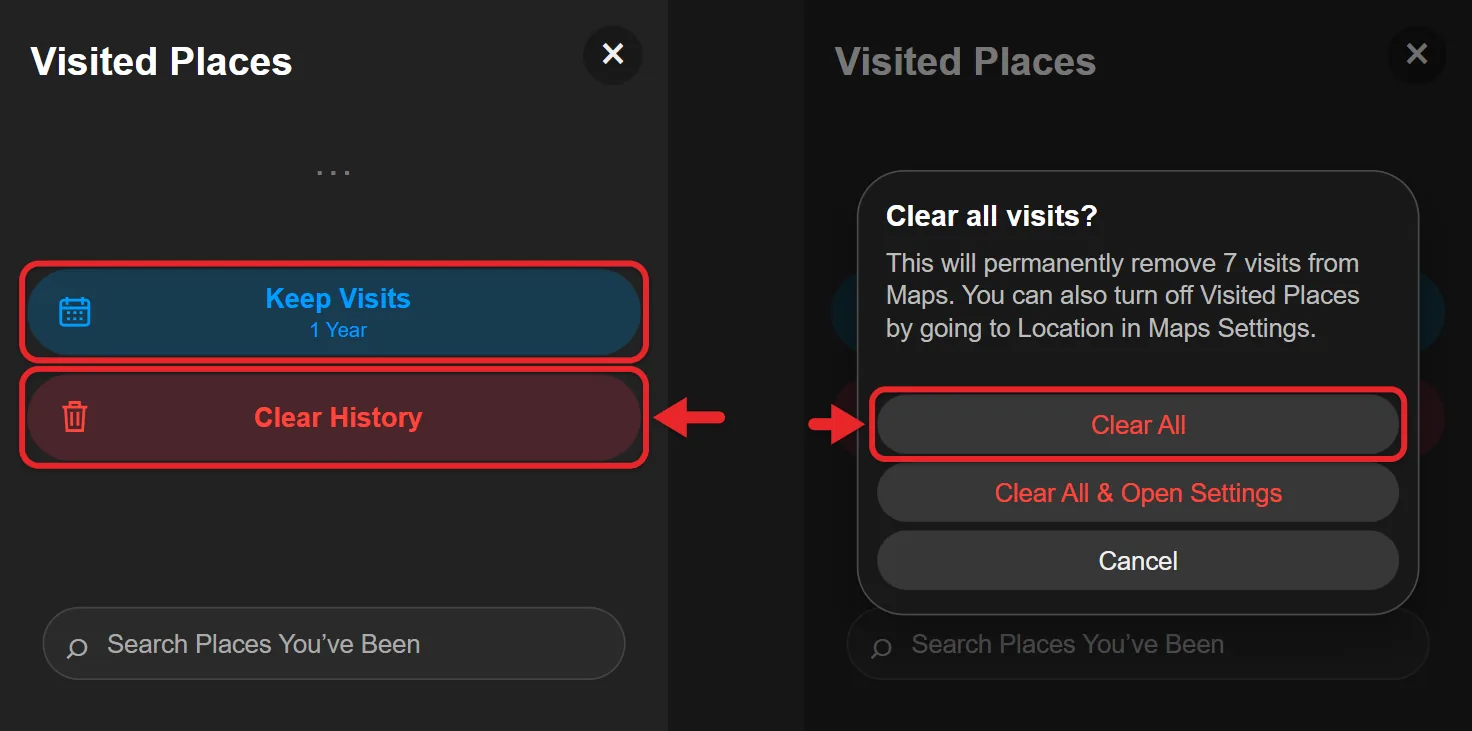
- Choose whether to clear the list only, or turn off Visited Places and clear the list.
Visited Places appears on every device signed in to the same Apple Account, so clearing it on your iPhone clears it everywhere. This data is end-to-end encrypted, which means Apple can’t read it.
Find Significant Locations & Routes
Significant Locations & Routes is the background setting that lets your iPhone learn the places that matter to you, such as home and work. It supports features like predictive traffic routing and Visited Places. On current iOS versions it no longer shows a browsable list of places.
- Open Settings on your iPhone and tap Privacy & Security.
- Tap Location Services. If the Location Services switch at the top is off, your iPhone isn’t recording new locations. (iPad has the same switch. Here’s how to turn off Location Services on iPad.)
- Scroll to System Services, then tap Significant Locations & Routes.
- Use Face ID, Touch ID, or your passcode if asked. The screen shows the Significant Locations & Routes switch and the Clear History button.
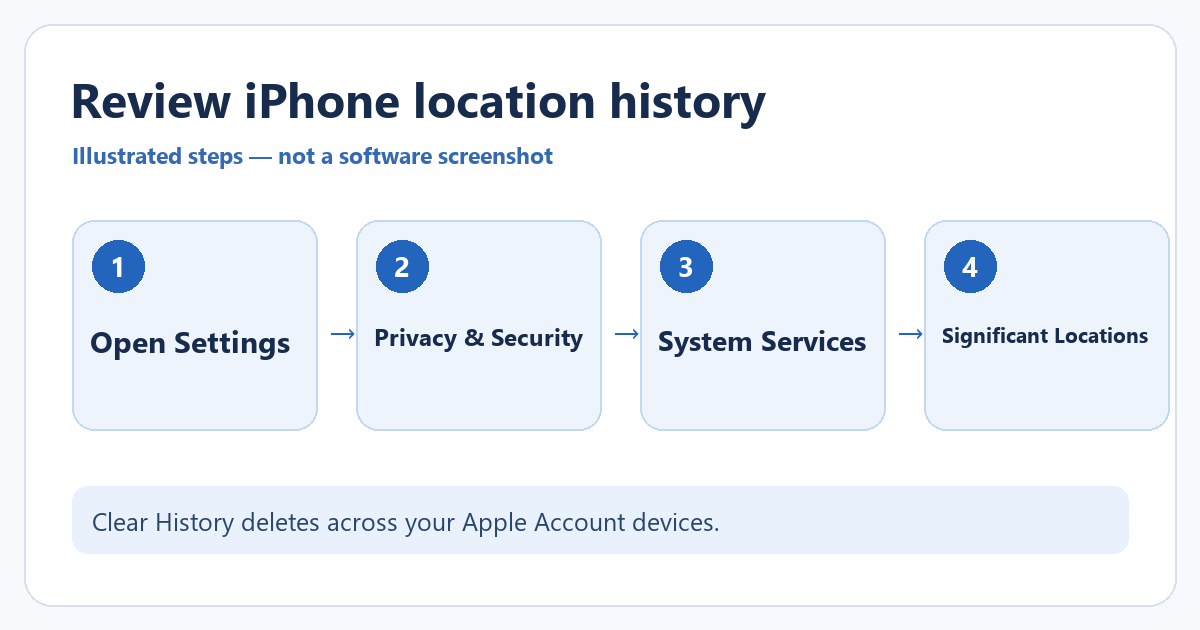
If you don’t see Significant Locations & Routes, make sure you opened System Services and not an app’s location page. A phone managed by work or school may hide this control.
Clear or Stop Significant Locations
- On the Significant Locations & Routes screen, tap Clear History.
- Read the prompt and confirm. This clears your significant locations everywhere you are signed in with the same Apple Account.
- To stop new places from being learned, turn off Significant Locations & Routes on the same screen.
Turning the switch off also stops Visited Places from recording new visits, and Maps suggestions based on your routines become less personal. You can turn it back on later, but that does not restore a history you cleared. Apple’s Significant Locations instructions document this path and the Visited Places controls.
Other Places That Show Where Your iPhone Has Been
Photos
If your camera saves location, every photo carries the place where it was taken. Open Photos and go to the Map collection to see your pictures and videos on a map. To check a single photo, open it and swipe up to see its location. A Facebook check-in is a separate, post-level location share, covered in how to check in on Facebook.
Find My
Find My shows where a device is now, not where it has been. On iCloud.com, an offline device’s last known location is shown for up to 24 hours. With the Find My network on, the Find My app on your other devices can show an offline device’s last known location for up to 7 days. To help find a phone with a dead battery, turn on Send Last Location in Find My. Neither option is a trail of past trips.
Google Maps Timeline
If you use Google Maps and turned on Timeline, it keeps a much more detailed record than Apple Maps, including routes between places. Google’s Timeline help page has the full details.
- Open Google Maps and tap your profile picture or initial.
- Tap Your Timeline.
- Tap Show calendar and pick a day to see where you went.
Timeline is off by default, and it needs your iPhone’s location permission for Google Maps set to Always. Timeline data is stored on your device, so deleting Google Maps or resetting your phone removes it unless you turned on Google’s backup. To delete it, tap Your Timeline, tap the More button, open Location & privacy settings, and choose Delete all Timeline data. You can also set Auto-delete Timeline data to remove entries older than 3, 18, or 36 months. Clearing your iPhone’s history does not touch Google’s data, and clearing Google’s data does not touch your iPhone’s.
Clear Recent Searches in Apple Maps
Recents in Maps are the places you searched for or got directions to, not where you actually went. Clearing them does not remove Visited Places or Significant Locations. These steps for clearing Maps recents come from Apple:
- Open Maps and scroll down to Recents.
- To remove one item, tap its More button, then tap Clear.
- To remove all recent searches, tap Recents, then tap Clear.
If Your History Looks Empty or Incomplete
- Visited Places is missing: check that your iPhone runs iOS 26 or later in Settings > General > About, and that the feature is available in your region.
- The list is empty: Visited Places may have been off, or you may have chosen Clear History or a short Keep Visits period. Check the switch in Settings > Apps > Maps > Location.
- Some places are missing: your iPhone records places where you spent time, not every street you passed. Location accuracy also depends on GPS, Wi-Fi, cellular, and Bluetooth signals, so short stops or indoor visits may not appear.
- History disappeared after a new phone or restore: history only covers the time the features were on for your Apple Account. If you cleared it, it can’t be brought back.
- Settings are grayed out: a work or school device profile or Screen Time restrictions may lock location settings.
If your concern is which apps can see where you are right now, review Location Services permissions on iPhone rather than clearing history alone. Maps can also share your location with ride-booking apps, which you can review by checking the Maps extension permissions on your iPhone.
Location History Questions
Can I see someone else’s iPhone location history?
No. Visited Places and Significant Locations belong to the owner’s Apple Account and are end-to-end encrypted, so they can only be viewed on that person’s own devices. If a friend or family member shares their location with you, Find My shows only where they are now. To set that up, learn how to share your location on an iPhone.
Does turning off Significant Locations stop all location tracking?
No. Apps with location permission and other system services can still use Location Services. To stop an app, change its setting in Settings > Privacy & Security > Location Services.
Can I check my iPhone location history on iCloud.com?
No. iCloud.com shows a device’s current or last known location in Find Devices, not a history of places.
Can I undo Clear History?
No. Apple does not offer an undo for Visited Places or Significant Locations, so decide before you confirm.
Will clearing location history free up storage?
Not noticeably. These are privacy and personalization controls, not a way to free up space.
If you think someone may be tracking your location without permission, Apple’s personal safety guide linked above shows how to review who can see your location.

Matthew Burleigh is the founder, head writer, and editor of Solve Your Tech, which he launched in 2012. He has written technology tutorials since 2008 and worked in IT since 2003, including small-business support, IT management, and consulting. He holds Bachelor’s and Master’s degrees in Computer Science from Arizona State University.
Matthew writes practical guides for Windows, iPhone and iPad, Microsoft Office, Outlook, Google apps, and Android. Solve Your Tech’s guides are checked step by step against the device or app maker’s own documentation and tested on his own devices whenever he has the hardware or software, with clear steps, sources, and update dates.
Read more about Matthew and how Solve Your Tech writes and updates its guides, or report a correction.