To turn off location on iPhone, open Settings, tap Privacy & Security > Location Services, and turn off Location Services. To turn it off for just one app, stay on that screen, tap the app, and choose Never. You can also pick While Using the App or turn off Precise Location if you only want to limit what an app sees.
iPhone has no separate GPS switch. Location Services controls GPS along with Wi-Fi, Bluetooth and cellular location, so turning it off turns off GPS for apps.
The steps apply to iOS 16 through iOS 27 on every iPhone. On iOS 15 and earlier, the menu is called Privacy instead of Privacy & Security.
Which setting do you need?
Location settings are spread across a few screens. Pick the row that matches what you want, then jump to that section.
| What you want | Setting to change |
|---|---|
| No app can use your location | Turn off the main Location Services switch |
| One app stops using your location | That app’s permission set to Never |
| An app sees only your general area | Turn off Precise Location for that app |
| New photos stop saving where they were taken | Camera set to Never |
| iPhone stops learning places you visit | System Services > Significant Locations & Routes |
| Friends and family stop seeing you in Find My | Share My Location |
For most people, limiting a few apps is a better trade than turning everything off, because Maps, Weather, Find My, and reminders that trigger at a place all need Location Services.
How to turn off Location Services for everything
- Open the Settings app.
- Tap Privacy & Security, then tap Location Services.
- Turn off the Location Services switch at the top.
- Tap Turn Off in the confirmation message. The switch turns gray.
Apps can no longer use your location from Location Services, in the foreground or the background. Apple notes this limits how well many Apple and third-party apps work, such as Maps directions and weather for your current area. Your per-app choices are kept, so they come back when you turn the switch on again.
Using an iPad? Follow the steps for turning Location Services on or off on iPad.

How to turn off location for one app
- Go to Settings > Privacy & Security > Location Services and make sure Location Services is on.
- Scroll down and tap the app. An app only appears in this list after it has asked to use your location.
- Choose an option: Never, Ask Next Time Or When I Share, While Using the App, or Always. Some apps offer only two choices.
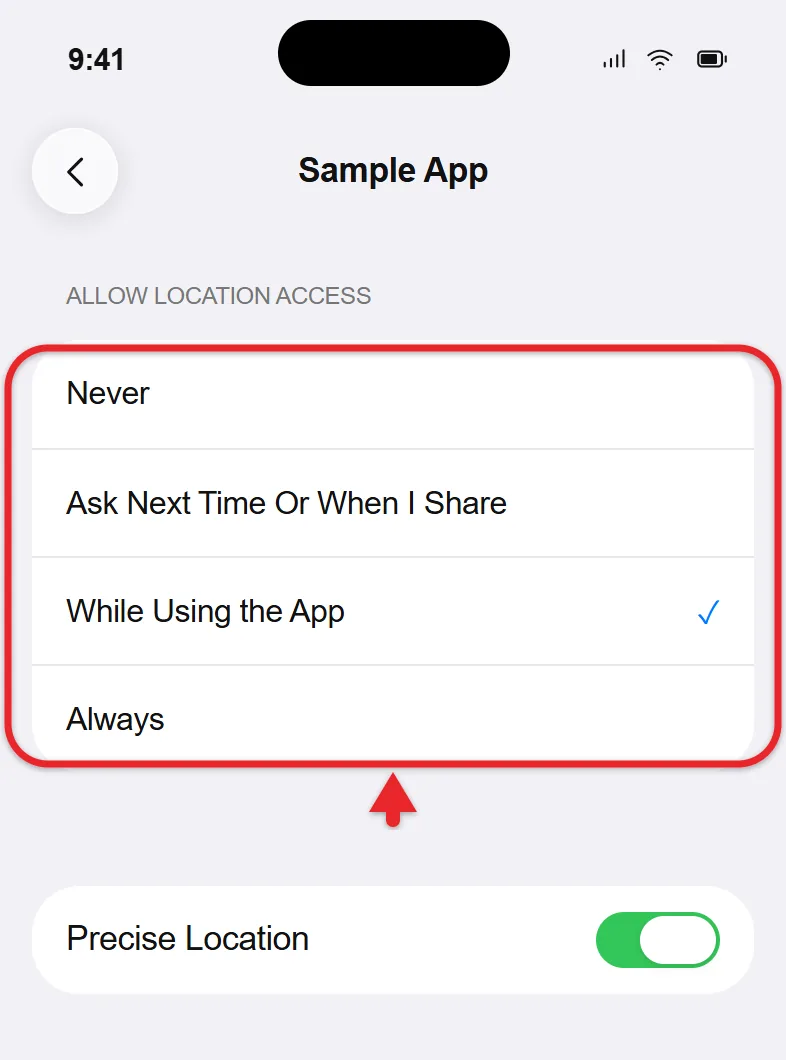
The app follows the setting you picked right away. Choose Never to block it completely. The same screen often shows the app’s own explanation of why it wants your location, which can help you decide. Location Services controls what the app can detect on its own, while the audience of a post with a place in it is a separate choice; see how to check in on Facebook without oversharing.
Setting App Store and News to Never also keeps Apple’s ads from using your location, one part of limiting ad tracking on your iPhone. To block every website in Safari at once, set Safari Websites to Never if it appears in the list.
What each option means
- Never: the app can’t use your location.
- Ask Next Time Or When I Share: the app asks each time, and you can choose Allow Once, While Using App, or Don’t Allow.
- While Using the App: the app gets your location only when it or one of its features is on screen.
- Always: the app can use your location in the background too. iPhone reminds you from time to time and shows a map of where the app used it. To keep the reminders but hide the map, go to Settings > Privacy & Security > Location Services > Location Alerts and turn off Show Map in Location Alerts.

A good habit is to check this list every few months. Any app set to Always that doesn’t need your location in the background, such as a shopping or social app, can usually move to While Using the App without losing features.
Stop Saving Your Location in New Photos
To change only the Camera app, leave the main Location Services switch on and change Camera’s permission:
- Open Settings > Privacy & Security > Location Services.
- Tap Camera.
- Choose Never.
This prevents Apple’s Camera app from attaching a location to new photos and videos; it does not remove locations already saved in your photo library. Other camera apps have separate permissions.
If you only want to leave location out of a shared photo, use the sharing options for that photo rather than disabling location for all apps. In the Photos app, tap Share, tap Options at the top of the share sheet, and turn off Location before you send it. Apple covers Camera location collection and sharing options in its Personal Safety User Guide.
- Go to Settings > Privacy & Security > Location Services.
- Tap the app.
- Turn off Precise Location.
The app gets your general area instead of your exact spot. That is often enough for weather, news, or store apps. Apple added this switch in iOS 14, so it isn’t there on older versions. In Maps, an approximate location shows as a larger blue circle instead of a precise dot.
How to turn off location for system services
- Go to Settings > Privacy & Security > Location Services.
- Scroll to the bottom and tap System Services.
- Turn off the services you don’t need, such as location-based suggestions.
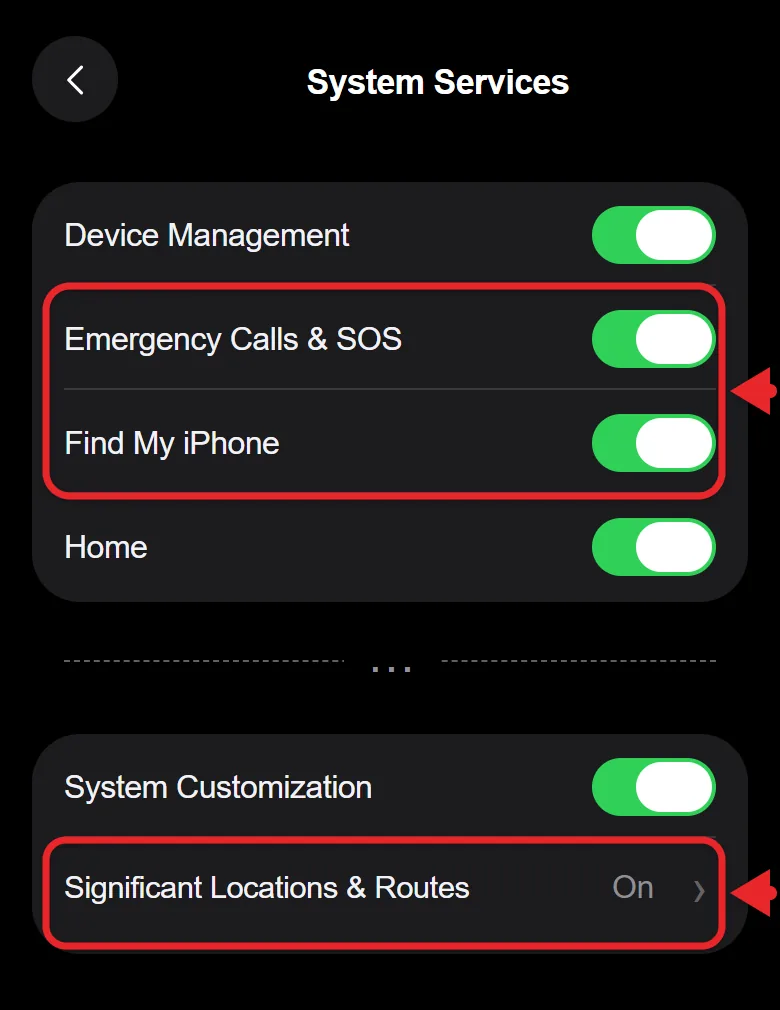
iOS stops using your location for those features. The list varies by iPhone and iOS version, but it commonly includes items like Location-Based Alerts, Location-Based Suggestions, Setting Time Zone, Significant Locations & Routes, and Emergency Calls & SOS. Leave Find My iPhone on if you want to be able to locate a lost phone, and leave Emergency Calls & SOS on so your location can help in an emergency.
Significant Locations & Routes keeps a private record of places you visit often so your iPhone can make suggestions. You can turn it off on this screen. Before you do, keep in mind that Stolen Device Protection needs Significant Locations, so leave it on if you use that feature. You can also see and clear what it has saved.
If you turn off Setting Time Zone and travel, check that the clock still shows the right time and set it by hand in Settings > General > Date & Time if needed.
On the same screen, you can turn on Status Bar Icon to see an arrow in the status bar when system services use your location.
How to stop sharing your location with people
Location Services controls apps, not people. To stop sharing your location with family and friends in Find My and Messages, go to Settings > Privacy & Security > Location Services > Share My Location and turn off Share My Location. You can also open the Find My app, tap Me, and turn it off there. To start sharing instead, follow the steps to share your location on an iPhone.
To stop sharing with just one person, open the Find My app, tap People, tap the person’s name, then tap Stop Sharing My Location and confirm. That person can no longer see you in their list.
If you are worried about who can see your location, Apple’s Safety Check in Settings > Privacy & Security lets you review and change who has access in one place.
What happens when Location Services is off
- Maps can’t show where you are or give turn-by-turn directions from your spot. Weather can’t show your current location, but you can still add cities to the Weather app by hand.
- Reminders and Shortcuts automations that trigger when you arrive at or leave a place stop working, and new photos aren’t tagged with a place.
- Find My can’t show where your iPhone is right now, which is why it’s best to leave location on for that feature.
- Apps and websites may still estimate your location in other ways, such as from your internet connection, and your location may still be used for emergency calls.
What can still find your location
Turning off Location Services stops apps from using it, but it isn’t a complete privacy shield.
- Emergency calls. Your location may be used when you call emergency services, whether Location Services is on or off. After an Emergency SOS call, your iPhone can also text your emergency contacts your location.
- Your cellular carrier. Carriers can estimate where a phone is from the cell towers it connects to. Apple’s Limit precise location from cellular networks setting reduces this, but only on the iPhone Air, iPhone 16e, and iPhone 17e with carriers that support it. Apple’s list of supported carriers is outside the US. On those models, it is under Settings > Cellular > Cellular Data Options > Limit Precise Location.
- Websites and apps. They can guess your general area from your IP address.
If you can’t change a location setting
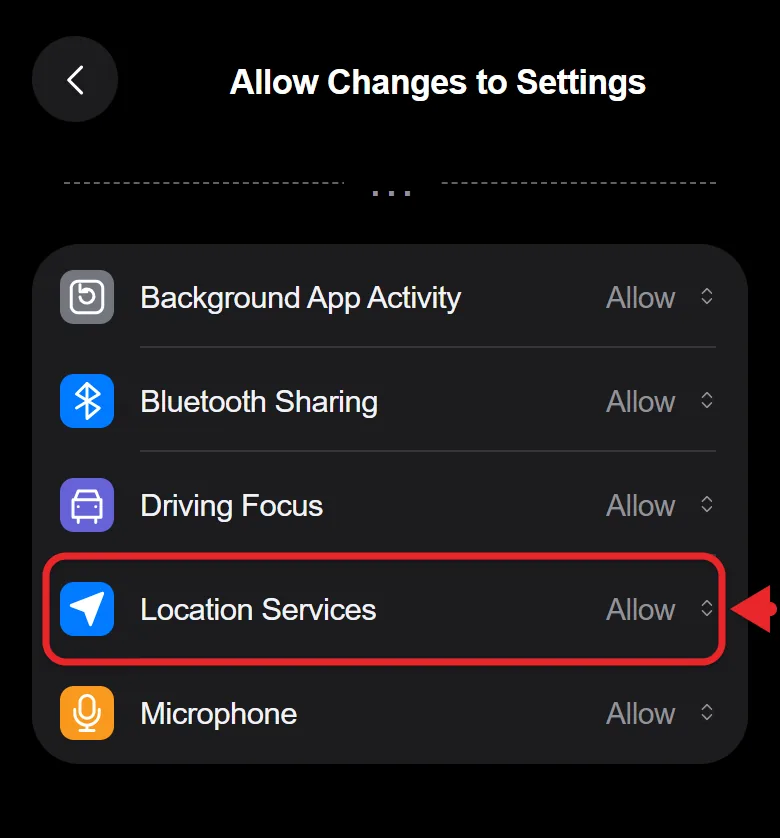
- The switches are grayed out. Screen Time may be blocking changes. Go to Settings > Screen Time > Content & Privacy Restrictions, tap Location Services, and choose Allow Changes. You may need the Screen Time passcode. Learn more about restrictions on an iPhone.
- It’s a child’s iPhone in Family Sharing. A parent or guardian manages these settings from their own device, so ask them to make the change.
- It’s a work or school iPhone. The organization may manage location settings. Check Settings > General > VPN & Device Management and ask your IT department.
- An app isn’t in the list. It hasn’t asked for your location yet, so it isn’t using it.
- Settings act strangely. Restart the iPhone and try again.
How to reset location settings
To put every app back to asking for permission, go to Settings > General > Transfer or Reset iPhone, tap Reset, then tap Reset Location & Privacy. Apps stop using your location until you allow them again. This doesn’t erase your data, and it is different from Reset Network Settings, which removes saved Wi-Fi networks.
Turn Location Services On for the App You Need
To turn location back on, open Settings > Privacy & Security > Location Services and turn Location Services on. Then tap each app that needs it and choose a permission such as While Using the App. Turning the main switch on does not give every app background access.
Location Services Questions
How do I know when an app is using my location?
An arrow icon appears in the status bar or Control Center when an app is using Location Services. A blue pill in the status bar means an app is using it in the background.
Does turning off location save battery?
It can help a little, because apps stop checking your location. If battery is your main concern, try setting apps to While Using the App instead of turning everything off.
Does turning off Location Services turn off Find My iPhone?
Find My iPhone is a separate setting, but it needs Location Services to show where your phone is. Leave Location Services on, with Find My iPhone on under System Services, if you want to be able to find a lost phone. For another useful backup, turn on Send Last Location in Find My.
Will my per-app settings be lost if I turn Location Services off?
No. iPhone remembers each app’s choice and uses it again when you turn Location Services back on. Only Reset Location & Privacy clears them.
Related: How to see and clear iPhone location history, How to stop Safari websites from using your location, How to see which apps can access your photos, and How to turn off Location Services on iPad.
Want to limit what Maps shares with other apps? Maps has its own extension permissions to check.
With Location Services on, you can get walking directions in Apple Maps that start from where you are standing.

Matthew Burleigh is the founder, head writer, and editor of Solve Your Tech, which he launched in 2012. He has written technology tutorials since 2008 and worked in IT since 2003, including small-business support, IT management, and consulting. He holds Bachelor’s and Master’s degrees in Computer Science from Arizona State University.
Matthew writes practical guides for Windows, iPhone and iPad, Microsoft Office, Outlook, Google apps, and Android. Solve Your Tech’s guides are checked step by step against the device or app maker’s own documentation and tested on his own devices whenever he has the hardware or software, with clear steps, sources, and update dates.
Read more about Matthew and how Solve Your Tech writes and updates its guides, or report a correction.