To change the program or file that opens when you click a shortcut in Windows, right-click the shortcut, select Properties, open the Shortcut tab, replace the path in the Target box with the path of the item you want, then select Apply and OK.
The change affects only that one shortcut. The original program or file stays where it is, and nothing is deleted. The steps below apply to Windows 11 and Windows 10, and the same Properties window exists in older versions such as Windows 7.
What a Shortcut Is and What the Target Does
A shortcut is a small link file, with the hidden file extension .lnk, that points to something else on your computer. Windows marks it with a small arrow in the lower-left corner of the icon. Microsoft’s Shell Links documentation explains that a link file stores the location of the item it opens, a working folder, any extra arguments, the icon, a description, and an optional keyboard shortcut.
The Target is the stored location, also called a path. A path is the full address of a file, such as C:\Users\YourName\Documents\Budget.xlsx. When you double-click the shortcut, Windows opens whatever is at that address. Change the address and the same icon opens something else.
Because the name under the icon is only the file name of the shortcut, it does not update when you change the target. You will probably want to rename the shortcut and change its icon afterward so they match the new item.
Before You Start
- Confirm the icon is a shortcut. Look for the small arrow on the icon. A real file or folder on the desktop has no arrow and no Shortcut tab.
- Know where the new item is stored. You need its full path, including the file name and extension.
- Write down or copy the current Target value before you change it. That is the simplest way to undo the change later.
- Expect a permission prompt for some shortcuts. Shortcuts stored in shared locations, such as the Public Desktop that every account on the PC can see, may need administrator approval to save.
How to Change What a Shortcut Opens in Windows 11 or Windows 10
These steps replace the target of an existing desktop shortcut.
- Find the program or file you want the shortcut to open. In File Explorer, browse to the item.
- Copy its path. In Windows 11, right-click the item and select Copy as path. In Windows 10, hold Shift while you right-click the item to see Copy as path. The path is copied with quotation marks around it.
- Right-click the shortcut you want to change and select Properties. If you do not see it in Windows 11, select Show more options first.
- Select the Shortcut tab if it is not already open.
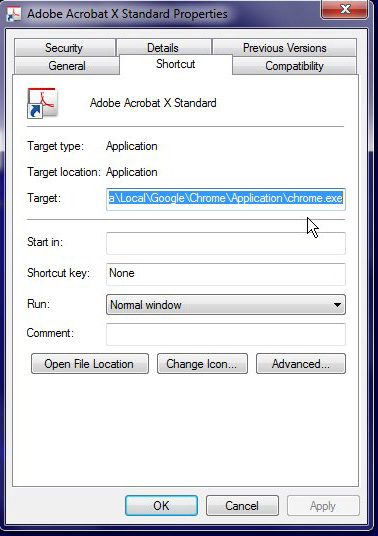
- Click inside the Target box and press Ctrl + A to select the current path.
- Press Ctrl + V to paste the new path over it.
- Check the Start in box. This is the working folder the program uses. If it still shows the old program’s folder, replace it with the folder that holds the new item, or clear it.
- Select Apply. If Windows says you need administrator permission, select Continue or Yes if you are allowed to make changes on this PC.
- Select OK to close the window.

The picture below shows the Target box on the Shortcut tab. It was captured in Windows 7, so the window styling differs from Windows 11, but the box has the same name and position.
Copying the Target From Another Shortcut
If you already have a second shortcut that opens the item you want, you can copy its target instead of finding the file. Right-click that second shortcut, select Properties, click inside the Target box, press Ctrl + A, then Ctrl + C, and select Cancel. Then paste that value into the Target box of the shortcut you are changing.
Rules for Typing a Target
- Put quotation marks around any path that contains a space, for example
"C:\Program Files\App Name\app.exe". Without them, Windows may read the path as two separate pieces. - Include the file extension, such as .exe, .docx, or .pdf.
- Anything after the closing quotation mark is treated as an argument, which is an extra instruction passed to the program. Remove arguments left over from the old program unless the new one supports them.
- If the path does not exist, Windows shows an error when you select Apply and does not save the change. Fix the path and try again.
Open a File With a Specific Program From One Shortcut
A shortcut that points to a document opens it in the default app for that file type. If you want one shortcut to open a file in a different program without changing the default for every file, put the program first and the file second in the Target box:
"C:\Path\To\Program.exe" "C:\Path\To\File.txt"
The first quoted path is the program. The second is passed to it as the file to open. This works with programs that accept a file name as an argument, which most document and media programs do. Check the program maker’s documentation if the file does not open.
Shortcut Target or Default App: Which One Do You Need?
These two settings are easy to confuse. The shortcut target controls one icon. The default app controls which program opens every file of a given type, such as all PDF files, no matter how you open them.

If your real goal is “every .pdf should open in a different program,” do not edit shortcuts. Microsoft’s Change Default Apps in Windows page gives the route: open Settings, select Apps > Default apps, type the file extension in the search box, select the result, and choose the app you want. Our guide to changing the default PDF viewer in Windows 11 walks through one common example.
| Goal | Where to change it | What is affected |
|---|---|---|
| One icon should open a different program or file | Shortcut Properties > Shortcut > Target | That shortcut only |
| One icon should open a file in a non-default program | Target with the program path, then the file path | That shortcut only |
| All files of one type should open in a different program | Settings > Apps > Default apps | Every file of that type for your account |
Alternative: Create a New Shortcut Instead
Editing the target is quick, but a fresh shortcut is often cleaner because it gets the right name and icon automatically. Microsoft lists several ways on its Customize the Desktop Icons in Windows page.
- From the desktop: right-click an empty area, select New > Shortcut, and follow the prompts to pick the file, folder, or web page.
- For an app: select Start, select All, then drag the app from the list to the desktop.
- For a file or folder: right-click it and select Show more options > Send to > Desktop (create shortcut). Some Windows installs show Send to right away.
Once the new shortcut works, you can delete the old one. Deleting a shortcut removes only the link, not the program or file it pointed to. For a browser-specific walkthrough, visit our Google Chrome shortcut on desktop guide.
Confirm the Change, Tidy Up, or Undo It
Double-click the shortcut. The new program or file should open. If the old one still opens, reopen Properties and check that the Target box shows the new path; the change is not saved if you closed the window with Cancel.
To make the icon match its new job:
- Rename it: right-click the shortcut, select Rename, and type a new name.
- Change the picture: in Properties, on the Shortcut tab, select Change Icon. Our guide on how to change app icons in Windows 11 covers this in more detail.
To undo the change, open Properties again and paste the original value back into the Target box, along with the original Start in value. If you did not save the old path, create a new shortcut to the original program using one of the methods above.
Troubleshooting
The Target Box Is Grayed Out
Some shortcuts do not expose an editable target. This is commonly reported for apps installed from the Microsoft Store and for some game launchers, where the shortcut points to an app entry and not to a file path. In that case you cannot retarget it from Properties. Create a new shortcut to the item you want instead.
There Is No Shortcut Tab
The item is probably not a standard shortcut. A real file or folder shows tabs such as General and Security only. A link to a website saved from a browser shows a Web Document tab with a URL box in place of a target. Edit the address there, or create a new shortcut.
Windows Says the Name in the Target Box Is Not Valid
The path is wrong or the quotation marks are in the wrong place. Check for a missing extension, a typo in a folder name, or a quotation mark that was not closed. Pasting the path with Copy as path avoids most typing mistakes.
You Are Asked for Administrator Permission
The shortcut is stored somewhere your account cannot change freely, such as a location shared by all users. Approve the prompt if you manage the PC. On a work or school computer, the request may be blocked, and your IT administrator would need to make the change.
The Shortcut Opens the File in the Wrong Program
The target is correct, but the default app for that file type is not the one you want. Either change the default app in Settings > Apps > Default apps, or use the program-then-file target format described above.
The Shortcut Stopped Working After You Moved a File
According to Microsoft’s documentation, Windows tries to find a moved or renamed item the next time you use the shortcut, and asks you for a location if it cannot. If it fails, open Properties and paste the item’s new path into the Target box.
Frequently Asked Questions
Does changing a shortcut’s target change the original program?
No. A shortcut is a separate link file. Editing its Target box changes where that one link points. The program or file it used to open is not moved, edited, or uninstalled.
Can I change the target of a taskbar or Start menu icon?
The Target method is meant for shortcut files you can right-click, such as those on the desktop or in a folder. For the taskbar, the more reliable route is to unpin the old item and pin the new one. See our guide on how to pin to the taskbar in Windows 11.
Can a shortcut open a folder or a website?
Yes. Microsoft’s instructions for New > Shortcut cover files, folders, and web pages. For a folder, the target is the folder path. A website shortcut is easiest to make by creating a new shortcut and entering the web address when prompted.
Why does the shortcut still show the old icon and name?
The name is the shortcut’s own file name, and the icon is stored separately in the shortcut. Neither one updates when you edit the target. Use Rename and Change Icon to update them.
Should I change someone else’s shortcuts?
Only change shortcuts on a computer you own or manage, or with the owner’s agreement. A shortcut that opens something unexpected can confuse the person using the PC, and on a work or school device it may break a setup your organization depends on.
Is it the same for Microsoft Office files?
Yes. A desktop shortcut to an Office document is a normal shortcut. Microsoft’s page on how to create a desktop shortcut for an Office program or file shows how to make one, and you can edit its target afterward with the steps in this article.
Next Step
Open Properties on the shortcut you want to change, copy the current Target value somewhere safe, then paste in the new path and test it. If the box is grayed out or the result is not what you expected, create a new shortcut and delete the old one.

Matthew Burleigh has been writing tech tutorials since 2008. His writing has appeared on dozens of different websites and been read hundreds of millions of times.
After receiving his Bachelor’s and Master’s degrees in Computer Science he spent several years working in IT management for small businesses. However, he now works full time writing content online and creating websites.
His main writing topics include iPhones, Microsoft Office, Google Apps, Android, and Photoshop, but he has also written about many other tech topics as well.