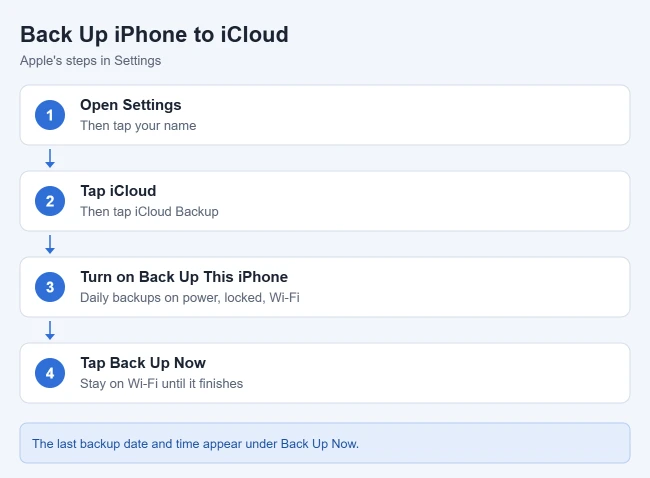
To back up an iPhone to iCloud, open Settings, tap your name, tap iCloud, tap iCloud Backup, and turn on Back Up This iPhone. Tap Back Up Now to start a backup right away. After that, iCloud backs up your iPhone automatically every day when it’s connected to power, locked, and on Wi-Fi.
These steps are written for iOS 27 and also match iOS 26 and earlier versions back to iOS 16, so they work on an iPhone 14 and every other iPhone that runs those versions. The steps follow Apple’s support article on backing up with iCloud and Apple’s iPhone User Guide page on backing up iPhone. You can also back up to a computer: Finder on a Mac, or Apple Devices (or iTunes) on a Windows PC.
Before You Start
- Sign in with your Apple Account. Your name needs to appear at the top of Settings. If you see Sign in to your iPhone instead, tap it and sign in.
- Check your iCloud storage. Every Apple Account gets 5 GB of free iCloud storage, shared with iCloud Photos, iCloud Drive, Mail, and backups. A full iPhone backup often needs more than that. The storage section below shows how to check.
- Use Wi-Fi and power. The first backup can take a while because everything uploads. Later backups only upload what changed, so they’re usually faster.
How to Back Up an iPhone to iCloud
- Connect your iPhone to a Wi-Fi network.
- Open the Settings app and tap your name at the top. Your Apple Account screen opens.
- Tap iCloud. You’ll see your iCloud storage bar and a list of apps saved to iCloud.
- Tap iCloud Backup.
- Turn on Back Up This iPhone. The switch turns green. If a message says your iPhone will stop backing up to your computer automatically, tap OK.
- Tap Back Up Now, and stay connected to Wi-Fi until the backup finishes. A progress bar and an estimate of the time left appear under the button.
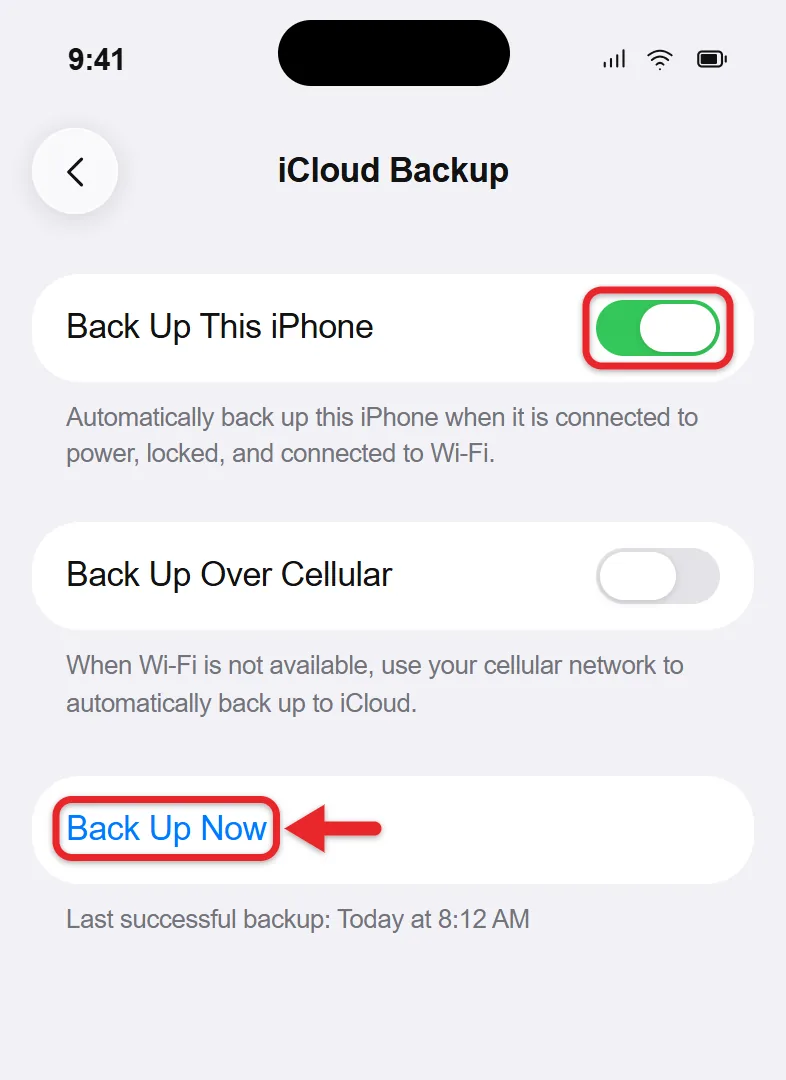
When the backup is done, the date and time of your last backup appear under Back Up Now. That line is the quickest way to confirm the backup worked. If it says “Today” with a recent time, the backup completed.
From now on, iCloud backs up daily on its own. Apple lists three conditions for an automatic backup: the iPhone is connected to power, it’s on Wi-Fi, and its screen is locked. For most people that happens overnight while the phone charges.
If you get an alert that you don’t have enough iCloud storage, follow the onscreen steps to buy more storage. You can also make the backup smaller, as explained below.
Did the backup finish?
Check the last successful backup time below Back Up Now. If it still shows yesterday after today’s attempt, yesterday’s backup is the last one confirmed. Look for a storage or connection message before trying again.
For example, if Next Backup Size is 6 GB and you have 2 GB free in iCloud, the estimate exceeds the available space by 4 GB. Review the apps included in this iPhone’s backup before buying storage. Exclude an app only if you are comfortable leaving its data out of the backup. Then check the updated estimate, run the backup again, and verify the new timestamp.
Back Up Over Cellular
On models that support 5G, your carrier may let you back up over your cellular network. Go to Settings > [your name] > iCloud > iCloud Backup, then turn Back Up Over Cellular on or off. A backup can upload several gigabytes, so leave this off if you have a limited data plan.
What an iCloud Backup Includes
Apple’s article What does iCloud back up? explains that a backup stores the information on your iPhone that doesn’t already sync to iCloud. That includes:
- Device settings, Home Screen layout, and app organization.
- Data for apps you downloaded, including third-party messaging, social media, and game apps, plus Apple apps that don’t sync with iCloud.
- Purchased ringtones and your Visual Voicemail password (which needs the SIM or eSIM that was in use during the backup).
- Your Apple Watch backup.
- Messages (iMessage, SMS, and MMS), if Messages in iCloud is off.
- Photos and videos, if iCloud Photos is off.
What It Doesn’t Include
Anything that already syncs to iCloud stays out of the backup because it’s stored in iCloud already. That covers iCloud Photos, iCloud Drive, Notes, and Messages in iCloud when those features are on. Apps that keep their data in iCloud Drive aren’t in the backup either.
This matters for two reasons. First, your backup may be smaller than you expect, which is normal. Second, iCloud Photos is a sync service, not a separate copy: if you delete a photo on one device, it’s deleted everywhere. The steps for turning iCloud Photos on or off explain how that sync works, and you can see the same photos on your iPad by syncing pictures between iPhone and iPad.
Some apps, such as WhatsApp, have their own backup setting inside the app. Check that app’s settings if you rely on it.
Is an iCloud Backup Encrypted?
Yes. Apple’s iCloud data security overview says iCloud Backup is encrypted in transit and on Apple’s servers. With standard data protection, Apple holds the keys. If you turn on Advanced Data Protection, the backup becomes end-to-end encrypted and only your trusted devices hold the keys.
How to Check Your iCloud Storage and Make the Backup Smaller
- Open Settings, tap your name, then tap iCloud. Your used and available iCloud storage appears at the top.
- Tap Storage (or Manage Account Storage), then tap Backups.
- Tap This iPhone to see the last backup, the backup size, and the Next Backup Size. The next backup size can take a few minutes to calculate.
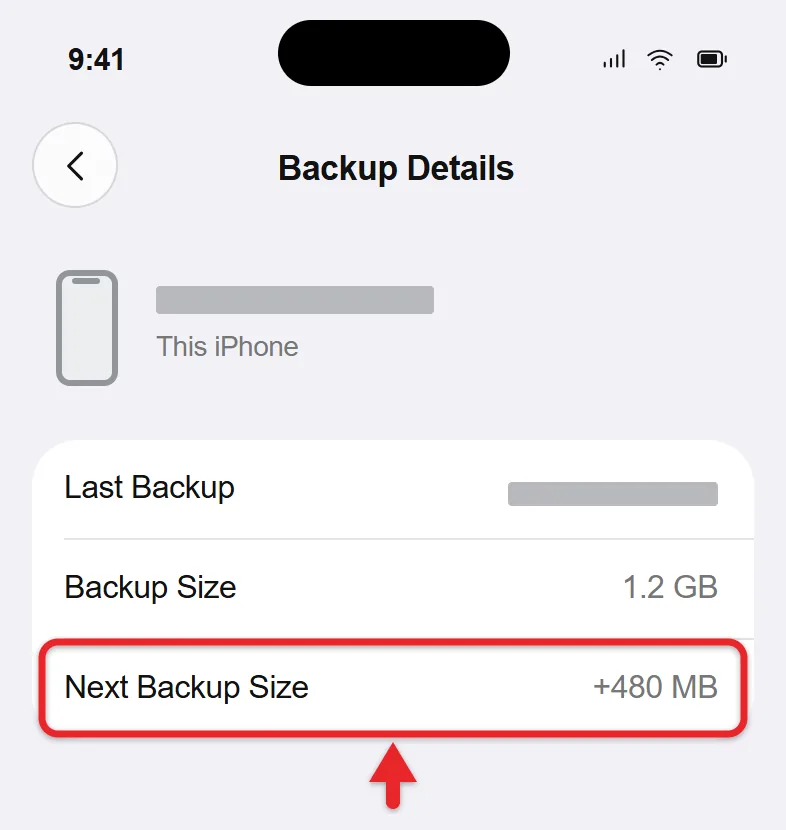
- Compare the next backup size with your free space. If the backup is bigger, it won’t finish.
- Turn off apps you don’t want to back up anymore.
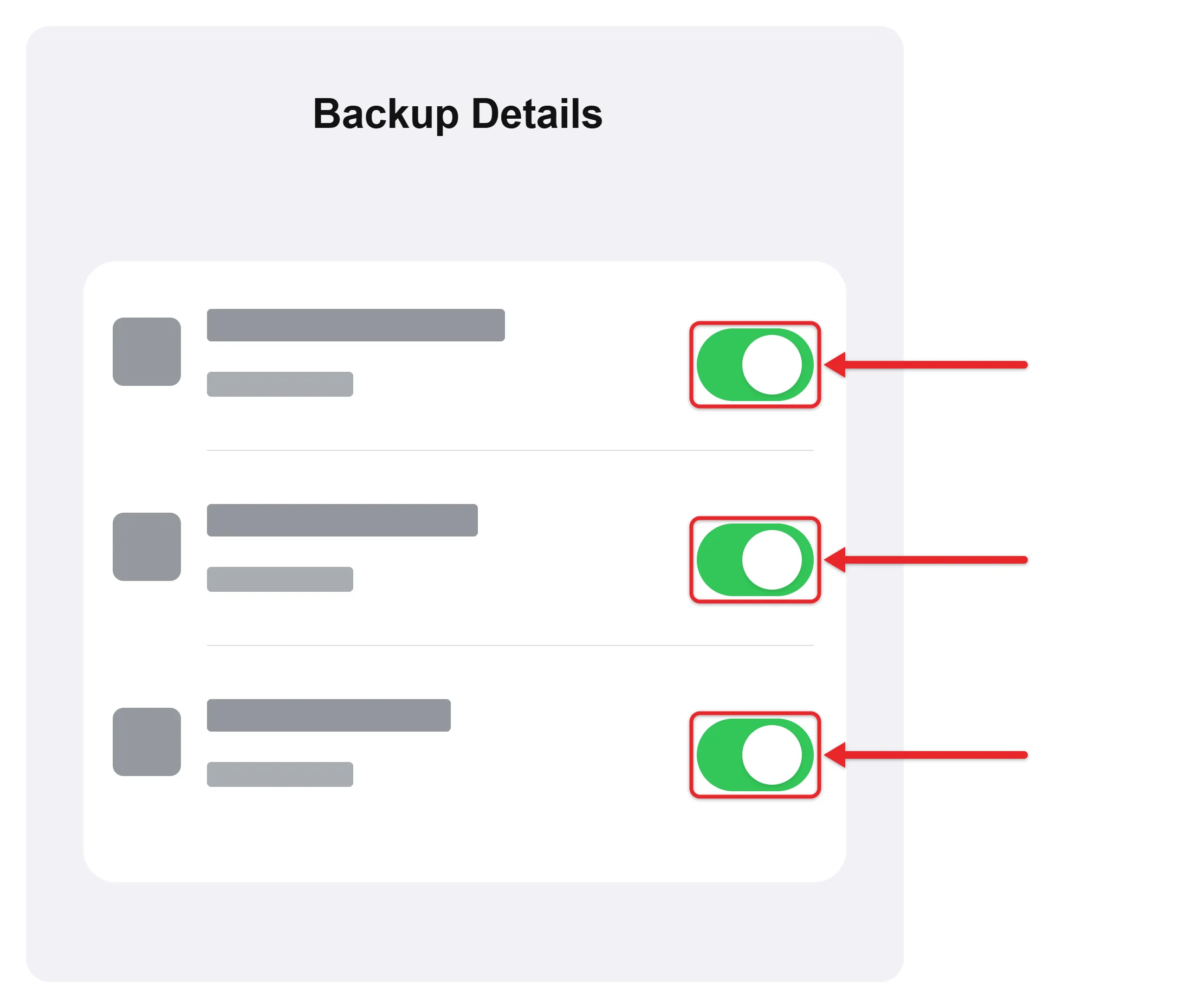
Turning off an app here also deletes that app’s existing backup data from iCloud. For a deeper look, read about shrinking an iPhone iCloud backup. The page on checking how much iCloud storage you have left explains each storage category.
If your free space still isn’t enough, Apple’s iCloud+ plans add more. These are Apple’s listed US monthly prices on its iCloud+ plans page:
| Plan | US price per month |
|---|---|
| 50 GB | $0.99 |
| 200 GB | $2.99 |
| 2 TB | $9.99 |
| 6 TB | $29.99 |
| 12 TB | $59.99 |
Some states add tax. A computer backup is the free alternative, since it uses your computer’s disk space instead of iCloud.
Getting a New iPhone Without Enough iCloud Storage
If you’re buying a new iPhone and don’t have room for a regular backup, Apple offers free temporary iCloud storage for the move. Apple’s temporary iCloud storage article has the full details.
- Update your current iPhone to the latest iOS.
- Go to Settings > General > Transfer or Reset iPhone.
- Under Prepare for New iPhone, tap Get Started.
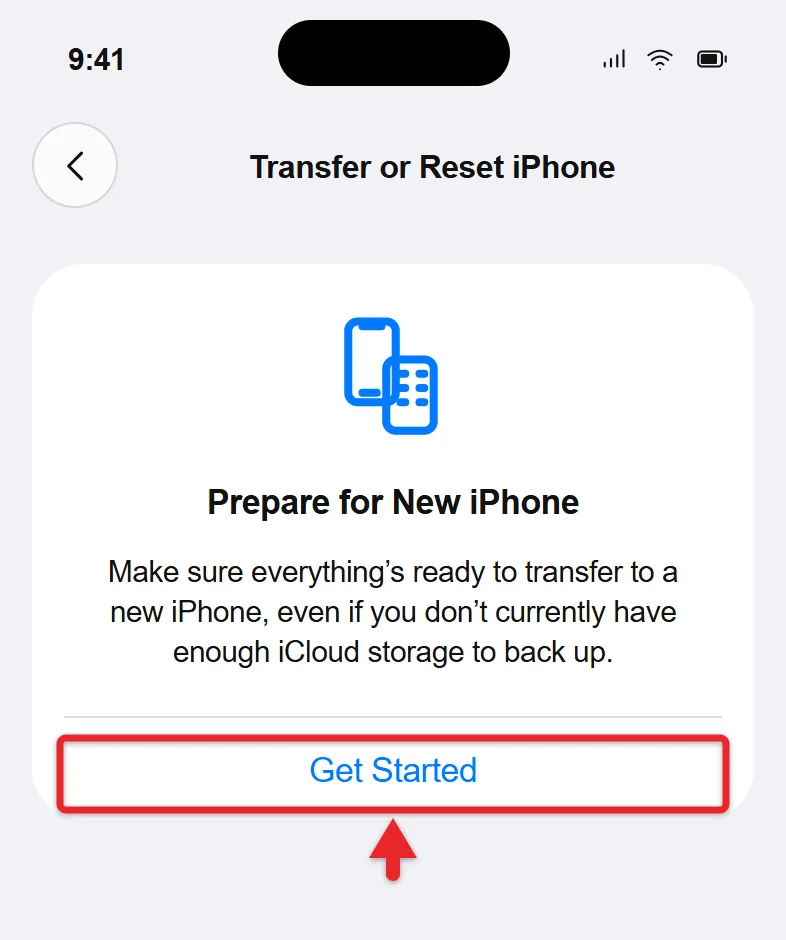
- If you see iCloud Backup is Turned Off, tap Turn On Backup to Transfer. If you’re offered free extra storage, tap Continue. If no offer appears, you already have enough storage for a regular backup.
- Wait for the backup to finish.
You then have 21 days to restore that backup to the new iPhone. If the new phone hasn’t arrived, open Settings on the old one and tap Keep My Backup Longer for 21 more days. Don’t erase the old iPhone until the restore is complete. Apple keeps the temporary backup for 7 days after the restore, and you need an iCloud+ plan to keep backing up after that.
If Your iPhone Won’t Back Up to iCloud
Apple’s article If you can’t back up to iCloud covers these cases:
- Not enough iCloud storage. Check Next Backup Size as described above, then turn off apps you don’t need, delete old backups, or upgrade your plan.
- “Your last backup couldn’t be completed.” Make sure you’re on Wi-Fi in Settings > Wi-Fi, install any update in Settings > General > Software Update, try a different Wi-Fi network, and check your storage.
- The backup is taking a long time. Check your Wi-Fi connection and upload speed. Leave the iPhone on power and Wi-Fi for 24 hours. If it still hasn’t finished, save important data another way and try again.
- iCloud Backup is grayed out. If the iCloud Backup screen says the iPhone is being restored, wait for the restore to finish; a backup starts on its own afterward. A work or school profile can also block backups. Check Settings > General > VPN & Device Management.
- Back Up Now is grayed out. The iPhone isn’t on Wi-Fi and Back Up Over Cellular is off. Connect to Wi-Fi and the button becomes available.
How to Turn Off iCloud Backup or Delete an Old Backup
To stop backing up, go to Settings > [your name] > iCloud > iCloud Backup and turn off Back Up This iPhone. Backups for a device that stops backing up stay in iCloud for 180 days.
To delete a backup and free its space right away, open Settings > [your name] > iCloud > Storage (or Manage Account Storage) > Backups, tap the device, and tap Turn Off and Delete from iCloud. This deletes every iCloud backup of that device and turns off iCloud Backup for it, so only use it for a phone you no longer need to restore.
How to Back Up an iPhone to a Computer
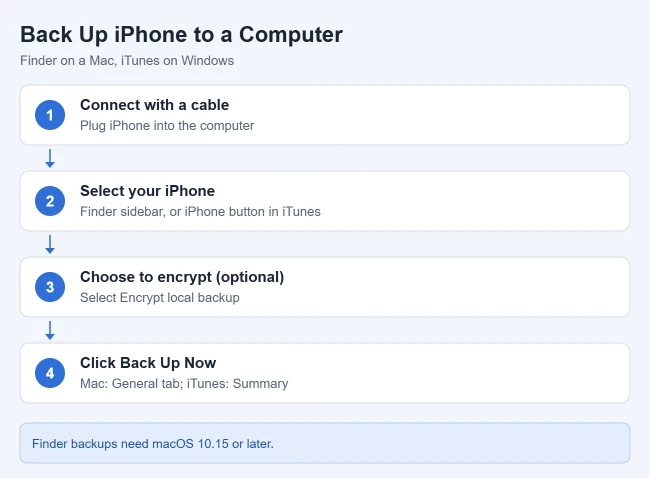
A computer backup doesn’t use iCloud storage, which makes it a good second copy or a free option when iCloud is full.
On a Mac
- Connect your iPhone to the Mac with a cable. If asked, allow the accessory to connect.
- In the Finder sidebar, select your iPhone. (Finder backups need macOS 10.15 or later; on earlier versions, use iTunes.)
- If asked, trust the computer and enter your iPhone passcode.
- At the top of the Finder window, click General.
- Select Back up all of the data on your iPhone to this Mac.
- To protect the backup with a password, select Encrypt local backup, then create a password and click Set Password.
- Click Back Up Now. When it finishes, Finder shows the date and time of your last backup.
Apple’s Mac backup article has more detail.
On Windows (Apple Devices or iTunes)
If your PC has the Apple Devices app, select your iPhone in it, choose General, select the option to back up all of the iPhone’s data to this computer, and click Back Up Now. Without Apple Devices, use iTunes as shown below. Apple’s Windows backup instructions cover both apps.
- Connect your iPhone to the PC with a cable. If asked, trust the computer and enter your passcode.
- In the iTunes app, click the iPhone button near the top left of the window.
- Click Summary.
- Click Back Up Now (below Backups).
- To encrypt the backup, select Encrypt local backup, type a password, then click Set Password.
The backup is stored on your computer. In iTunes, choose Edit > Preferences, then click Devices to see your backups. Encrypted backups show a lock icon.
Should You Encrypt a Computer Backup?
Usually, yes. Apple’s encrypted backup article says only encrypted backups include saved passwords, Wi-Fi settings, website history, Health data, and call history. The catch is the password: if you forget it, you can’t use your earlier encrypted backups. Store it in a password manager or somewhere safe.
iCloud or Computer: Which Should You Use?
| iCloud | Computer | |
|---|---|---|
| Runs automatically | Yes, daily | No, you connect the iPhone and start it |
| Needs a cable | No | Usually |
| Cost | 5 GB free, then iCloud+ | Free, uses disk space |
| Works if your phone is lost | Yes, restore from anywhere | Only if you can reach the computer |
Many people use both: iCloud for daily protection, and a computer backup before a big change like an iOS update or a trade-in.
What to Do With Your Backup
If you replace your iPhone, you can use the backup to move your information to the new device. The steps for transferring data from iPhone to iPhone cover the options. A backup is also a good idea before you factory reset an iPhone. Setting up a new phone? Start with turning on and setting up a new iPhone.
Once the backup finishes, you can sign out of your Apple Account on the old iPhone before you hand it over.
Want a copy of your photos outside iCloud as well? Backing up iPhone photos to an external drive gives you that second copy.
When you need that data back, restore the iPhone from the backup.
Frequently Asked Questions
How often does iCloud back up my iPhone?
Daily, as long as iCloud Backup is on and your iPhone is connected to power, locked, and on Wi-Fi.
How long does an iCloud backup take?
Apple doesn’t give a fixed time. It depends on how much data is new and how fast your upload speed is. The first backup takes the longest; later ones only upload changes.
Should I back up to iCloud or a computer?
iCloud backs up automatically without a cable. A computer backup doesn’t use iCloud storage. If you can, use both.
Does an iCloud backup include my photos?
Only if iCloud Photos is off. When iCloud Photos is on, your photos are already stored in iCloud, so the backup skips them.
What does encrypting a computer backup do?
Encrypting a local backup protects it with a password you set and adds saved passwords, Health data, and other sensitive items to the backup. Keep that password somewhere safe, since you’ll need it to restore the backup.
To open individual files you’ve stored in iCloud, use the iCloud Drive app on an iPhone.

Matthew Burleigh is the founder, head writer, and editor of Solve Your Tech, which he launched in 2012. He has written technology tutorials since 2008 and worked in IT since 2003, including small-business support, IT management, and consulting. He holds Bachelor’s and Master’s degrees in Computer Science from Arizona State University.
Matthew writes practical guides for Windows, iPhone and iPad, Microsoft Office, Outlook, Google apps, and Android. Solve Your Tech’s guides are checked step by step against the device or app maker’s own documentation and tested on his own devices whenever he has the hardware or software, with clear steps, sources, and update dates.
Read more about Matthew and how Solve Your Tech writes and updates its guides, or report a correction.