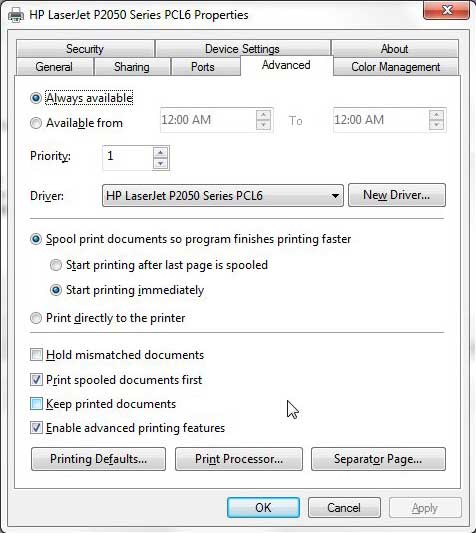
To adjust the print spooler settings for an HP LaserJet P2055dn, open the printer’s Printer properties window in Windows, select the Advanced tab, and choose between Spool print documents so program finishes printing faster and Print directly to the printer. Select Apply, then OK.
These options belong to Windows, not to the printer itself. The P2055dn has no spooler menu on its control panel, so everything in this guide happens on the computer that sends the print jobs.
What the print spooler does
The print spooler is the Windows service that manages documents on their way to a printer. When you print, Windows saves the job on your computer first, adds it to a list called the print queue, and then passes it to the printer in the background. That saving step is called spooling.
Spooling is why you can keep working in your program while a long document is still printing. It is also why several documents can wait in line when the printer is busy, out of paper, or turned off.
Each printer installed in Windows has its own spooling options. Changing them for the P2055dn does not change them for any other printer on the same computer.
Before you start
- Windows version: The steps below are written for Windows 11, with the Windows 10 and Control Panel routes listed separately. Microsoft’s current printing help articles apply to both Windows 11 and Windows 10.
- Driver: The printer must already be installed. For Windows 11, HP’s download page for the P2055dn lists the HP Universal Print Driver, so the properties window may be titled with a Universal Printing name instead of the older HP LaserJet P2050 Series PCL6 name. The Advanced tab is the same either way because Windows supplies it.
- Permissions: You may need an administrator account. If the options on the Advanced tab are gray, see the troubleshooting section below.
- Shared printers: If the P2055dn is shared from another computer or a print server, the spooling options for that shared queue are set on the computer that shares it. On an office network, ask your administrator before changing anything.
If the printer is not installed yet, start with our guide to the HP LaserJet P2055dn driver, or go to HP’s software and driver page for the P2055dn.
How to adjust the P2055dn print spooler in Windows 11
Microsoft documents this route in its article on troubleshooting slow printing in Windows.
- Select Start, then Settings.
- Select Bluetooth & devices, then Printers & scanners. A list of installed printers appears.
- Select your HP LaserJet P2055dn. Its name depends on the driver, so look for P2055, P2050 Series, or HP Universal Printing.
- Select Printer properties. Do not choose Printing preferences, which opens paper and quality settings instead.
- In the window that opens, select the Advanced tab.
- Choose a spooling option in the middle of the tab. The choices are explained in the next section.
- Select Apply, then OK.
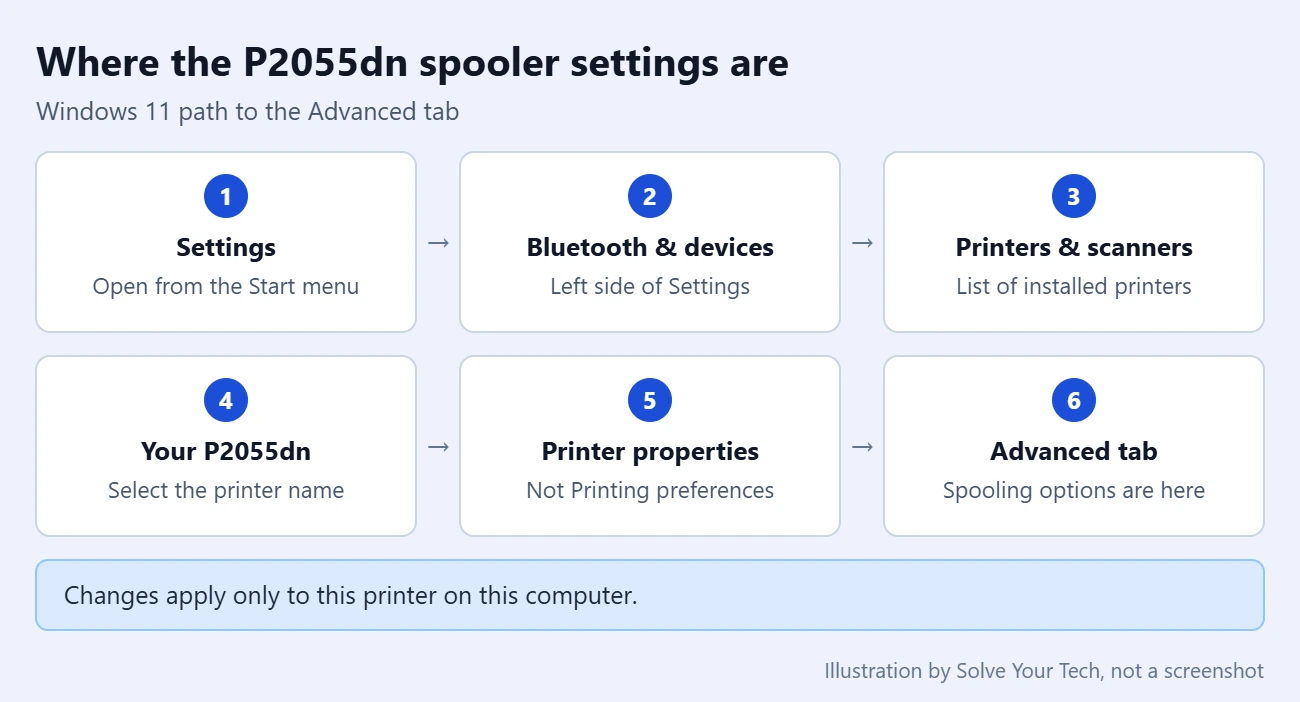
The change takes effect for the next document you print. Jobs that are already in the queue may not be affected.
What each spooler option does
The Advanced tab has two main choices, and the first one has two sub-options. The descriptions below follow Microsoft’s printer attribute documentation.
| Option | What it does | When to use it |
|---|---|---|
| Spool print documents so program finishes printing faster | Windows saves the job on the computer and feeds it to the printer in the background. | Normal everyday printing. |
| Start printing immediately | The printer starts while the rest of the document is still being spooled. | When you want the first page as soon as possible. |
| Start printing after last page is spooled | Windows waits until the whole document is spooled before sending anything. | When jobs pause partway through, especially over a network. |
| Print directly to the printer | The job is sent straight to the printer and is not spooled. | As a short test when you suspect a spooling problem. |
On most installations, spooling is turned on with Start printing immediately selected, but check your own window because drivers and administrators can change the starting values.
For slow or stop-and-start printing, Microsoft suggests turning on three settings together: Spool print documents so program finishes printing faster, Start printing after last page is spooled, and Print spooled documents first. Microsoft says this combination helps the printer prepare jobs more efficiently and is especially useful over shared or slower network connections. The P2055dn has a built-in network port, so this is a sensible setup to try if the printer is connected by Ethernet.
Print directly to the printer turns spooling off for this printer. Your program has to wait while the printer accepts the whole job, and the queue-related checkboxes on the tab no longer apply. Treat it as a troubleshooting test and switch back afterward.
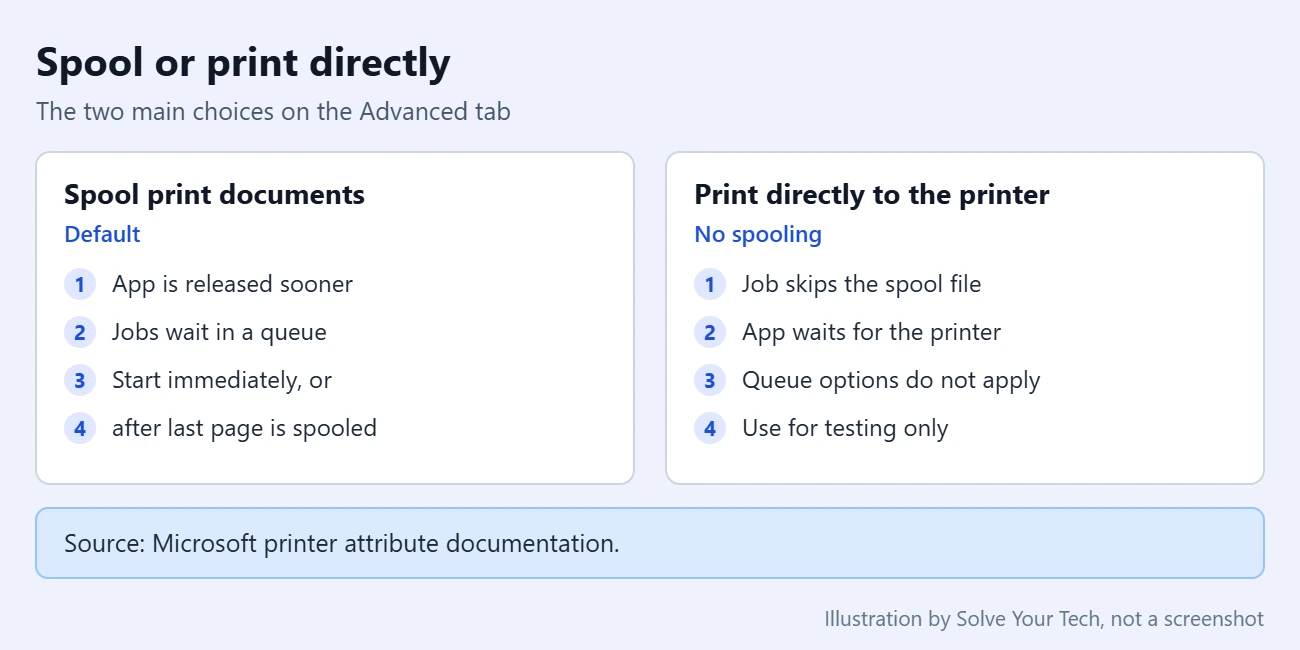
The checkboxes below the spooling options
Four checkboxes sit under the spooling choices. Two of them directly affect how spooled jobs are handled.
- Print spooled documents first: When the printer is set to print while spooling, documents that have finished spooling are scheduled ahead of documents that are still spooling. This keeps a short, ready document from waiting behind a large one. It matters most when several people print to the same queue.
- Keep printed documents: Windows keeps jobs in the queue after they print instead of deleting them. That lets you print one again from the queue, but the saved jobs take up disk space and anyone who can open the queue can see their names. Leave it off unless you need it.
- Hold mismatched documents: Windows checks each document against the printer setup and holds any that do not match, such as a job that calls for a paper size the printer is not set up for. Other jobs keep printing.
- Enable advanced printing features: This relates to driver features such as page order and pages per sheet, not to the queue. Leave it as you found it unless HP or your administrator tells you to change it.
The top of the same tab also has Always available and Available from, which control the hours when Windows releases jobs to the printer, plus a Priority value. Our guide on how to set an available time for a printer covers that setting in detail.
Other ways to open Printer properties
Windows 10
Open Settings, select Devices, then Printers & scanners. Select the P2055dn, select Manage, and then select Printer properties. The Advanced tab and its options are the same as in Windows 11.
Control Panel (Devices and Printers)
This is the route the older screenshots in this article show. Open Control Panel and select Devices and Printers. Right-click the P2055 printer and choose Printer properties. The menu also has a plain Properties item at the bottom, which opens a different window without the Advanced tab.
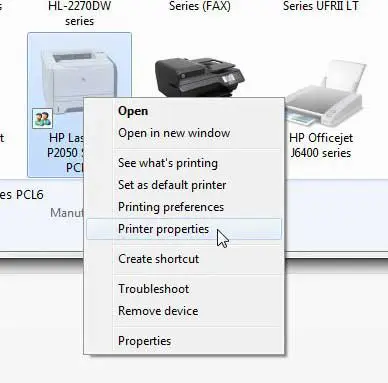
On recent versions of Windows 11, selecting Devices and Printers in Control Panel may open the Settings app instead. If that happens, use the Windows 11 steps above.
Whichever route you use, select the Advanced tab at the top of the properties window.
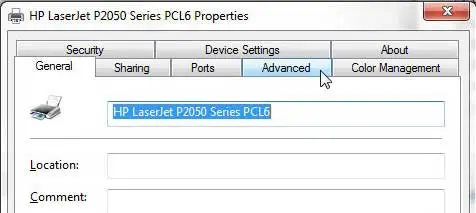
The spooling options are in the middle of the tab, with the checkboxes underneath.
How to confirm the change or undo it
To confirm the change, reopen Printer properties, go back to the Advanced tab, and check that your selection is still there. Then print a short document of two or three pages and watch what happens.
- With Start printing after last page is spooled, expect a short delay before the first page, followed by steady printing.
- With Print directly to the printer, expect your program to stay busy until the printer has received the job.
To undo a change, return to the same tab and select the option you had before. Before you experiment, it helps to note the original settings or take a picture of the tab. If you are not sure what the original settings were, selecting Spool print documents so program finishes printing faster with Start printing immediately and Print spooled documents first is the usual arrangement.
Troubleshooting
The options on the Advanced tab are gray
Your account probably does not have permission to manage this printer. Look on the General tab for a Change Properties button, select it, and approve the administrator prompt. On a work computer, your administrator may control these settings, and you may not be able to change them at all.
I cannot find Printer properties
In Settings, the link appears only after you select the printer’s name in the Printers & scanners list. If you see paper size and print quality choices, you opened Printing preferences by mistake. Close that window and choose Printer properties.
The P2055dn is not in the printer list
The printer is not installed on this computer, or it is listed under the driver’s name. Look for an HP Universal Printing entry. If nothing matches, see how to get a printer online in Windows 11 or 10 for connection checks.
Documents are stuck in the queue
Changing a spooling option does not release jobs that are already stuck. Cancel the stuck jobs first. If they will not cancel, the Print Spooler service may need a restart. Be aware that restarting the service interrupts printing for every printer on the computer, and canceled jobs have to be sent again.
Microsoft’s steps are to press Windows key + R, type services.msc, press Enter, right-click Print Spooler, and select Restart. See Microsoft’s article on fixing Print Spooler service errors, or our walkthrough on how to clear the printer queue in Windows 11 or 10.
An extra page prints after every job
That is not a spooler setting. A page containing a GET/DEVMgmt/DiscoveryTree.xml HTTP/1.1 message comes from the printer status notification option on the Device Settings tab, which you can turn off. Our guide to stopping the HP LaserJet P2055 from printing an extra page has the steps and covers other kinds of extra pages.
Frequently asked questions
Where are the print spooler settings for the HP LaserJet P2055dn?
They are on the Advanced tab of the printer’s Printer properties window in Windows. In Windows 11, go to Settings > Bluetooth & devices > Printers & scanners, select the printer, and select Printer properties. There is no spooler setting on the printer’s own control panel.
Should I spool print documents or print directly to the printer?
Spool them for normal use. Spooling lets your program finish sooner and lets documents wait in a queue. Print directly to the printer skips the spooler entirely, so it is mainly useful as a temporary test when you think spooling is causing a problem.
Which spooler settings does Microsoft suggest for slow printing?
Microsoft’s slow-printing article suggests enabling Spool print documents so program finishes printing faster, Start printing after last page is spooled, and Print spooled documents first. It lists this as an advanced step after simpler checks such as print quality, connection type, firmware, and document size.
Does changing these settings affect other printers?
No. The options on the Advanced tab are stored separately for each printer installed in Windows. Restarting the Print Spooler service is different, because that one service handles every printer on the computer.
Do these settings change anything inside the printer?
No. They are Windows print queue settings saved on your computer. If you print to the same P2055dn from a second computer, that computer uses its own settings.
Is turning off spooling the same as disabling the Print Spooler service?
No. Print directly to the printer only stops spooling for one printer. The Print Spooler service is a Windows component that all printing depends on, and stopping it prevents printing from that computer until it is started again.
Next step
Once the spooler is set the way you want, you can save paper on the same printer by learning how to do automatic duplexing with the HP LaserJet P2055.

Matthew Burleigh is the founder, head writer, and editor of Solve Your Tech, which he launched in 2012. He has written technology tutorials since 2008 and worked in IT since 2003, including small-business support, IT management, and consulting. He holds Bachelor’s and Master’s degrees in Computer Science from Arizona State University.
Matthew writes practical guides for Windows, iPhone and iPad, Microsoft Office, Outlook, Google apps, and Android. Solve Your Tech’s guides are tested on current devices or checked against official product documentation, with clear steps, sources, and update dates.
Read more about Matthew and how Solve Your Tech writes and updates its guides, or report a correction.