Reachability temporarily slides the top of the iPhone screen downward so you can reach a control with one hand. It works differently on iPhones with Face ID and with a Home button. The screen returns to normal after you use it or dismiss it.
Turn on Reachability
- Open Settings.
- Tap Accessibility.
- Tap Touch.
- Turn on Reachability.
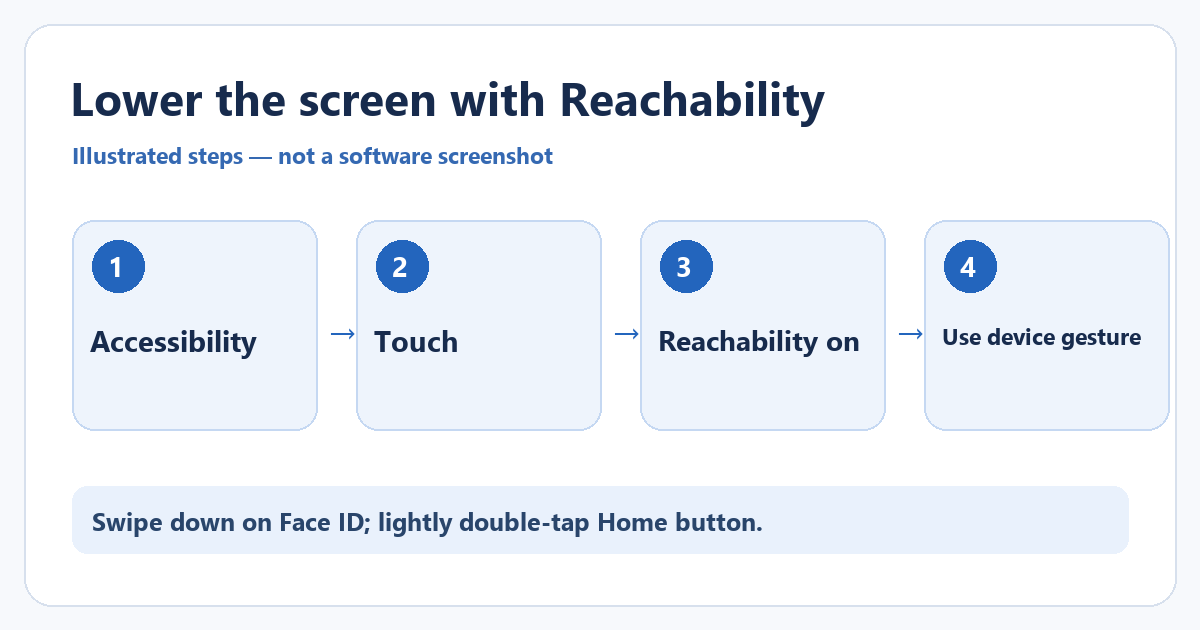
If the switch was already on, you can go directly to the gesture below. Reachability works in portrait orientation, so rotate the phone upright before testing it.
Use it on an iPhone with Face ID
Swipe down from the bottom edge of the screen. Begin near the gesture bar and make a short downward swipe. The top half of the current screen will move lower. Tap the control you wanted, or swipe up from the bottom edge to return to the full screen. A swipe from the upper-right corner opens Control Center instead, so start at the bottom edge.
Lightly double-tap the Home button. Do not press it twice: two full presses can trigger the app switcher on supported models. The screen shifts down so you can reach an item near its top. Tap in the upper blank area or use the Home button to return to the normal view.
If Reachability will not open
Check the Settings > Accessibility > Touch > Reachability switch, then retry in portrait orientation from an app or the Home Screen. On a Face ID model, a swipe beginning too high can scroll content rather than trigger Reachability. On a Home-button model, use two light touches instead of clicks. If the gesture still seems unresponsive, restart the iPhone and test again. A damaged or unresponsive touch area can also affect the gesture.
Reachability changes where the screen sits; it does not enlarge text or icons. If the controls themselves are too small, use iPhone text-size settings instead. You can also review how to change Siri's voice for another accessibility-related iPhone setting.
What Reachability changes
Reachability temporarily shifts the upper part of the display downward so a thumb can reach controls near the top. It does not shrink the whole interface permanently, rotate the screen, or change the text size. The feature is particularly useful on a large iPhone when you are using one hand. Once you tap a control or dismiss Reachability, the layout returns to its normal position.
Gesture details by iPhone type
On a model with Face ID, swipe down on the bottom edge of the screen after turning Reachability on. Start at the edge rather than in the middle of an app, where a downward swipe might scroll content instead. On a model with a Home button, lightly double-tap the Home button without pressing it all the way down. A full double-click can open the app switcher or another shortcut instead. These are different gestures for different hardware; use the one that matches your phone.
Confirm and dismiss the shifted view
When Reachability is active, the top of the app moves into the lower part of the display and blank space appears above it. Tap the control you needed. To dismiss without selecting anything, tap the blank area above the shifted screen or perform the gesture again if your model supports it. If the screen never shifts, confirm Settings > Accessibility > Touch > Reachability is enabled, then try the gesture more slowly at the correct edge or button.
Can Reachability make buttons larger? No. If a button remains hard to see, use Text Size, Display Zoom, or another accessibility setting suited to visibility rather than reach.
Does it work in every app? It acts on the display, but an app's own layout may still place a control differently. If a particular app intercepts your gesture, start the swipe precisely at the bottom edge on Face ID models.
Apple's Reachability guide confirms both gestures and the settings path.

Matthew Burleigh has been writing tech tutorials since 2008. His writing has appeared on dozens of different websites and been read hundreds of millions of times.
After receiving his Bachelor’s and Master’s degrees in Computer Science he spent several years working in IT management for small businesses. However, he now works full time writing content online and creating websites.
His main writing topics include iPhones, Microsoft Office, Google Apps, Android, and Photoshop, but he has also written about many other tech topics as well.