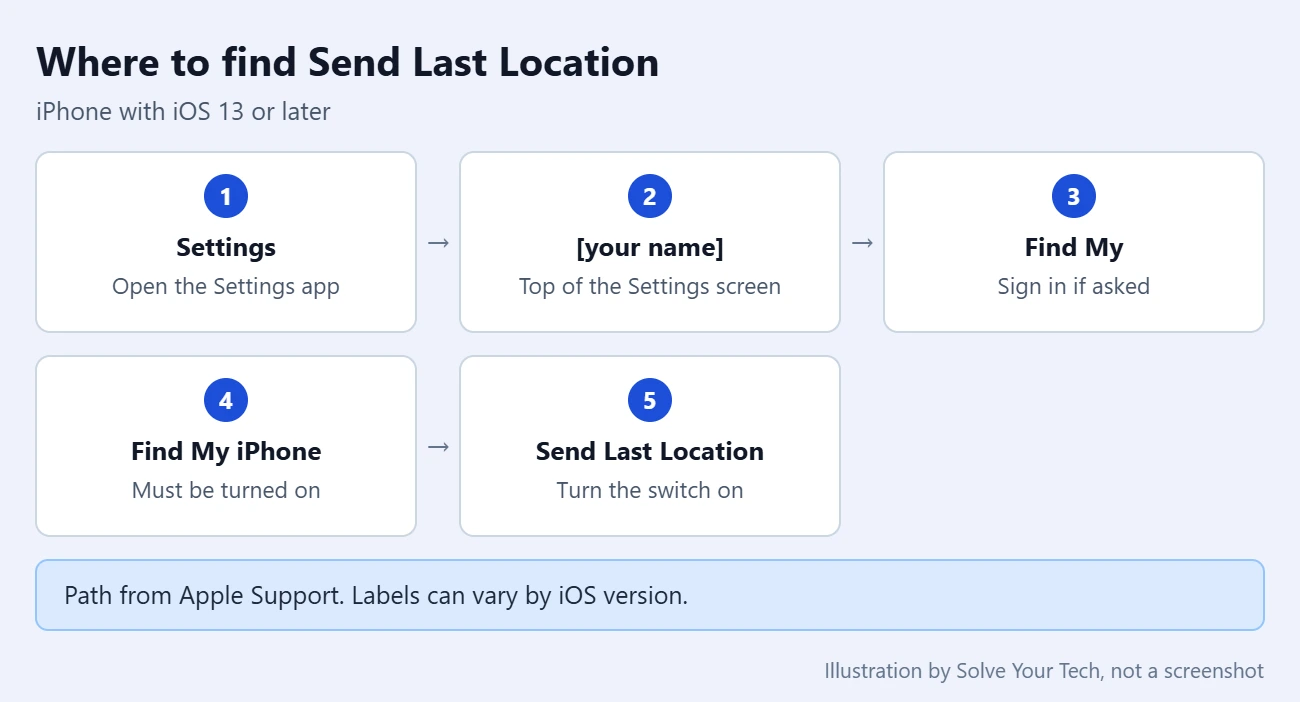
To enable the last location option in Find My iPhone, open Settings, tap your name, tap Find My, tap Find My iPhone, and turn on Send Last Location. With the switch on, your iPhone automatically sends its location to Apple when the battery charge becomes critically low.
That matters because a phone with a dead battery can no longer report where it is. The setting leaves a last known position on the map, so you have somewhere to start looking. It only helps if it is turned on before the phone goes missing.
What You Need First
These steps follow Apple’s current iPhone User Guide and apply to iPhones running recent versions of iOS, where the Find My settings sit under your name at the top of the Settings app. Before you start, check the following:
- An Apple Account signed in on the iPhone. Find My is tied to the account, so the phone has to be signed in. If it is not, Settings shows a sign-in prompt at the top.
- Find My iPhone turned on. Send Last Location is an add-on to Find My iPhone. It does nothing by itself if the main switch is off.
- Location Services turned on. Apple says you need Location Services on for Find My to show a lost device on a map. The switch is in Settings > Privacy & Security > Location Services.
How to Turn On Send Last Location
- Open the Settings app on your iPhone.
- Tap your name at the top of the screen. This opens your Apple Account settings.
- Tap Find My. If you are asked to sign in, enter your Apple Account information.
- Tap Find My iPhone. The next screen has the main Find My iPhone switch. Turn it on if it is off.
- Turn on Send Last Location. The switch turns green when the setting is on.
There is nothing to save. The setting takes effect as soon as the switch is on, and you can close Settings. Apple documents the same path in How to turn on Find My on your iPhone, iPad, or Mac and in the iPhone User Guide page Add your iPhone to Find My.
What Send Last Location Does
Apple describes the setting in one line: if your device’s battery charge level becomes critically low, its location is sent to Apple automatically. You do not have to do anything when it happens, and the phone does not ask first.
Apple does not publish the exact battery percentage that triggers it, so do not count on a specific number. The point is simply that the phone reports in shortly before it shuts down, instead of going dark with no recent position on record.
The stored location is not kept forever. Apple’s troubleshooting article on Find My says a device can show as offline when Send Last Location is on and more than 24 hours have passed since it last connected to a Wi-Fi or data network. If your phone is missing with a dead battery, check Find My as soon as you can.
Send Last Location vs. Find My Network
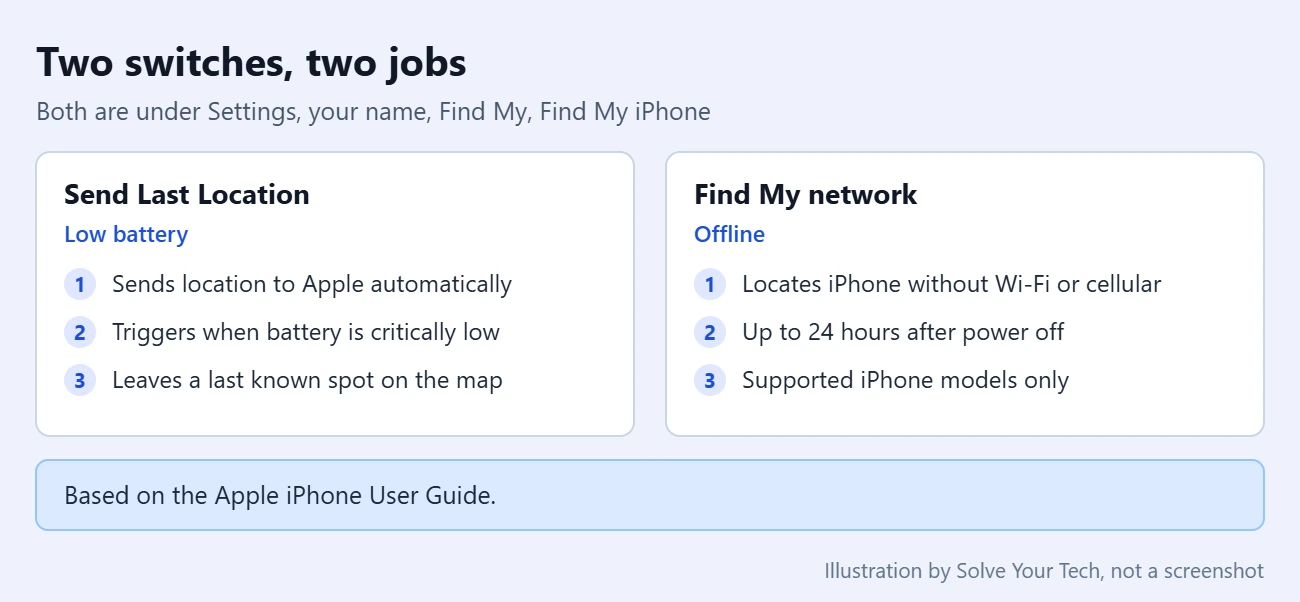
The same screen has a second switch called Find My network. The two are easy to mix up, but they cover different situations.
| Switch | When it helps | What Apple says it does |
|---|---|---|
| Send Last Location | The battery is about to run out | Sends the device location to Apple automatically when the battery charge is critically low |
| Find My network | The iPhone is offline, meaning not connected to Wi-Fi or cellular | Lets Find My locate the device using the Find My network. On a supported iPhone, this works for up to 24 hours after it is turned off, or up to 5 hours in power reserve mode |
The Find My network is Apple’s name for a crowdsourced network of Apple devices that use Bluetooth to detect a nearby device and report its approximate location back to the owner. Apple says the process is anonymous and encrypted. Turning on both switches gives you the best chance of seeing a location for a phone that has lost power.
How to See Your iPhone’s Last Location
If the phone goes missing, you can look up its location from another device. You will need to sign in with the same Apple Account that the missing iPhone uses.
- On another Apple device: open the Find My app, tap Devices, then tap the name of the missing iPhone. If it can be located, it appears on the map.
- On the web: go to icloud.com/find in a browser, sign in, and choose the iPhone from the list of your devices.
- On a family member’s iPhone: if you use Family Sharing, your devices can appear in the Find My app on their phone, below their own devices.
If you see No location found under the device name, turn on Notify When Found under Notifications. Apple says you then get a notification when the device is located.
If you cannot get the phone back right away, Apple recommends marking it as lost. Lost Mode locks the iPhone with your passcode and suspends payment cards and passes used with Apple Pay. The full process is in Apple’s article How to find your lost iPhone or iPad. Apple also warns that it will never contact you to say your iPhone has been found, so treat messages claiming otherwise as scams.
How to Turn Send Last Location Off
Go back to Settings > your name > Find My > Find My iPhone and turn off Send Last Location. This only stops the low-battery report. Find My iPhone itself stays on.
There is little reason to turn it off for everyday use. If you are selling or giving away the phone, the switch you need is the main one. Our guide on how to turn off Find My iPhone covers that, including what happens to Activation Lock, the feature that stops someone else from activating your iPhone.
If You Can’t Find or Change the Setting
- There is no Find My option under your name. Check that you are signed in. If Settings shows a sign-in prompt at the top, tap it and sign in with your Apple Account. Apple also notes that Find My is not available with a Managed Apple Account from a school or other educational institution.
- You only see an iCloud menu. Very old versions of iOS kept Find My iPhone inside the iCloud menu in Settings instead of a separate Find My menu. The exact layout depends on the iOS version, so look for Find My iPhone under iCloud and update iOS if the phone supports it.
- Send Last Location is missing. The switch sits on the Find My iPhone screen, one level below the Find My menu. Tap the Find My iPhone row to open it. If the main Find My iPhone switch is off, turn it on first.
- The iPhone does not show in Find My on another device. Apple suggests confirming that every device uses the same Apple Account, that the phone has a Wi-Fi or cellular connection, and that Set Automatically is on in Settings > General > Date & Time. Turning Airplane Mode on and off, or restarting, can also help.
- The iPhone shows as offline. See Apple’s article If Find My is offline or not working for the reasons this happens and what you can still do.
Locate a Missing iPhone and Mark It as Lost
From another Apple device, open Find My > Devices and select the missing iPhone. For a phone likely nearby, use Play Sound when available. On the web, visit icloud.com/find, sign in to the phone’s Apple Account and select it under All Devices. Review the shown location and timestamp. If you cannot recover it, choose Mark as Lost and follow the contact-message instructions. Apple documents Lost Mode and its account protections.
Find My must have been enabled beforehand; turning it on on another device cannot retroactively locate a missing phone. An offline report may be an old position. Use Notify When Found where offered, keep the device associated with your account and contact the appropriate authorities for a suspected theft. Do not confront someone at a map location. Remote erase and removal from the account are separate actions with significant consequences, not required steps for checking its location.
Lock a Missing iPad From Your iPhone
On an iPhone signed in to the same Apple Account, open Find My > Devices and select the intended iPad. In the current layout, tap its More button and choose Lost Mode; older layouts offer Activate under Mark As Lost. Follow the prompts for a contact number and message, review them, and tap Activate. If asked to create a passcode, the owner should complete that step. Find My must already have been enabled on the iPad. Apple’s Lost Mode guide shows the controls.
Check the device’s status: Activated means Lost Mode is active, while Pending means the offline device still needs to connect. Avoid putting private information in the Lock Screen message. Do not choose Erase or Remove This Device merely to lock it. When the iPad is recovered, the owner can enter its passcode to turn Lost Mode off, or use the Lost Mode status controls in Find My. Locking a device remotely does not guarantee that an offline command takes effect immediately.
Remote Erase Is a Separate Last Resort
If recovery is unlikely and you deliberately need to remove the missing device’s data, first review your backups and any theft-and-loss claim. In the current Find My app, choose Devices > the missing iPhone > More > Erase > Continue. Review the contact-message prompts, then confirm Erase and the Apple Account authentication only when ready. Older layouts label this Erase This Device. Apple documents the erase procedure. An offline request shows Erase Pending and starts when the device connects; before that happens, its Cancel Erase control can cancel the request. Erasure cannot be undone once completed. Keep the device in Find My: Activation Lock remains enabled, and removing it is a different action. Contrary to older instructions, an erased device with iOS 15 or later can still be located or play a sound through Find My. Neither an erase request nor a map position guarantees recovery.
Frequently Asked Questions
Is Send Last Location on by default?
Apple’s documentation lists Send Last Location as a switch you can turn on or off and does not say what the default is. Open Settings > your name > Find My > Find My iPhone and check the switch yourself.
Does Send Last Location work if Find My iPhone is off?
No. If Find My was not turned on before the device was lost, Apple says the device will not appear in the Find My app or at icloud.com/find, and you cannot mark it as lost or erase it remotely.
Can I find my iPhone after the battery dies?
Possibly. With Send Last Location on, the phone sends its location to Apple before the battery runs out. With Find My network on, a supported iPhone can also be located for a limited time after it powers off. Neither is guaranteed, and the location may be approximate or out of date.
Does Send Last Location share my location with other people?
No. Apple’s description says the location is sent to Apple, and it shows up for devices listed under your Apple Account. Sharing your location with friends is a separate feature in the Find My app. Friends on Android can share through Google instead, as shown in seeing a shared location on Google Maps. Members of a Family Sharing group can see each other’s devices in Find My.
Does the iPad have Send Last Location too?
Yes. Apple’s instructions for iPhone and iPad are the same: Settings > your name > Find My > Find My iPad, then turn on Send Last Location.
If Your iPad Is Missing and Find My Was Not Enabled
Check icloud.com/find or another trusted Apple device using the same Apple Account first. If Find My was enabled before the iPad went missing, the device may appear even if you do not have the Find My app installed on the device you are using to search.
If Find My was never enabled on the missing iPad, Apple says you cannot locate it through Find My, mark it as lost, or erase it remotely. You cannot enable that protection from another device after the loss. Retrace where you last used it and ask nearby venues about lost property. A separate tracker helps only if it was already attached and set up.
If theft is suspected, report it to local police and provide the serial number if available. Review your Apple Account security and change its password to protect account access. Avoid messages claiming Apple found the device. See Apple’s lost iPhone or iPad guidance. After recovery, enable Find My iPad and Send Last Location using the settings above.
Next Steps
While you are on the Find My iPhone screen, turn on Find My network as well. A passcode keeps the phone locked if someone else picks it up, so see our guide on how to turn on or change your iPhone passcode if you do not use one. To track keys or a bag in the same app, here is how to connect an AirTag to your iPhone.

Matthew Burleigh is the founder, head writer, and editor of Solve Your Tech, which he launched in 2012. He has written technology tutorials since 2008 and worked in IT since 2003, including small-business support, IT management, and consulting. He holds Bachelor’s and Master’s degrees in Computer Science from Arizona State University.
Matthew writes practical guides for Windows, iPhone and iPad, Microsoft Office, Outlook, Google apps, and Android. Solve Your Tech’s guides are tested on current devices or checked against official product documentation, with clear steps, sources, and update dates.
Read more about Matthew and how Solve Your Tech writes and updates its guides, or report a correction.