To check who viewed a Google Doc, open it on a computer and choose Tools > Activity dashboard, then look at All viewers (organization). This works for files owned by a work or school account when you have edit access. Version history shows edits, not a list of readers.
Viewer history is not available for every document. A file owned by a personal Google account does not provide Activity dashboard view history. For a work or school file, your access, organization, Workspace edition, administrator settings, and viewers’ privacy choices affect what you can see.
Check Whether Your Document Is Eligible
Before looking for a missing menu, check three things:
- The owner: The document must belong to a work or school organization that supports this feature. Merely sharing a personally owned document with a work account does not change who owns it.
- Your permission: You need editing access to see Activity dashboard data. Permission to read the document is not enough.
- Your organization: Google requires you to be in the same domain as the file owner to view the dashboard. Your administrator can also turn off viewer information.
In practice, that means you and the file owner need accounts in the same work or school organization. Google documents the rules in its Activity dashboard administrator guide. If you’re not sure the file qualifies, ask the owner or your administrator.
See Viewer Activity in Google Docs
- Open the document in Google Docs on a computer.
- Check the account shown by your profile picture. Use the work or school account that has editing access.
- Open Tools in the document’s menu bar, then select Activity dashboard.
- Look at All viewers (organization) to see who in your organization opened the file and when each person last viewed it. People who hid their view history don’t appear.
- Use Viewer trend if you want a chart of viewing activity over time. Use Shared with to see who the file was shared with.
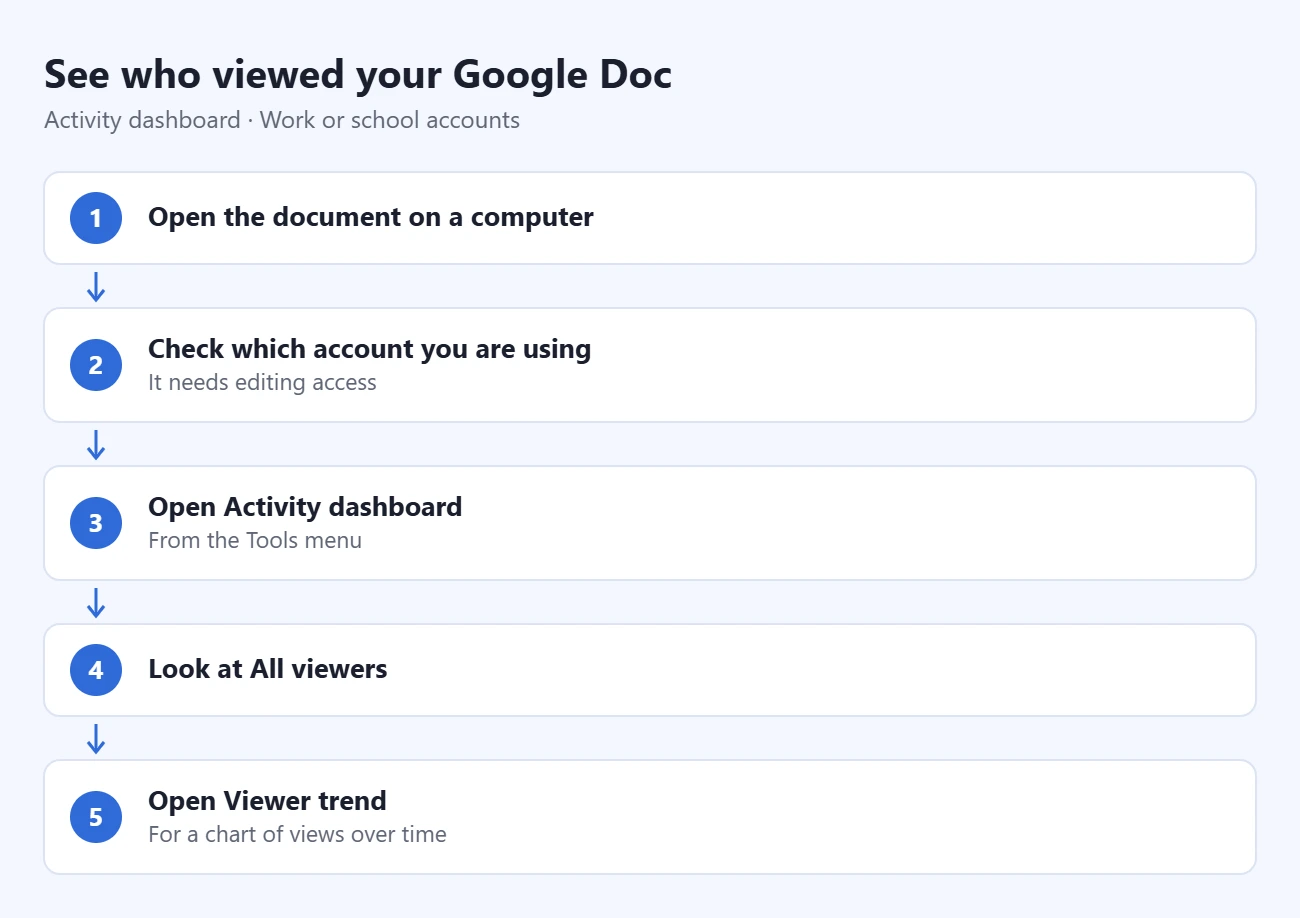
Google’s file collaboration instructions describe these dashboard sections. Their availability depends on your Workspace edition and administrator configuration.
Being on the sharing list doesn’t mean someone opened the file. Compare Shared with against All viewers (organization) to spot people who have access but haven’t viewed it.
Why the Dashboard or a Viewer May Be Missing
- A personally owned document: Google doesn’t show a viewer list for files owned by a personal Google account, so there is no menu to find.
- The wrong signed-in account: Check your account before concluding the feature is unavailable. A personal account and your organization’s account can have different permissions.
- Viewer or commenter access: ask the owner or an editor to check the dashboard for you.
- A document from another organization: Being able to edit a file doesn’t get around the same-domain requirement for its dashboard.
- Organization restrictions: Ask your administrator whether the feature is available for your edition and enabled for your account.
- An absent name: A person may have hidden their view history. A missing entry is not reliable proof that the document was never opened.
Because people can hide their view history, the dashboard isn’t a reliable read receipt. If you need to know a teammate read something, ask them to confirm.
Viewer History, Version History, and Access Are Different
For changes to the document, use File → Version history → See version history. Select a timestamp to see the edits and contributors for that version. This shows who changed the text, not everyone who only read it.
To label important points so they are easy to find later, name versions in Google Docs.
The Share window is for access permissions. To reduce who can open the file, follow the steps for stopping Google Docs sharing. Checking viewing activity does not remove access.
For an administrative investigation, talk to your administrator. Activity dashboard is not meant to be an audit tool; administrative logs are a separate resource. Don’t treat this dashboard as a complete security record.
Control Your Own Activity Dashboard View History
On a computer, open the organization’s document and choose Tools → Activity dashboard privacy. Turn off Show my view history for this document if the option is available.
For the broader setting, open the Google Docs home screen, then Menu → Settings. Under Activity dashboard, turn off Show your view history.
This affects Activity dashboard visibility, not logs elsewhere. If you enable history again, earlier recorded views can reappear; views made while history was off do not appear. See Google’s view-history privacy instructions for these limits.
Frequently Asked Questions
Can I do this from the Google Docs phone app?
Use a computer for the documented workflow. Google’s mobile view-history help directs users to a computer to change Activity dashboard history.
Will editing access alone show every reader?
No. Account and organizational requirements still apply, and privacy settings can hide viewing information. The dashboard is not an exhaustive attendance list.
Can I use Google Analytics or an add-on to recover missing viewer history?
No. Google Analytics can’t track individual readers of a Google Doc, and add-ons can’t recover view history that Google doesn’t record. Be wary of any tool that asks for access to your files with that promise.

Matthew Burleigh is the founder, head writer, and editor of Solve Your Tech, which he launched in 2012. He has written technology tutorials since 2008 and worked in IT since 2003, including small-business support, IT management, and consulting. He holds Bachelor’s and Master’s degrees in Computer Science from Arizona State University.
Matthew writes practical guides for Windows, iPhone and iPad, Microsoft Office, Outlook, Google apps, and Android. Solve Your Tech’s guides are checked step by step against the device or app maker’s own documentation and tested on his own devices whenever he has the hardware or software, with clear steps, sources, and update dates.
Read more about Matthew and how Solve Your Tech writes and updates its guides, or report a correction.