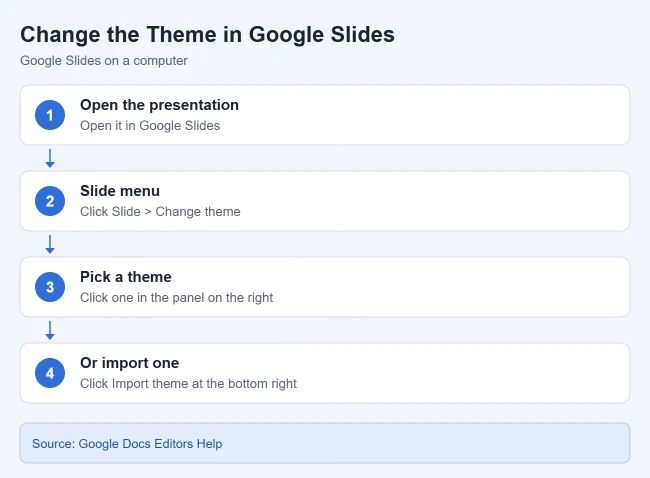
To change the theme in Google Slides, click Slide > Change theme and pick a theme in the panel on the right. To change the background, click Slide > Change background, choose a color or image, then click Done for one slide or Add to theme for every slide.
These steps are for Google Slides in a web browser on a computer and follow Google’s guide to templates, themes, backgrounds, and layouts. A section near the end covers the Google Slides app on iPhone, iPad and Android, which can do less.
Theme vs. Background
Google defines a theme as a preset group of colors, fonts, background, and layouts that applies to the whole presentation. The background is only the picture or color behind a slide’s content. Change the theme when you want a whole new look. Change the background when you like the fonts and layouts but want a different color or picture behind them.
How to Change the Theme in Google Slides
- Open the presentation in Google Slides. You need edit access.
- At the top, click Slide > Change theme. The Themes panel opens on the right.
- Scroll the list and click the theme you want.
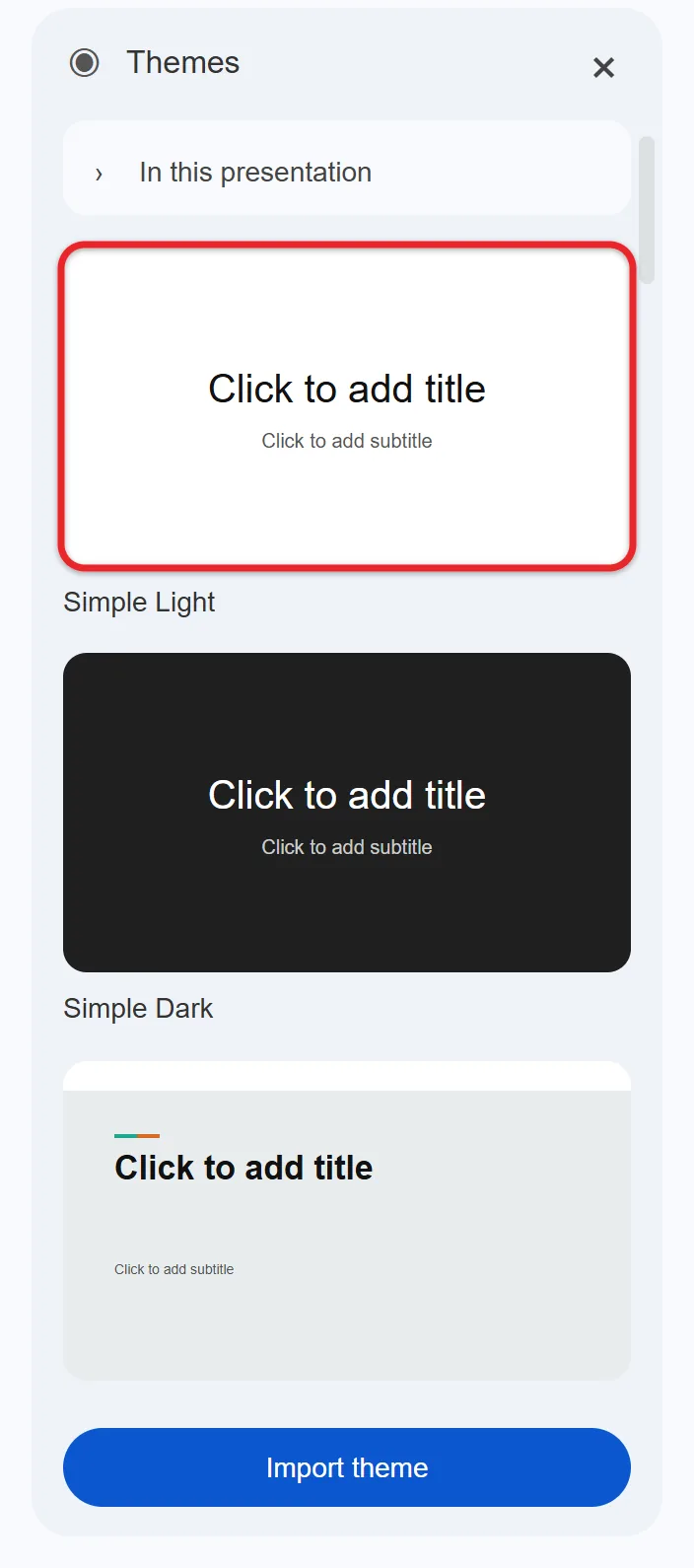
Every slide switches to the new theme’s colors, fonts, background, and layouts right away. The top of the panel lists the themes already used In this presentation, so you can switch back to the original by clicking it there. Close the panel with the X when you’re done.
A theme always applies to the whole deck. Google Slides has no way to apply a theme to only some slides.
To see the new theme at full size, start a Google Slides slideshow and step through a few slides.
How to Import a Theme From Another File
You can import a theme from another Google Slides presentation or a PowerPoint file. This is the way to reuse a company template or a theme you downloaded.
- Click Slide > Change theme.
- At the bottom right of the panel, click Import theme.
- Double-click the presentation you want to use. For a PowerPoint file that isn’t in Google Drive yet, use the Upload tab to pick it from your computer.
- Click the theme you want, then click Import theme.
The imported theme replaces the current one on every slide, and its layouts show up under Layout in the toolbar. If you’re moving a whole deck from PowerPoint, you can convert it to Google Slides instead.
How to Change the Background Color
- In the slide list on the left, click the slide you want to change.
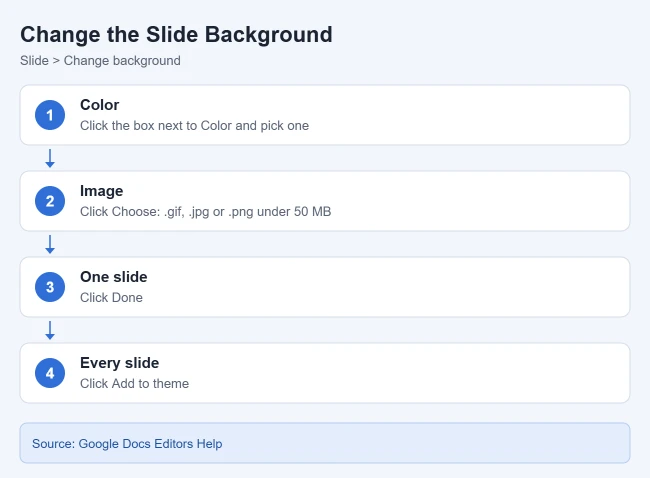
- At the top, click Slide > Change background. You can also right-click the slide in the list and choose Change background.
- To the right of Color, click the box and select a color. For your own shade, click Add under Custom, then type a hex code or adjust the color, hue, and transparency and click OK.
- Click Done to change only this slide, or Add to theme to change every slide that uses the theme.
For a gradient, click the Color box, switch from Solid to Gradient, and pick a preset. Click Custom under the gradients to choose the colors, the type (linear or radial), and the angle.
To undo a background change on a slide, open Change background again and click Reset to theme. The slide goes back to the theme’s own background.
How to Add a Background Picture
Google says background images must be a .gif, .jpg, or .png file and less than 50 MB.
- Choose a slide, then click Slide > Change background.
- To the right of Image, click Choose.
- Upload an image from your computer or pick one from Google Drive or the other tabs shown, then click Select.
- Click Done for one slide, or Add to theme for the whole presentation.
The picture fills the slide behind your text and shapes. Google also notes you can drag an image near the edge of the slide canvas to replace a background image.
Two tips help a background picture look right:
- Match the shape of the slide. A background image stretches to fill the slide. New presentations use a wide 16:9 shape, so a wide photo works better than a tall phone photo. Check your slide size under File > Page setup.
- Use a large image. A photo at least 1920 pixels wide stays sharp when you present on a big screen.
A background image can’t be faded, moved, or animated. If you need any of those, insert the picture with Insert > Image instead. Then right-click it, choose Format options > Adjustments, and drag Transparency to fade it. Use Arrange > Order > Send to back so it sits behind your text.
For more on stacking, read about changing layer order in Google Slides, and you can make the picture fly in if you want it to move.
Edit the Theme’s Colors, Background, and Layouts
The theme editor changes the theme itself, so your edits reach every slide that uses it. Click Slide > Edit theme to open it. The large slide at the top of the left panel is the theme master, and the slides under it are the layouts, such as Title slide and Section header.
- Theme colors: click Colors in the toolbar, choose a color under Theme colors, and pick a preset or enter a hex value. Text, shapes, and charts that use theme colors update.
- Master background: click the master slide, click Background in the toolbar, pick a color or image, and click Done. Every slide that uses the theme picks up the new background unless it has its own custom background.
- One layout’s background: click a layout under the master and change its background the same way. Only slides with that layout change.
- Layout for a slide: close the editor, select a slide, click Layout in the toolbar, and choose a new arrangement. Here’s more on how to add a slide and change its layout.
To close the theme editor, click the X at the top right. The same editor is how you change the font on all slides at once.
Want to reuse your edited theme? Give the presentation a clear name, then in any other deck use Import theme and pick this file. Google Slides saves your theme changes automatically.
On a Phone or Tablet
The Google Slides apps can switch themes, but they can’t open the theme editor.
- iPhone or iPad: open the presentation, tap More at the top right, then Change theme, and tap a theme. For a background, touch and hold a slide at the bottom, tap More > Change background, and tap the background you want. Tap Apply to theme to use it on every slide.
- Android: double-tap a slide, tap More > Change theme, and tap a theme. Google’s Android instructions say to use a computer to change the background.
When Only Some Slides Change
Only one slide changed
If you clicked Done instead of Add to theme, the background only applies to the slide you had selected. Open Change background again and click Add to theme.
Some slides kept their old background
A slide with its own custom background keeps it after you change the theme’s background. Select that slide, open Change background, and click Reset to theme.
Change theme is grayed out
You probably have view or comment access only. Ask the owner for edit access, or click File > Make a copy to get your own editable copy.
Your image won’t upload
Check that it’s a .gif, .jpg, or .png and smaller than 50 MB, which are Google’s limits for background images.
Text is hard to read on the new background
Change the theme’s text colors under Slide > Edit theme > Colors so your fonts contrast with the background, or pick a lighter or darker background color.
Slides Theme Questions
Can I use a different theme on just one slide?
No, a theme applies across the presentation. To make one slide look different, change only that slide’s background and click Done instead of Add to theme, or give it a different layout.
How do I undo a theme change?
Press Ctrl + Z (Command + Z on a Mac) right away, or reopen Slide > Change theme and click the old theme under In this presentation. For older changes, use File > Version history > See version history and restore an earlier version.
Can I use a video as the background?
Not as a true background. You can insert a video, resize it to cover the slide, and send it to the back, but it stays a normal object you can click and move.
What’s the difference between a theme and a template?
A template is a pre-designed set of slides that combines themes, layouts, backgrounds, fonts, color schemes, and sample content. Start one with File > New > From template gallery. The built-in Slides templates are only available in the English (US) locale.
Related Guides
- How to add a slide and change its layout
- How to crop and edit pictures in Google Slides
- How to convert PowerPoint to Google Slides
- How to insert a YouTube video into Google Slides
- How to resize or delete a text box in Google Slides
- How to print 4 slides per page in Google Slides (and hide the background to save ink)

Matthew Burleigh is the founder, head writer, and editor of Solve Your Tech, which he launched in 2012. He has written technology tutorials since 2008 and worked in IT since 2003, including small-business support, IT management, and consulting. He holds Bachelor’s and Master’s degrees in Computer Science from Arizona State University.
Matthew writes practical guides for Windows, iPhone and iPad, Microsoft Office, Outlook, Google apps, and Android. Solve Your Tech’s guides are checked step by step against the device or app maker’s own documentation and tested on his own devices whenever he has the hardware or software, with clear steps, sources, and update dates.
Read more about Matthew and how Solve Your Tech writes and updates its guides, or report a correction.