This post contains affiliate links. As an Amazon Associate, solveyourtech.com earns from qualifying purchases, at no extra cost to you.
To AirPlay a picture from your iPhone to your Apple TV, open Photos, tap the picture, tap the Share button, swipe up, tap AirPlay, and choose your Apple TV. The photo appears on your TV. Both devices need to be on the same Wi-Fi network.
Apple’s iPhone User Guide lists these steps for iOS 27 and recent versions. This guide also covers slideshows, screen mirroring, and what to check when your Apple TV doesn’t show up.
Before You Start
Check these things first. Most AirPlay problems come down to one of them.
- Same Wi-Fi network. Apple says your iPhone and Apple TV must both be on the same Wi-Fi network to stream photos. On the iPhone, open Settings > Wi-Fi and note the network name. On the Apple TV, look in Settings > Network. A guest network and a main network count as two different networks.
- A TV that can receive AirPlay. Apple’s current guide names Apple TV 4K and AirPlay 2-enabled smart TVs. An AirPlay 2-enabled smart TV is a television with AirPlay built in, so it works without an Apple TV box.
- The TV is on the right input. Turn on your TV and switch it to the HDMI input your Apple TV is plugged into. If you don’t have enough HDMI inputs for all your devices, consider an HDMI switch.
- AirPlay is turned on for the Apple TV. It is a setting on the Apple TV itself, covered later in this guide.
- No VPN in the way. If you use a VPN (an app that routes your internet traffic through another server), its configuration should not block local networking, because that can interfere with features like AirPlay.
How to AirPlay a Photo From Your iPhone

- Open the Photos app on your iPhone.
- Tap the photo you want to show so it fills the screen.
- Tap the Share button. It is the square with an arrow pointing up. A panel called the Share sheet slides up with ways to send the photo.
- Swipe up on the Share sheet to see the list of actions, then tap AirPlay.
- Choose your Apple TV from the list of devices. An AirPlay 2-enabled smart TV appears in the same list.
- If an AirPlay passcode appears on the TV screen, type that passcode on your iPhone.
The photo shows on your TV. The iPhone stays in control, so the TV follows along as you move to other pictures in the Photos app.
The same steps work for a video saved in Photos. With an Apple TV 4K and an iPhone that supports 4K HDR video, videos from the Photos app stream in full 4K HDR resolution.
Why AirPlay Is Under the Share Button
Many video apps put an AirPlay button right on the playback screen. Photos is different. In some apps you need to tap another button first, and Photos is one of them: tap Share, then tap AirPlay. If you are hunting for an AirPlay icon on the photo itself and cannot find it, that is why.
Plex works differently too; here is how to AirPlay a Plex movie to an Apple TV from Control Center.
How to Play a Slideshow on Your Apple TV
A slideshow moves through a group of photos automatically, which is easier than swiping when you are showing a whole trip.
- Open Photos and tap Library.
- Tap Select, then tap each photo or video you want to include.
- Tap the menu button for more options, then tap Start Slideshow. The slideshow begins on your iPhone with music.
- Tap the screen while the slideshow plays to show its controls.
- Open the slideshow’s options menu, tap AirPlay, then select your Apple TV.
Tap Customize during the slideshow to change the music or turn on Loop. For silence, turn off the slideshow music.
How to Stop Showing Photos on the TV

Tap the AirPlay button near the top of the iPhone screen, then tap Turn off AirPlay. The TV stops showing your photos and they appear only on your iPhone again.
AirPlay streams the photo to the TV. Your pictures stay in your iPhone’s library, and stopping AirPlay only ends the stream.
Mirror Your Whole iPhone Screen Instead
Screen Mirroring shows everything on your iPhone on the TV, not just photos. It is the better choice when you want to show an app that has no AirPlay button, or flip between Photos and something else. It only works with AirPlay receivers, which is why you cannot mirror an iPhone to an iPad this way.
Before you mirror: the TV shows exactly what is on your iPhone, including messages, notifications, and anything else you open. If other people are watching, consider turning on a Focus such as Do Not Disturb first, and close anything private.
- Open Control Center. On an iPhone X or later, swipe down from the upper-right corner of the screen. On an iPhone 8 or earlier, swipe up from the bottom edge.
- Tap the Screen Mirroring button.
- Choose your Apple TV or AirPlay 2-enabled smart TV from the list.
- Enter the AirPlay passcode on your iPhone if one appears on the TV.
Your iPhone screen appears on the TV. Open Photos and whatever you look at shows up there.
To switch back, open Control Center, tap Screen Mirroring, then tap Stop Mirroring. You can also press the Back button on the Apple TV Remote (Menu on older remotes). For more on this method, including TVs that are not made by Apple, read how to screen mirror an iPad or iPhone to a TV.
AirPlay From Photos vs. Screen Mirroring
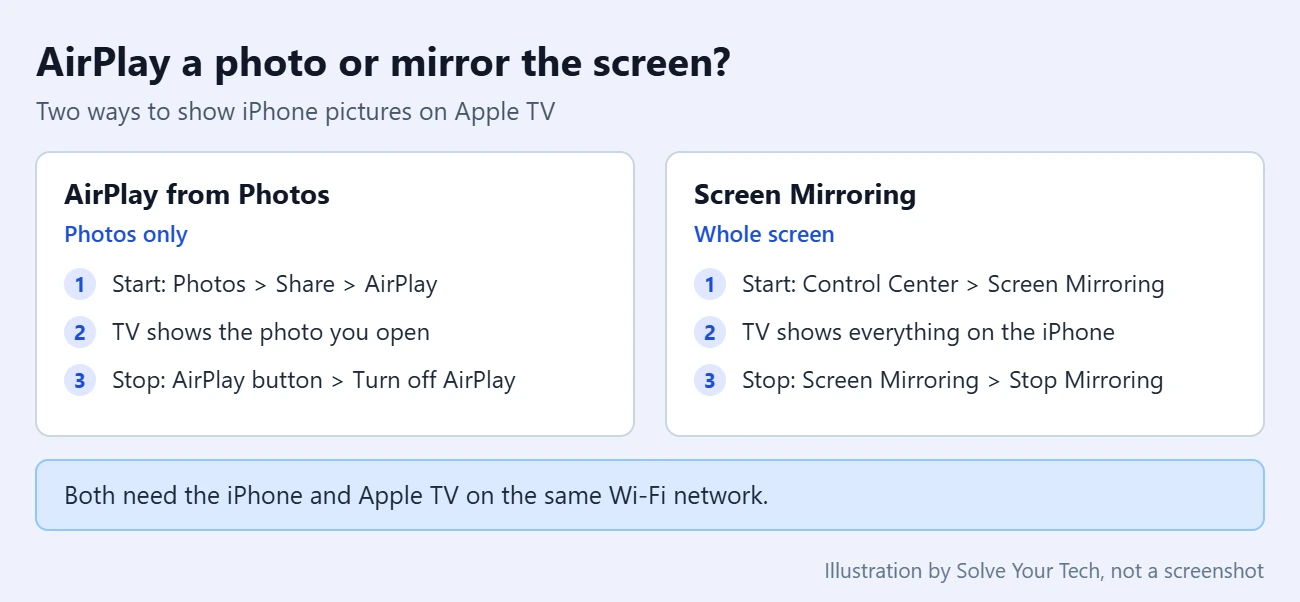
| Question | AirPlay from Photos | Screen Mirroring |
|---|---|---|
| Where do you start it? | Photos > Share > AirPlay | Control Center > Screen Mirroring |
| What does the TV show? | The photo or video you open | Everything on the iPhone screen |
| How do you stop it? | AirPlay button > Turn off AirPlay | Screen Mirroring > Stop Mirroring |
| Best for | Showing pictures without the rest of your phone on view | Showing apps, websites, or several things in a row |
If you only want people to see your pictures, use AirPlay from the Photos app. Use Screen Mirroring when you need the TV to follow everything you do.
Check the AirPlay Settings on Your Apple TV
The Apple TV decides whether it accepts AirPlay and from whom. If your iPhone cannot see the Apple TV, or it asks for a password you do not know, check these settings. On older tvOS versions the menu is called AirPlay and HomeKit. We have a separate walkthrough on how to turn AirPlay on or off on Apple TV.
- On the Apple TV, open Settings.
- Go to AirPlay and Apple Home.
- Make sure AirPlay is turned on. This is the switch that allows devices to stream to the Apple TV.
- Select Allow Access and choose who can use AirPlay.
The Allow Access choices are:
- Everyone: anyone can stream content to the Apple TV.
- Anyone on the Same Network: anyone connected to the same network as you can stream.
- Only People Sharing This Home: only people you have added to your home in the Home app can stream.
- Require Password: people must enter a password to stream. When it is on, select Password to set the one you want.
For most households, Anyone on the Same Network keeps things simple, because a visitor needs your Wi-Fi password before they can put anything on your TV. If you choose Only People Sharing This Home, a guest’s iPhone will not be able to connect even when it is on your Wi-Fi.
The same menu has AirPlay Display Underscan. Turn it on if the AirPlay picture appears cropped, and turn it off if you see black bars around the image.
To see which devices have connected before, go to Settings > Remotes and Devices > Remote App and Devices on the Apple TV. Select a device and choose Forget This Device to remove it from the list.
Let Your iPhone Connect Automatically
If your iPhone keeps offering your TV when you don’t want it, change how it connects automatically.
- Open Settings on your iPhone.
- Tap General.
- Tap AirPlay & Continuity, then tap Automatically AirPlay.
- Choose Never to always pick the AirPlay device yourself, Ask to get a suggestion you can tap or ignore, or Automatic to let the iPhone connect on its own.
The iPhone and the AirPlay device must be on the same Wi-Fi network for suggestions to appear, and for an Apple TV you need to be signed in to the same iCloud account on both.
If Your Apple TV Doesn’t Show Up
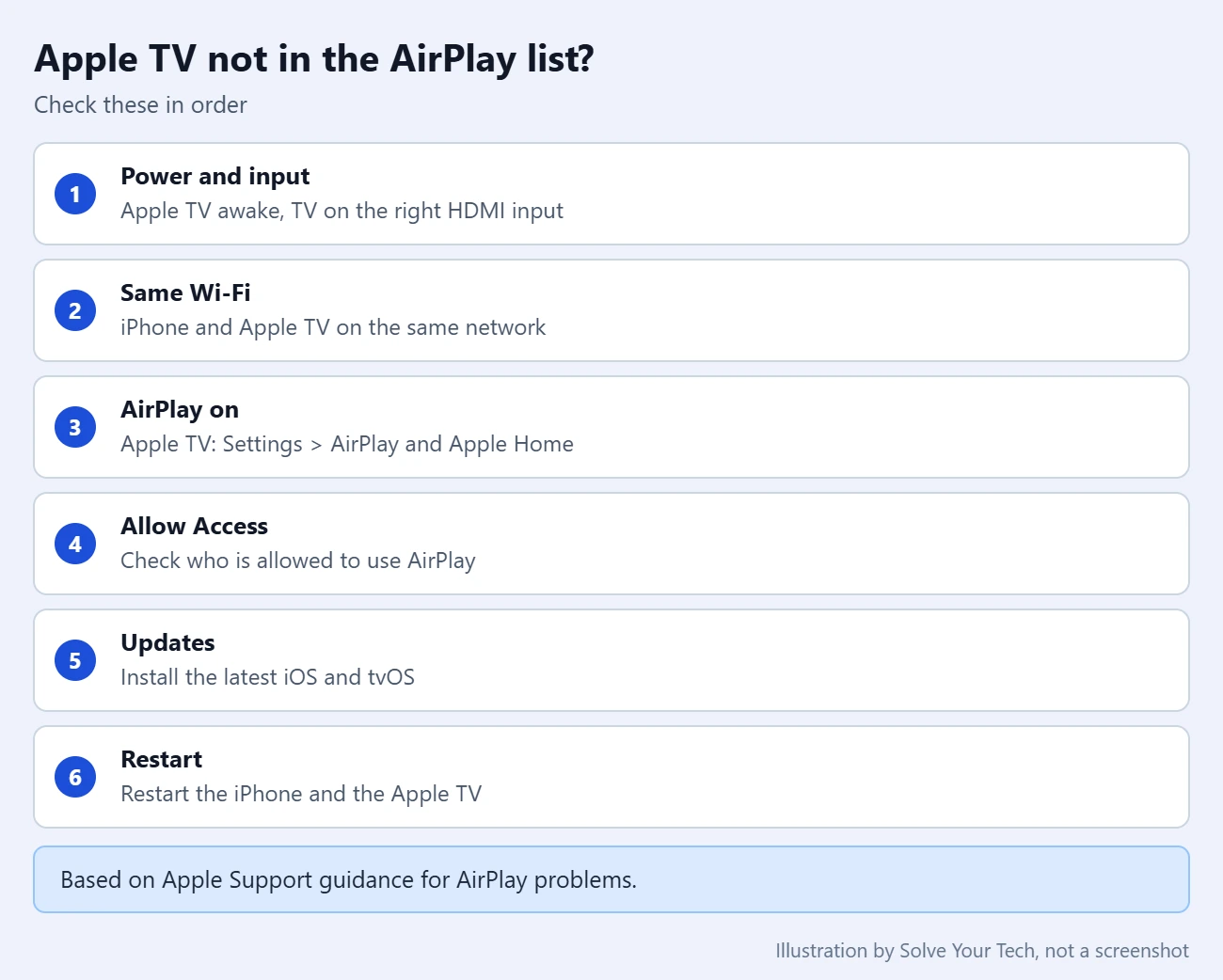
Work through these in order and try AirPlay again after each one. They are based on Apple’s article If screen mirroring or streaming isn’t working on your AirPlay-compatible device.
- Check power and distance. Make sure the Apple TV is turned on and awake, the TV is on the right input, and the iPhone is near the Apple TV.
- Confirm the Wi-Fi network. Both devices must be on the same network. Check the network name on each one.
- Check the Apple TV’s AirPlay settings. Go to Settings > AirPlay and Apple Home, confirm AirPlay is on, and review Allow Access.
- Update both devices. Make sure each one is running the latest software.
- Restart both devices. Restart the iPhone and the Apple TV, then look for the Apple TV in the AirPlay list again.
- Check the Home app. If the Apple TV was added to the Home app, open Home, tap the More button, select Home Settings, then Speakers & TV, and make sure AirPlay is not being restricted there.
- Check your VPN. If you use one on the iPhone, make sure it allows local networking, or turn it off while you use AirPlay.
If you’re not sure how to install a tvOS update, here’s how to update the Apple TV software.
Other Problems You Might Run Into
- The iPhone asks for a password, not a code. A code shown on the TV is the normal AirPlay passcode. A password prompt means Require Password is on in the Apple TV’s Allow Access settings, or content restrictions are set. Check both.
- There is no AirPlay option in the Share sheet. Swipe up on the Share sheet. AirPlay sits in the list of actions below the row of apps, so it is easy to miss.
- The picture is cut off at the edges. Turn on AirPlay Display Underscan on the Apple TV.
- A video from Photos plays without sound. Make sure the volume is turned up and not muted on both the iPhone and the TV or receiver.
If none of this helps, contact Apple Support.
Frequently Asked Questions
Can I AirPlay photos to a Roku?
Some Roku devices support AirPlay, and there are other ways to get pictures onto one. Here’s how to view iPhone pictures on a Roku.
Do I need an Apple TV to AirPlay photos to a TV?
No. You can show photos on an Apple TV 4K or on an AirPlay 2-enabled smart TV. If your TV has AirPlay built in, it appears in the same AirPlay list in the Photos app and you choose it the same way. Apple keeps a list of AirPlay 2-enabled TVs on its Home accessories website.
Does AirPlay use cellular data?
AirPlay between your iPhone and Apple TV works over your Wi-Fi network, which is why both devices need to be on the same network. A photo saved on your iPhone is sent to the TV across that local network.
Why is my photo sideways on the TV?
There’s no rotation setting for AirPlay photos, so fix the picture itself in the Photos app before you show it. Here’s how to change a picture from portrait to landscape.
Why does my TV ask for a code every time?
The AirPlay passcode is how the TV confirms that the person connecting can see the screen. Apple’s steps say to enter it on your iPhone if it appears. Whether you are asked again later depends on the Apple TV’s Allow Access and password settings, so review those if the prompts become a nuisance.
Can I use my iPhone for other things while a photo is on the TV?
The TV shows what you open in the Photos app, so leaving Photos changes what you are able to control. If you need the TV to follow you into other apps, use Screen Mirroring, which shows the entire iPhone screen.
Can I AirPlay photos to a hotel TV?
Sometimes. If your hotel room TV supports AirPlay, you can open the Camera app, scan the AirPlay QR code shown on the TV, and follow the onscreen instructions to connect. After that you pick the hotel TV as the AirPlay destination in Photos. This is not available in all countries or regions.
Next Step
Try it with one photo first: Photos > Share > AirPlay > your Apple TV. Once that works, start a slideshow so you can put the phone down.
AirPlay works for videos too. Here’s how to watch YouTube on the Apple TV with an iPhone.

Matthew Burleigh is the founder, head writer, and editor of Solve Your Tech, which he launched in 2012. He has written technology tutorials since 2008 and worked in IT since 2003, including small-business support, IT management, and consulting. He holds Bachelor’s and Master’s degrees in Computer Science from Arizona State University.
Matthew writes practical guides for Windows, iPhone and iPad, Microsoft Office, Outlook, Google apps, and Android. Solve Your Tech’s guides are checked step by step against the device or app maker’s own documentation and tested on his own devices whenever he has the hardware or software, with clear steps, sources, and update dates.
Read more about Matthew and how Solve Your Tech writes and updates its guides, or report a correction.