To turn on Caps Lock on an iPad or iPhone, quickly double-tap the Shift key (the up arrow) on the onscreen keyboard. Every letter you type is then a capital until you tap Shift again.
These steps cover iPadOS 27 and iOS 27, and the double-tap works the same way on older versions, including an iPad 2. They follow Apple’s Type with the onscreen keyboard on iPad guide and its keyboard accessibility settings guide. To type just one capital letter, tap Shift once and then tap the letter.
Before You Start
- Enable Caps Lock must be on. It’s on by default, so most people don’t need to change anything. If the double-tap doesn’t lock capitals, see the troubleshooting section below.
- You need Apple’s own keyboard. Keyboards from other apps can handle Shift differently.
- Caps Lock is not the same as Auto-Capitalization. Auto-Capitalization only capitalizes the first word of a sentence and some names. Caps Lock makes every letter a capital.
How to Turn On Caps Lock on iPad
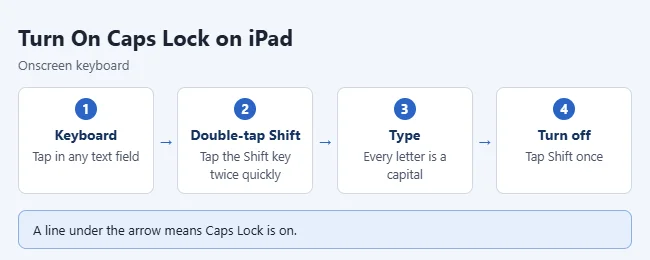
- Tap in any text field, such as a note, a message or the Safari address bar. The onscreen keyboard opens.
- Quickly double-tap the Shift key. The Shift key changes: the arrow fills in and a short line appears under it.
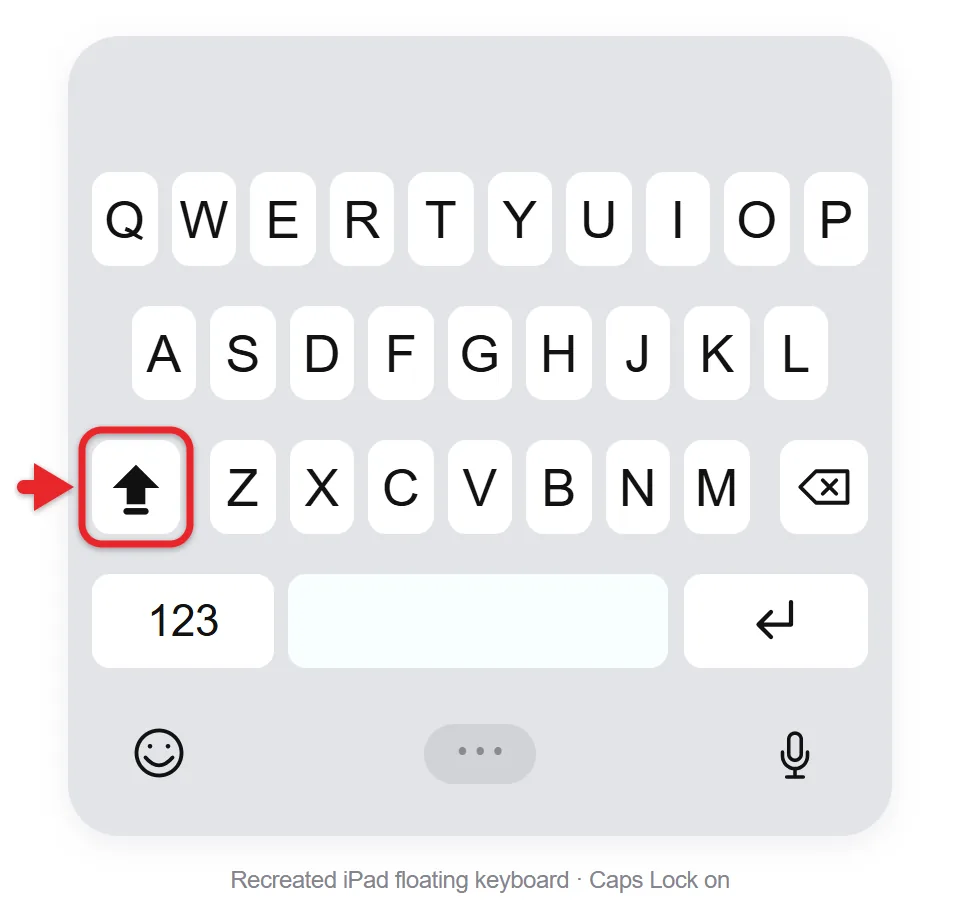
- Type your text. Every letter appears in uppercase. Numbers and symbols are not affected.
- Tap Shift once to turn Caps Lock off. The line under the arrow disappears and the keyboard goes back to lowercase.
If the keyboard doesn’t open when you tap a text field, a connected keyboard case or Bluetooth keyboard may be hiding it. Here is how to bring the on-screen keyboard back.
On the largest iPad screens, such as the 12.9-inch iPad Pro, the full-size onscreen keyboard also shows a separate caps lock key on the left side. Tap it to lock capitals, and tap it again to unlock them. Double-tapping Shift still works on those models.
Use Caps Lock on an iPhone
The iPhone works the same way.
- Open an app where you can type, such as Messages or Notes, and tap the text field.
- Double-tap Shift on the onscreen keyboard. The line appears under the Shift arrow.
- Type your text in capitals.
- Tap Shift once to turn the lock off.
Apple’s iPhone keyboard guide documents the same Shift behavior. If double-tapping doesn’t work, open Settings > General > Keyboard and turn on Enable Caps Lock, then try again. This setting enables the gesture. It does not make every app’s text permanently uppercase.
How to Type a Single Capital Letter
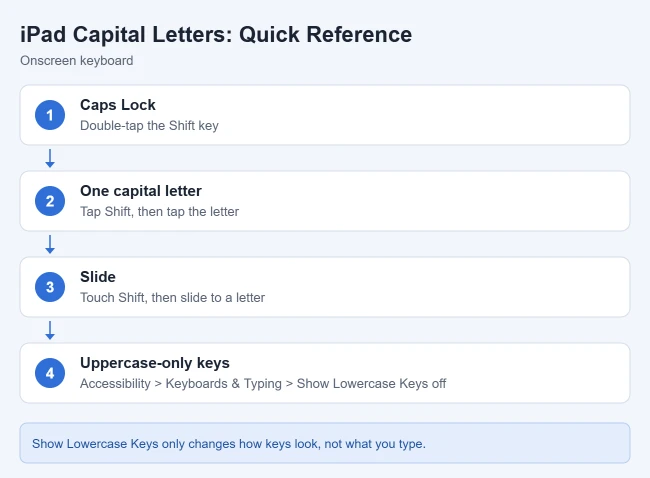
Apple lists two ways to type one uppercase letter:
- Tap Shift, then tap the letter.
- Touch Shift and slide your finger to the letter, then lift.
After one capital, the keyboard goes back to lowercase on its own.
The keyboard also turns Shift on by itself at the start of a sentence. That’s Auto-Capitalization. You can turn it off in Settings > General > Keyboard if you don’t want it.
What to Do if Double-Tapping Shift Doesn’t Work
If a double-tap on Shift only capitalizes one letter, work through these checks in order.
Turn on Enable Caps Lock
- Open Settings.
- Tap General, then Keyboard.
- Under All Keyboards, find Enable Caps Lock and make sure the switch is on (green).
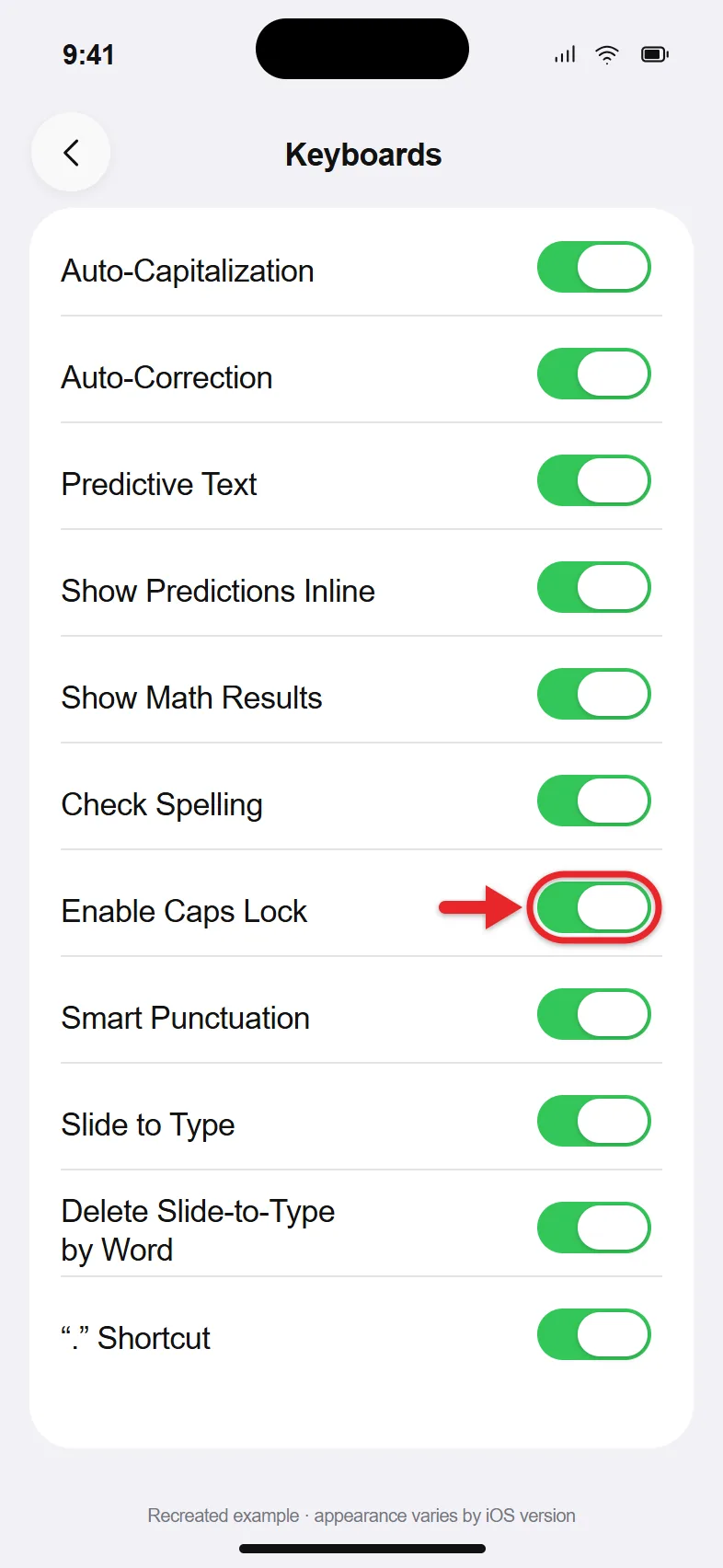
The typing features under All Keyboards can be turned on or off here. You can also get to this screen from the keyboard: touch and hold the emoji or globe key, then tap Keyboard Settings.
Tap faster
The two taps need to land close together. If they’re too slow, the keyboard reads them as two single taps, which turns Shift on and then off again.
Switch to Apple’s keyboard
If you use a keyboard from another app, touch and hold the globe key and choose your language’s standard keyboard, such as English (US). Try the double-tap again. If it works there, the other keyboard is the cause, and its own settings control Shift.
Restart and update
A restart clears temporary glitches. Apple’s Restart your iPhone page has the button steps for each model, and iPad works the same way. If the problem continues, go to Settings > General > Software Update and install any update that’s available.
How to Show Only Uppercase Letters on the Keys
If uppercase letters are easier for you to read, Apple lets you stop the keyboard from showing lowercase letters.
- Open Settings > Accessibility > Keyboards & Typing.
- Turn off Show Lowercase Keys.
This only changes how the keys look. What you type still follows Shift and Caps Lock.
Apple also suggests turning the iPad to landscape for a larger keyboard in apps like Mail, Messages, Notes and Safari. If the screen stays upright when you turn it, see why your iPad screen will not rotate. If the text on the screen is hard to read as well, here’s how to make text bigger on an iPad.
Using an External Keyboard
On a Magic Keyboard or another physical keyboard, press the Caps Lock key to type in all capitals, and press it again to turn it off. Many keyboards light a small indicator on the key while it’s on.
If you haven’t connected one yet, here’s how to set up an Apple wireless keyboard on iPhone.
If pressing Caps Lock changes the language instead of locking capitals, you probably have a Chinese, Japanese, Korean or Hebrew keyboard added. With one of those keyboards added, the Caps Lock key switches between Latin letters and that keyboard. You can turn that behavior off in Settings > General > Keyboard > Hardware Keyboard. Language keyboards are managed on the same Keyboards screen on iPad and iPhone, where you can add a Spanish keyboard or any other language.
If Caps Lock does something else entirely, it may have been remapped. Go to Settings > General > Keyboard > Hardware Keyboard > Modifier Keys and check what the Caps Lock key is set to.
If you use a physical keyboard, Apple’s accessibility settings in Settings > Accessibility > Keyboards & Typing also include Key Repeat, Sticky Keys (press keys in a combination one at a time) and Slow Keys.
Frequently Asked Questions
How do I know Caps Lock is on?
The Shift key shows a filled arrow with a line under it. Type a letter to check. On a physical keyboard, look for the light on the Caps Lock key.
How do I turn Caps Lock off?
Tap the Shift key once. On a physical keyboard, press Caps Lock again.
Why does only the first letter get capitalized?
A single tap on Shift only capitalizes the next letter. Double-tap Shift for Caps Lock. If a double-tap still gives one capital, turn on Enable Caps Lock in Settings > General > Keyboard.
Is Caps Lock turned off by default on iPhone and iPad?
No. Enable Caps Lock is on by default. It only needs attention if someone turned it off.
Can I make the keyboard show only capital letters?
Yes. Turn off Show Lowercase Keys in Settings > Accessibility > Keyboards & Typing.
For Caps Lock and the other typing switches on an iPhone, here’s how to change iPhone keyboard settings. More keyboard help: how to turn off predictive text on iPad and how to fix a split iPad keyboard. To keep your favorite apps one swipe away, change the apps in the iPad Dock. Related: how to sync an iPad and iPhone.

Matthew Burleigh is the founder, head writer, and editor of Solve Your Tech, which he launched in 2012. He has written technology tutorials since 2008 and worked in IT since 2003, including small-business support, IT management, and consulting. He holds Bachelor’s and Master’s degrees in Computer Science from Arizona State University.
Matthew writes practical guides for Windows, iPhone and iPad, Microsoft Office, Outlook, Google apps, and Android. Solve Your Tech’s guides are checked step by step against the device or app maker’s own documentation and tested on his own devices whenever he has the hardware or software, with clear steps, sources, and update dates.
Read more about Matthew and how Solve Your Tech writes and updates its guides, or report a correction.