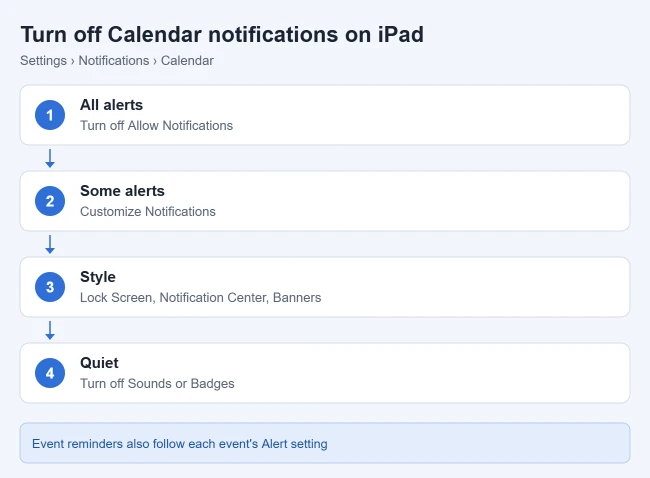
To turn off calendar notifications on iPad, open Settings, tap Notifications › Calendar, and turn off Allow Notifications. To keep some alerts, leave it on and tap Customize Notifications to turn off only certain types, such as invitations or shared calendar changes.
These steps follow Apple’s Keep track of events in Calendar on iPad and Change your Calendar settings on iPad pages, plus its notification settings guide, for current versions of iPadOS. Below you will find how to silence everything, turn off only some alerts, stop reminders for events, and change default alert times so new events don’t buzz.
How to turn off all Calendar notifications
- Open the Settings app.
- Tap Notifications.
- Tap Calendar.
- Turn off Allow Notifications.
Result: Calendar stops showing banners, sounds, and Lock Screen alerts. Your events stay in the Calendar app.
How to turn off only some Calendar alerts
- Go to Settings › Notifications › Calendar and make sure Allow Notifications is on.
- Tap Customize Notifications.
- Turn off the types you don’t want, such as Upcoming Events, Invitations, Invitee Responses, or Shared Calendar Changes.
Result: Apple says you can choose whether notifications appear for specific occasions, so you keep the alerts you care about and lose the rest. Option names can vary with your accounts.
How to change how Calendar alerts look
On the same Settings › Notifications › Calendar screen, Apple lets you choose where and how alerts appear:
- Lock Screen, Notification Center, Banners: choose where alerts show up.
- Sounds: turn off the alert sound but keep the banner.
- Badges: turn off the red number on the Calendar icon.
How to stop reminders for new events
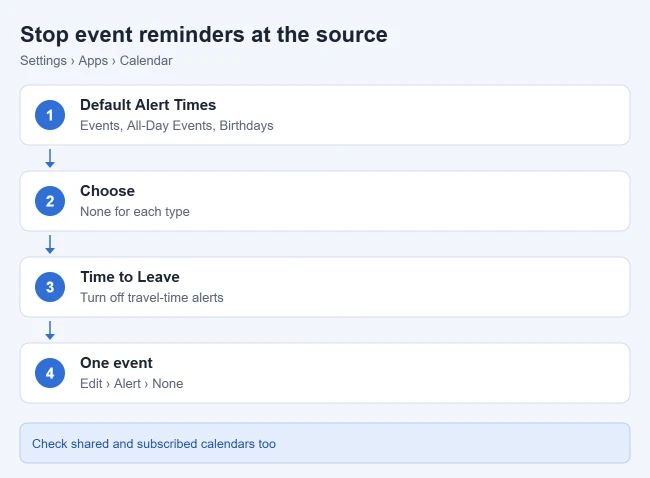
- Open Settings, tap Apps, then tap Calendar.
- Tap Default Alert Times.
- Tap Events, All-Day Events, or Birthdays and choose None.
- Turn off Time to Leave if you don’t want travel-time alerts.
Result: Apple documents these defaults; new events you create won’t include an automatic reminder unless you add one.
How to turn off the alert for one event
- Open the event in the Calendar app.
- Tap Edit.
- Tap Alert and choose None. If there’s a second alert, set it to None too.
- Tap Done.
Result: that event no longer sends a reminder. Events can have more than one alert, so check both.
How to stop Calendar suggestions
Calendar can also feed suggestions into Siri, Search, widgets, and notifications. Apple explains that you can control this in Settings › Apps › Calendar › Siri: turn off Learn from this App, and turn off the options that let suggestions and content from Calendar appear in Search, widgets, and as notifications.
Result: you won’t see Calendar-based suggestions pop up, while your normal event alerts follow the settings above.
How to turn Calendar notifications back on
Go to Settings › Notifications › Calendar and turn on Allow Notifications. Then choose where alerts appear and use Customize Notifications to pick which types you get. If you set Default Alert Times to None, set them back in Settings › Apps › Calendar › Default Alert Times.
Troubleshooting
- Alerts still appear: they may come from another app, such as Google Calendar or Outlook, which has its own notification settings.
- Alerts on your other devices: each iPhone, iPad, and Mac has its own notification settings. Change them on each one.
- Shared calendar changes keep popping up: turn off Shared Calendar Changes in Customize Notifications.
Frequently asked questions
Will turning off notifications delete my events?
No. Events stay in Calendar. You just won’t get alerts until you turn notifications back on.
Can I silence Calendar alerts only at night?
Yes. Use a Focus, such as Sleep or Do Not Disturb, to silence notifications during certain hours instead of turning Calendar alerts off completely.
Related: How to delete an alarm on iPad, How to show text messages on the iPad Lock Screen, and How to remove the Mail badge on iPad.

Matthew Burleigh is the founder, head writer, and editor of Solve Your Tech, which he launched in 2012. He has written technology tutorials since 2008 and worked in IT since 2003, including small-business support, IT management, and consulting. He holds Bachelor’s and Master’s degrees in Computer Science from Arizona State University.
Matthew writes practical guides for Windows, iPhone and iPad, Microsoft Office, Outlook, Google apps, and Android. Solve Your Tech’s guides are tested on current devices or checked against official product documentation, with clear steps, sources, and update dates.
Read more about Matthew and how Solve Your Tech writes and updates its guides, or report a correction.