To take smaller pictures on an Android phone, lower the photo resolution in the Camera app. On a Samsung Galaxy, tap the ratio button in the camera and choose the plain 3:4 option instead of one with a high megapixel label like 3:4 50MP or 3:4 200MP; on a Google Pixel Pro, open the camera settings, tap the Pro tab, and set Resolution to the lower option.
These steps match the current Samsung Camera app on Galaxy phones and the Pixel Camera app on the Pixel 8 Pro through Pixel 10 Pro XL. Older phones, including ones still running Android 6.0 Marshmallow, usually keep the same kind of control in the camera’s settings under a name like Picture size or Resolution.
Why Your Photos Are So Big
Photo file size depends mostly on how many pixels the camera records. A megapixel (MP) is one million pixels, so a 50MP photo holds roughly four times the detail of a 12MP photo, and the file grows to match. Samsung says a 50MP photo on the Galaxy S23 takes about 6 to 9 MB, and a 200MP photo takes about 25 to 30 MB.
Most phones shoot at a standard size by default and only switch to a high-megapixel mode when someone turns it on. If your photos suddenly got larger, that mode is the first thing to check. Lowering it changes new photos only. Photos you already took stay the same size until you resize them, which is covered further down.
| What you want | Best built-in option | Changes old photos? |
|---|---|---|
| Smaller new photos on a Galaxy | Standard 3:4 ratio instead of 50MP or 200MP | No |
| Smaller new photos on a Pixel Pro | Resolution set to the lower option | No |
| Smaller copy of one existing photo | Resize in the Samsung Gallery app | Yes, that photo |
| Smaller cloud backups | Storage saver in Google Photos | Only backups |
Take Smaller Pictures on a Samsung Galaxy
On Galaxy phones, high-resolution capture lives in the camera ratio menu. In Samsung’s guide to capturing high resolution photos, you turn it on by picking an option such as 3:4 64MP, so you turn it off by picking the standard ratio instead.
- Open the Camera app and make sure Photo mode is selected at the bottom.
- Tap the ratio button in the camera controls. It shows the current ratio, such as 3:4 or 3:4 50MP.
- Look at the list of ratios. Options with a megapixel number (50MP, 64MP, 108MP or 200MP, depending on your model) are the high-resolution modes.
- Tap the plain 3:4 option. The ratio button now shows 3:4 with no megapixel label.
- Take a test photo. Open it in Gallery, then swipe up on it or tap More options (three dots) > Details to see its resolution and file size.

Samsung also notes that high-resolution photos take extra processing time, so switching back to the standard ratio lets you take the next shot sooner.
The 1:1 and 9:16 ratios crop the frame, so they record fewer pixels than full 3:4. They can make files a little smaller, but you lose part of the scene, so stick with 3:4 unless you want that shape.
Some camera settings and modes may not be available, depending on your phone’s camera and software version. If your ratio menu has no megapixel labels, your Galaxy is already taking standard-size photos.
Optional: Save Galaxy Photos in HEIF Format
Many Galaxy phones have a High efficiency pictures switch in the camera settings. Open Camera, tap the Settings gear, and look under Advanced picture options. With it on, new photos are saved as HEIF (.heic) files instead of JPEG, which usually makes them smaller at similar quality.
The catch is compatibility. Some computers, websites and email recipients can’t open HEIC files, as Samsung Community members have reported when sending them by email. If people need to open your photos anywhere, leave this switch off and lower the resolution instead.
Take Smaller Pictures on a Google Pixel
Only Pro models can take 50MP high-resolution photos: the Pixel 8 Pro, Pixel 9 Pro, Pixel 9 Pro XL, Pixel 10 Pro and Pixel 10 Pro XL. Google’s high-resolution photo steps show how to turn the mode on, and the same control turns it off:
- Open the Camera app.
- Tap Settings in the bottom-left corner of the viewfinder.
- Tap the Pro tab.
- Tap Resolution and choose the lower option instead of 50 MP.
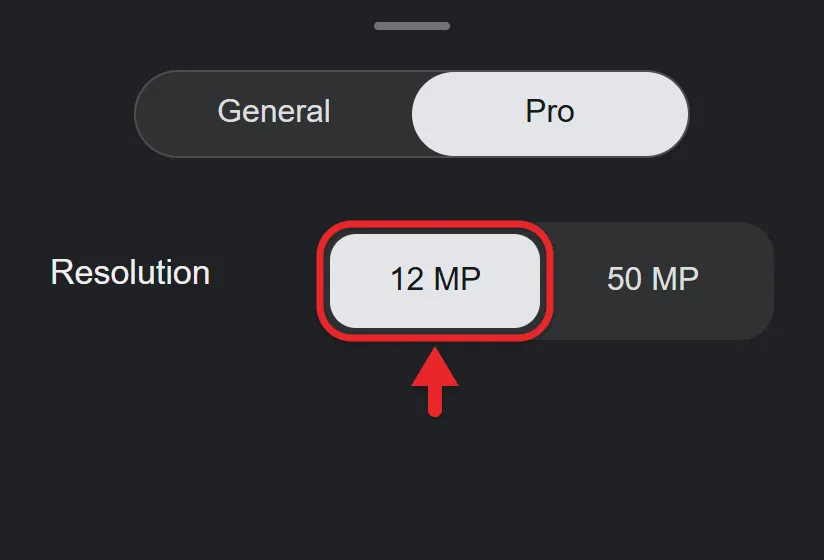
- Close the settings panel and take a test photo. New photos are saved at the standard resolution.
On the Pixel 10 Pro and Pixel 10 Pro XL, the 50 MP setting applies to both the default photo mode and Portrait mode, so changing it shrinks Portrait photos too.
If you see two files for every photo in Google Photos, with a RAW badge on one, the camera is saving RAW files as well as JPEGs. RAW files are much larger. The camera saves JPEG plus RAW when RAW/JPEG is turned on in the camera settings, so switch that control back to JPEG only if you don’t edit RAW photos.
Pixel phones other than the Pro models don’t have the 50 MP option, so there is no resolution setting to lower.
Take Smaller Pictures on Other Android Phones
Motorola, OnePlus, Xiaomi and other brands use their own camera apps, so the labels differ. Use this checklist:
- Open the camera and look for a ratio or megapixel button along the top or side of the viewfinder. If it shows a number like 50M or 108MP, tap it and pick the standard option.
- If there is no button, open the camera settings (usually a gear icon or a menu with three lines).
- Look for Resolution, Picture size, Photo size or Megapixels.
- Choose a lower option and take a test photo to check the size.
If none of these settings exist, check your phone maker’s support site for your exact model.
Shrink Photos You Already Took
The camera setting only affects new photos. On a Galaxy phone, the Gallery app can resize an existing photo:
- Open Gallery and tap the photo.
- Tap the Edit icon (a pencil) at the bottom of the screen.
- Tap More options (three vertical dots) at the top right.
- Tap Resize.
- Choose a percentage and tap Done.
- To keep the original, tap More options and choose Save copy. Tapping Save replaces the original photo instead.
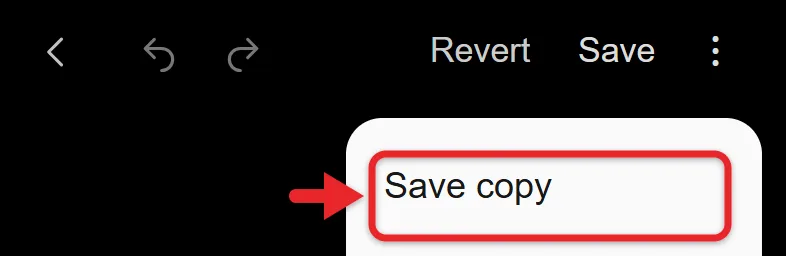

You can’t resize a photo to be larger than the original, and the Resize option may not be supported on every model. Check the new size under Details.
Google Photos and most other gallery apps don’t offer the same resize tool. Cropping in the editor removes part of the picture, which makes the file somewhat smaller but isn’t the same as shrinking the whole image.
Keep Cloud Backups Smaller
If you back up your phone with Google Photos, you can choose a smaller backup quality. This doesn’t change the photos on your phone, only the copies stored in your Google Account.
- Open the Google Photos app.
- Tap your profile picture or initial at the top right.
- Tap Google Photos settings, then Backup, then Photos & videos quality.
- Choose Storage saver.
With Storage saver, Google compresses photos slightly, resizes photos larger than 16 MP down to 16 MP, and resizes videos above 1080p to 1080p. Photos may be converted to .jpg. Some countries also get an Express option that resizes photos to 3 MP.
All backup qualities count toward the 15 GB of storage that comes with a Google Account, and you can’t change the backup quality once that storage is full. To shrink photos you already backed up, Google offers Recover storage on a computer at photos.google.com/settings, under Manage storage. It converts existing items to Storage saver and can be used once a day. Some Android portrait photos saved in a multi-picture format may not compress.
To find out what’s filling the phone itself, read about why your Android phone storage is full. To stop backing up a phone entirely, unsync Google Photos on it.
Smaller files also upload faster when you post pictures to X from your Android phone.
If Your Photos Are Still Large
- You changed the wrong mode. Make sure Photo mode is selected when you change the ratio. Other camera modes have their own controls, so check the mode you use most.
- You’re checking old photos. Only photos taken after the change are smaller. Take a fresh test photo and compare it under Details.
- Videos are taking the space. Video files are usually far larger than photos. Lower the video resolution in the camera’s video settings if that’s the problem.
- The phone has no setting. Many phones already shoot at a standard size and have nothing lower to pick. Resize individual photos or use Storage saver for backups instead.
Frequently Asked Questions
Will smaller pictures look worse?
For photos you view on a phone, send in messages or post online, the standard resolution is plenty. The extra detail in 50MP and 200MP photos matters mostly for large prints and for cropping deep into a shot. Original quality backups are the better choice for large prints for the same reason.
Does lowering the resolution change photos I already took?
No. The camera setting only applies to new photos. Use the Gallery resize tool on a Galaxy phone to shrink an existing one.
How do I switch back to full resolution?
Repeat the same steps and choose the high-megapixel ratio on a Galaxy or 50 MP on a Pixel Pro. Photos taken in the lower mode stay at their lower size.
Do messaging apps make photos smaller?
Many messaging apps compress photos when you send them, unless you pick a high-quality or original option. That helps the person receiving the photo, but the copy on your phone stays full size.
Next step: before you delete large originals to free up space, back up your Android phone so you keep a full copy. Related: how to empty the trash on Android and how to scan a QR code on Android.

Matthew Burleigh is the founder, head writer, and editor of Solve Your Tech, which he launched in 2012. He has written technology tutorials since 2008 and worked in IT since 2003, including small-business support, IT management, and consulting. He holds Bachelor’s and Master’s degrees in Computer Science from Arizona State University.
Matthew writes practical guides for Windows, iPhone and iPad, Microsoft Office, Outlook, Google apps, and Android. Solve Your Tech’s guides are checked step by step against the device or app maker’s own documentation and tested on his own devices whenever he has the hardware or software, with clear steps, sources, and update dates.
Read more about Matthew and how Solve Your Tech writes and updates its guides, or report a correction.