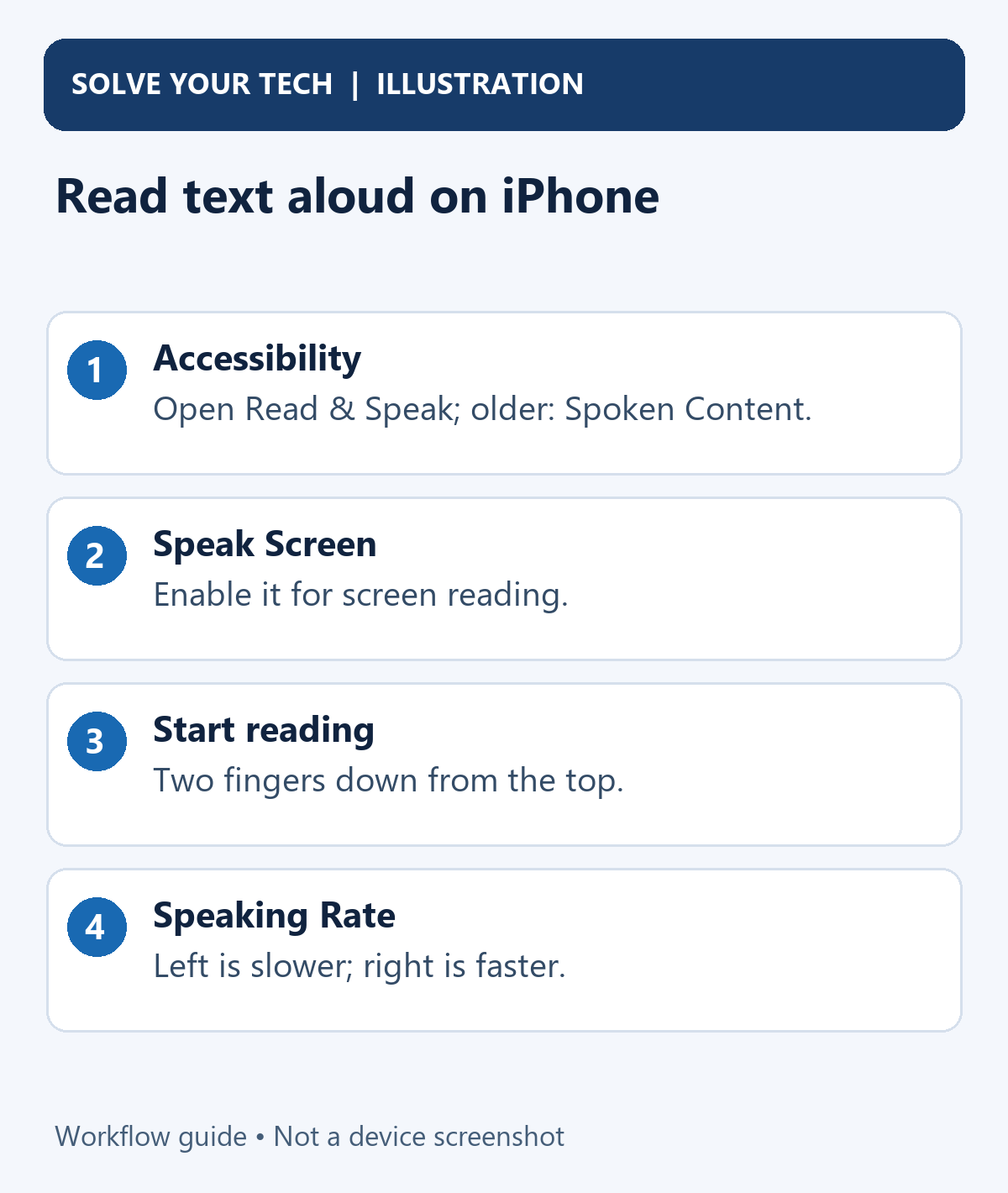
To slow down or speed up text reading on iPhone, open Settings > Accessibility > Read & Speak and move the Speaking Rate slider. To read the screen aloud, enable Speak Screen, then swipe down with two fingers from the top of the screen.
On older iOS versions, the same group of reading features is named Spoken Content. The current Read & Speak controls include Speak Screen, Speak Selection, voices, language choices, and reading highlights. They are separate from VoiceOver and Voice Control.
Choose the reading feature you need
| Feature | What it does |
|---|---|
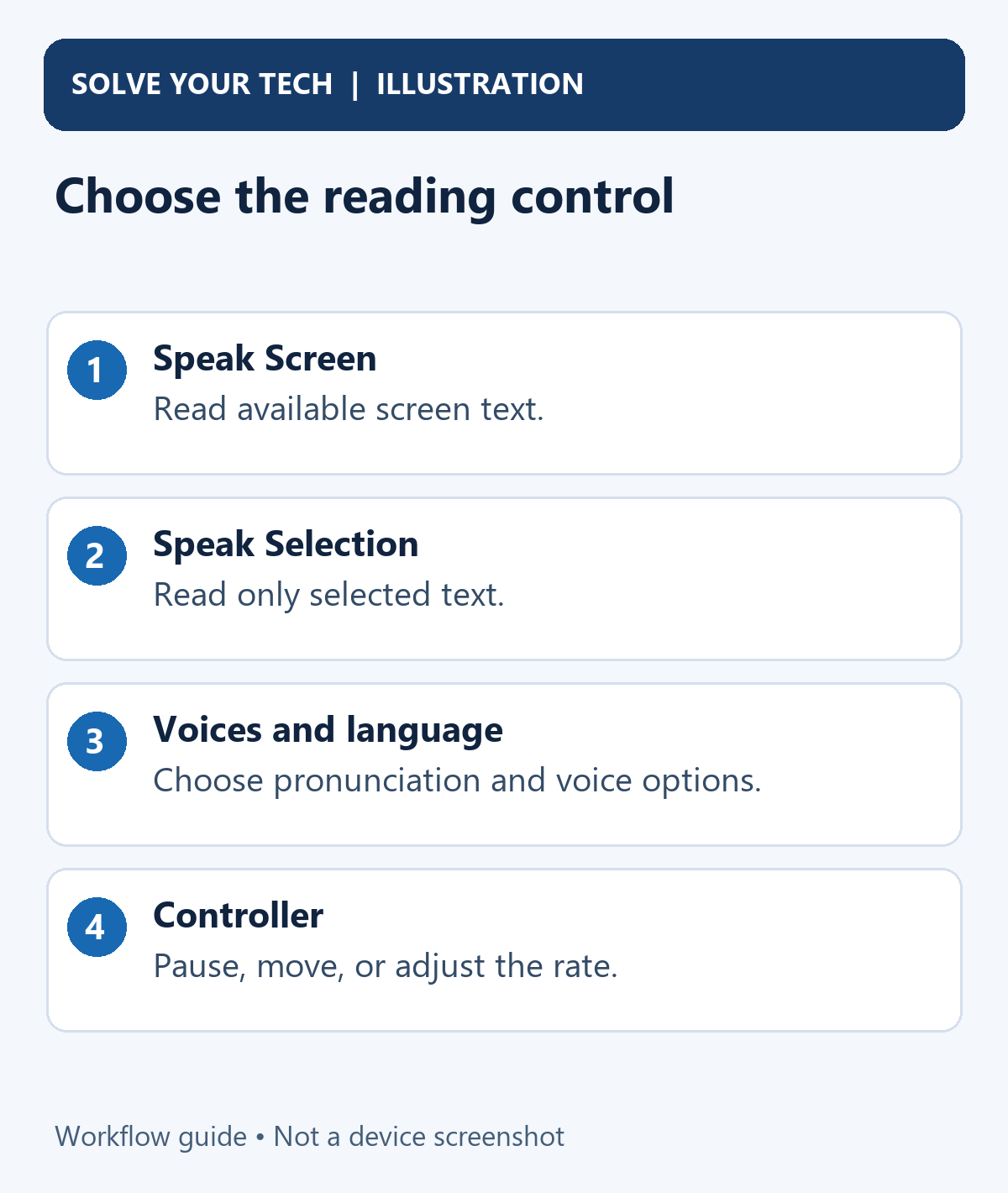
| Speak Screen | Reads available text on the current screen. |
| Speak Selection | Reads text you select and ask it to speak. |
| Speaking Rate | Adjusts the pace of the reading voice. |
| VoiceOver | Provides a broader screen-reader interface with different interaction gestures. |
| Voice Control | Lets you operate the phone with spoken commands. |
For a page or long message, begin with Speak Screen. For one paragraph or sentence, Speak Selection gives you a narrower choice. You do not need to enable VoiceOver just to hear a page read aloud.
Apple's Read & Speak guide documents the current features. If your settings use Spoken Content, follow that label instead of looking for a second identical menu.
Change the speaking rate
- Open Settings.
- Tap Accessibility.
- Tap Read & Speak, or Spoken Content on an older version.
- Find Speaking Rate.
- Drag the slider left to slow down or right to speed up.
- Read a short passage with the selected feature and adjust the rate again if needed.
Use the same paragraph when comparing settings. A comfortable pace depends on the voice, the language, and the material. Dense instructions often benefit from a slower rate than familiar prose; there is no single percentage that is best for everyone.
This setting affects supported spoken reading. It is not a speed control for music, recorded videos, podcasts, or every Siri response. Those sources have their own playback or voice settings.
Have iPhone read the screen
- In Read & Speak, turn on Speak Screen.
- Open a page or app containing text you want to hear.
- Swipe down with two fingers from the top of the screen.
- Use the reading controller to pause, continue, move through the content, or adjust the rate.
You can also ask Siri to “Speak screen” when Siri is available. The reading feature works with available screen text; it does not guarantee that every image, scanned document, protected page, or app exposes readable content.
The controller gives you a way to interrupt reading without disabling the feature altogether. If the reader starts from an inconvenient place, pause it, adjust the visible content or reading position using the available controls, and resume.
Within the Speak Screen settings, Show Controller can keep a convenient controller available. Supported versions also provide Speak on Touch and controller actions. Review the labels on your phone, since the arrangement varies across releases.
Read only selected text
- Turn on Speak Selection in Read & Speak.
- Open an app that allows text selection.
- Select the sentence or paragraph, adjusting the selection handles if needed.
- Tap Speak in the selection menu. Check additional menu options if the command is off-screen.
- Pause or stop the reading using the available controls.
Selecting text determines the scope. If you accidentally select one word, the reader will not necessarily read the whole paragraph you meant to hear. Check the selection before starting.
Some content does not support normal text selection. A picture containing words is not automatically the same as selectable text. If Speak Selection is unavailable, try Speak Screen on accessible page content or use a source that exposes the text directly.
Choose a voice and language
Open Voices in Read & Speak and choose the relevant language and available voice. Voice choices can include different dialects and download options. A downloaded voice may require storage and a connection before it becomes available.
Listen to a sample where offered, then compare the same passage with the new voice. A voice change can improve pronunciation or clarity, but it does not fix text that is missing from an app's accessible content.
The Default Language and Detect Languages choices help control how supported text is spoken. Review them if a passage is being read with the wrong pronunciation rules, particularly when a page contains more than one language.
For a recurring name or specialized term, the Pronunciations settings allow a pronunciation adjustment. Add the phrase and its intended pronunciation using the controls available on your version, then listen to the result. That is a more targeted change than altering the speed of every passage because one name sounds wrong.
Follow the text with highlights
The Highlighting settings can highlight words or sentences while they are spoken. Choose an available style and color that remain visible against the content's background.
Highlights can help you keep your place when switching between listening and reading. They do not change the document's formatting for other people; they assist your reading session.
If the page is cluttered with navigation or unrelated material, a cleaner reading view can help. Our Safari Reader guide explains the browser's article view where supported. Newer iOS versions also offer Accessibility Reader features; those are additional display and reading options rather than requirements for the basic two-finger gesture.
Troubleshooting speech and controls
The two-finger swipe does not start reading
Confirm Speak Screen is on, start at the top with two fingers, and try a page with ordinary text. A one-finger gesture can open a different system panel. If the gesture is difficult, try Siri's Speak screen command or the reading controller where available.
Speak is missing from the selection menu
Check that Speak Selection is enabled and that text is actually selected. Look through additional selection-menu options. The feature may not be available for an image or an app that does not allow text selection.
The voice is too quiet or seems silent
Check the playback volume and audio destination. Sound may be routed to Bluetooth headphones or another connected device. Volume and speaking rate are separate: slowing the slider does not make the voice louder.
The reading starts with navigation or unrelated text
Try a cleaner article view, select only the desired passage, or use the controller to move through the content. Speak Screen cannot infer your intended paragraph perfectly in every app.
My phone responds to different gestures now
Check whether VoiceOver was enabled by mistake. It changes how you interact with the interface and is a separate accessibility tool. Voice Control listens for commands; see turning off Voice Control if that is the feature you enabled.
If you prefer to magnify the text instead of hearing it, iPhone Zoom provides another accessibility approach.
Stop reading or undo your changes
Pause or close the current reading controller when you only want to stop the current session. To remove the gesture or selection command, return to Read & Speak and turn off Speak Screen or Speak Selection separately.
You can restore a previous voice or move Speaking Rate back to your preferred position without disabling the reading features. Change one setting at a time and listen to the same sample so you can tell which adjustment helped.
The practical result should be clear: the intended passage reads at a comfortable speed, through the expected audio device, with a voice and language suitable for the text.

Matthew Burleigh is the founder, head writer, and editor of Solve Your Tech, which he launched in 2012. He has written technology tutorials since 2008 and worked in IT since 2003, including small-business support, IT management, and consulting. He holds Bachelor’s and Master’s degrees in Computer Science from Arizona State University.
Matthew writes practical guides for Windows, iPhone and iPad, Microsoft Office, Outlook, Google apps, and Android. Solve Your Tech’s guides are tested on current devices or checked against official product documentation, with clear steps, sources, and update dates.
Read more about Matthew and how Solve Your Tech writes and updates its guides, or report a correction.