To restart an app on iPhone, open the App Switcher, find the app, and swipe up on it to close it. Then tap the app on the Home Screen or in App Library to open it again. Use this when an app is frozen or not responding. If it still responds, save your work and finish any uploads before closing it; unsaved changes may be lost.
This guide covers opening the App Switcher on every iPhone, closing and reopening an app, when closing apps actually helps, and what to try if the app still misbehaves. The steps follow Apple’s guide to quitting and reopening an app and its support article on closing apps.
How to Close and Restart an App on iPhone
- Open the App Switcher. On an iPhone with Face ID, swipe up from the bottom of the screen and pause in the middle. On an iPhone with a Home button, double-click the Home button.
- Swipe right or left to find the app you want to close.
- Swipe up on the app’s preview to close it.
- Go to the Home Screen or App Library and tap the app to open it again.
Check: Open the app again and try the feature that failed. If it responds normally, stop here. Closing and reopening can resolve a temporary problem, but does not guarantee a fix or save unfinished work.
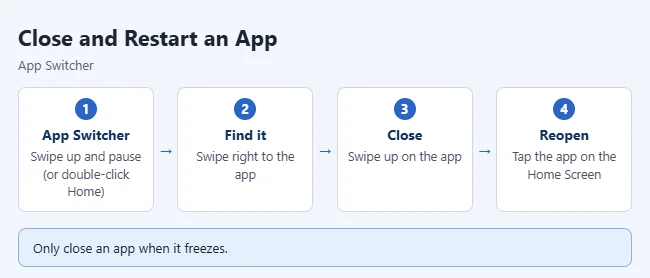
Which App Switcher steps do I use?
- iPhones with Face ID, including iPhone 13 and iPhone 14: swipe up from the bottom edge and pause until the app cards appear.
- iPhone SE, iPhone 8 and earlier (Home button): double-click the Home button to show recently used apps.
Choose the route for your phone’s controls: iPhone SE uses the Home-button method. A quick swipe to the Home Screen does not close an app; you must swipe its preview off the App Switcher.
Should You Close Apps You’re Not Using?
No. Apple says iPhone automatically manages how apps run in the background, so quitting apps you’re not using doesn’t prolong battery life. Its support article adds that closing all your apps doesn’t affect overall performance, because recently used apps only use resources when they’re active or doing specific background tasks.
Use closing and reopening for a specific unresponsive app. A row of recently used app cards does not mean every app is actively running, and clearing that row is not routine maintenance.
If the App Still Isn’t Working
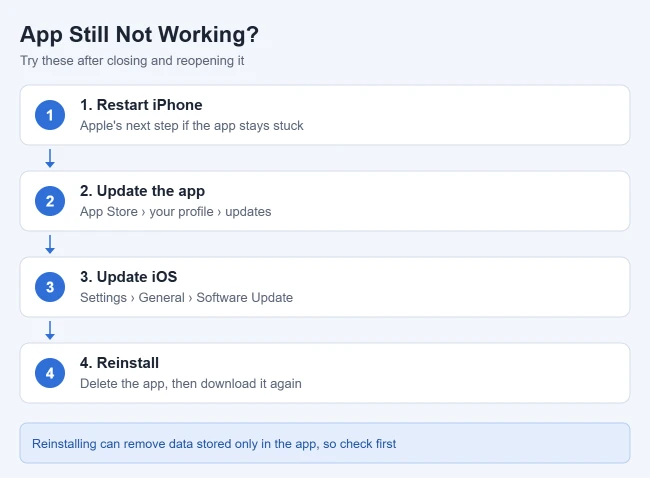
- Restart your iPhone. Apple suggests this if the app is still unresponsive after you quit and reopen it.
- Update the app. Open the App Store, tap your profile picture, then App Updates, and install any available update for the affected app.
- Check for an iOS update if no app update is available. Go to Settings › General › Software Update.
- Reinstall the app. Touch and hold the app icon, delete it, then download it again from the App Store. Check first whether the app saves your data to an account or iCloud, because some data may be lost.
Try the app again after each step. Reinstallation is a later option, so confirm that you can recover important local data before deleting anything. If the problem continues, contact the app’s developer. Apple’s app troubleshooting guide explains the escalation steps.
Frequently Asked Questions
Is there a Close All button on iPhone?
There is no built-in Close All button in the iPhone App Switcher. To dismiss additional apps, find and swipe up on each preview. Apple recommends closing an app only when it is unresponsive, so you do not need to empty the App Switcher before using your phone.
Does closing an app delete my data?
Closing an app does not uninstall it or erase its saved data. Unsaved work can be lost, however; there is no automatic-save guarantee. Deleting the app is a separate action and can remove data stored only in the app.
Does closing Safari close its tabs?
Closing Safari from the App Switcher is different from closing browser tabs. Use the browser controls described in our iPhone tab-closing guide when that is your goal.
More iPhone Guides
- How to find all apps installed on iPhone
- How to shut down an iPhone from Settings
- How to close apps on iPad

Matthew Burleigh is the founder, head writer, and editor of Solve Your Tech, which he launched in 2012. He has written technology tutorials since 2008 and worked in IT since 2003, including small-business support, IT management, and consulting. He holds Bachelor’s and Master’s degrees in Computer Science from Arizona State University.
Matthew writes practical guides for Windows, iPhone and iPad, Microsoft Office, Outlook, Google apps, and Android. Solve Your Tech’s guides are tested on current devices or checked against official product documentation, with clear steps, sources, and update dates.
Read more about Matthew and how Solve Your Tech writes and updates its guides, or report a correction.