To turn off Focus assist in Windows 11, where it is now called Do not disturb, press Windows key + N to open the notification center and select the bell icon with zZ on it. To keep it from coming back, open Settings > System > Notifications and clear the conditions under Turn on do not disturb automatically.
These steps follow Microsoft’s Notifications and Do Not Disturb in Windows and Focus: Stay on Task Without Distractions in Windows pages, checked in October 2026. They apply to current versions of Windows 11. Windows 10 has its own section near the end.
What Focus Assist Is Called Now
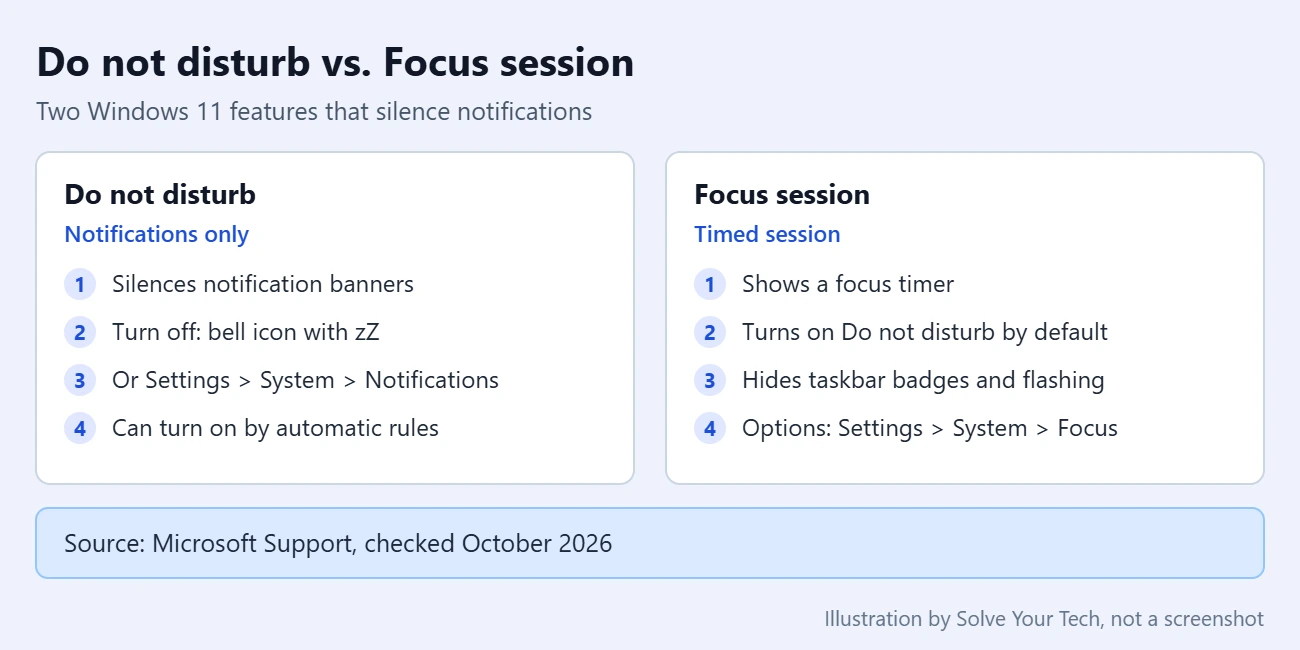
Windows 11 splits the old Focus assist feature into two parts. Do not disturb silences notification banners, which are the small alerts that slide onto the screen. Focus is a timed session that turns on Do not disturb for you while it runs. If notifications are missing, either one can be the cause, so it helps to check both.
How to Turn Off Do Not Disturb in Windows 11
- Select the clock or the notification bell on the taskbar, or press Windows key + N. The notification center opens on the right side of the screen.
- Select the bell icon with zZ on it. This is the same button that turns Do not disturb on.
Result: Banners appear again. Microsoft says you can then review any notifications you missed, which stay listed in the notification center.

Turn it off from Settings instead
Select Start > Settings > System > Notifications and turn off the Do not disturb switch. Microsoft describes this switch in Make it easier to focus on tasks. If you are not sure how to get there, see how to open Settings on Windows 11.
Stop Do Not Disturb From Turning On Automatically
Turning Do not disturb off by hand does not change its automatic rules. If one of them is still checked, Windows turns Do not disturb back on the next time that condition is met.
- Select Start > Settings > System > Notifications.
- Select Turn on do not disturb automatically to expand it.
- Uncheck each condition you don’t want. To stop it completely, uncheck all of them.
Microsoft lists five conditions. The exact wording on your PC may differ slightly.
| Condition | What it does |
|---|---|
| During certain times of the day | Turns Do not disturb on and off on a schedule you set |
| When duplicating the display | Silences banners while your screen is mirrored, such as to a projector |
| When playing a game | Silences banners during games |
| When using an app in full-screen mode | Silences banners while an app fills the whole screen |
| For the first hour after a Windows feature update | Keeps things quiet right after a large update |
Result: Do not disturb only turns on when you select the bell icon yourself or start a Focus session.

Check Your Focus Sessions
Microsoft says that when you start a Focus session, a focus timer appears, Do not disturb turns on, and flashing and badges on taskbar apps are turned off. You get a notification when the session ends, and Microsoft notes that you can end a session early. Its help page does not name the button, so look for the stop control on the focus timer or on the Focus page in Settings.
To keep future sessions from silencing notifications:
- Select Start > Settings > System > Focus.
- Clear Turn on do not disturb.
The same page has Hide badges on taskbar apps and Hide flashing on taskbar apps. To hide badges all the time, see how to remove the numbers from taskbar icons. One more detail from Microsoft: if Do not disturb was already on before a session started, it stays on after the session ends, so you still need to turn it off yourself.
Let Important Notifications Through Instead
You don’t have to turn Do not disturb off to get the alerts that matter. Microsoft says that with it on, you still get banners for alarms, reminders and apps you choose, and everything else goes to the notification center.
- Select Start > Settings > System > Notifications, then select Set priority notifications if you see it.
- Under Calls and reminders, check the boxes to allow incoming calls or reminders.
- Under Apps, select Add apps and pick the apps that may still show banners.
If the alert you are waiting for is a reminder, our Windows 11 reminders guide shows how to create one and test that it arrives.
Windows 10: Focus Assist
Microsoft ended support for Windows 10 on October 14, 2025, and its current help pages describe this feature under the Do not disturb name. On a Windows 10 PC the setting is still labeled Focus assist. It is normally found at Settings > System > Focus assist, where Off lets every notification through and Priority only and Alarms only limit them. The Automatic rules section on that page holds the switches that turn it on by itself. We could not confirm these Windows 10 labels in Microsoft’s current documentation, so your screen may differ.
If Notifications Still Don’t Appear
- The bell icon is not there. Open the notification center with Windows key + N, or use the Do not disturb switch in Settings instead.
- It turns back on later. An automatic rule is still checked, or a Focus session started. Review both Settings pages above.
- Do not disturb is off but one app stays silent. In Settings > System > Notifications, make sure the main Notifications switch is on, then select the app under Notifications from apps and other senders and check that its notifications and banners are on.
- A setting is grayed out. On a work or school PC, your organization may manage notification settings. Ask your IT administrator.
Frequently Asked Questions
Why does Do not disturb keep turning on?
Usually because an automatic rule is checked, such as playing a game or using a full-screen app, or because a Focus session started. Uncheck the rules under Turn on do not disturb automatically and clear Turn on do not disturb on the Focus page.
Do I lose notifications that arrived while Do not disturb was on?
No. Microsoft says notifications that are not shown as banners are sent to the notification center. Press Windows key + N to read them.
Can I turn off notifications completely instead?
Yes. Go to Settings > System > Notifications and turn the Notifications switch off, or turn notifications off for individual apps in the list below it. This is the opposite of turning off Do not disturb, so only do it if you want fewer alerts.
More Windows Guides

Matthew Burleigh is the founder, head writer, and editor of Solve Your Tech, which he launched in 2012. He has written technology tutorials since 2008 and worked in IT since 2003, including small-business support, IT management, and consulting. He holds Bachelor’s and Master’s degrees in Computer Science from Arizona State University.
Matthew writes practical guides for Windows, iPhone and iPad, Microsoft Office, Outlook, Google apps, and Android. Solve Your Tech’s guides are tested on current devices or checked against official product documentation, with clear steps, sources, and update dates.
Read more about Matthew and how Solve Your Tech writes and updates its guides, or report a correction.