To turn off AirDrop receiving on an iPad, open Settings, tap General, tap AirDrop, and choose Receiving Off. You can also do it from Control Center: swipe down from the top-right corner, touch and hold the group of connectivity controls, tap AirDrop, and choose Receiving Off. After that, nobody can send photos or files to your iPad with AirDrop.
These steps are for iPadOS 27, and the AirDrop menus are the same in iPadOS 26 and recent earlier versions. They apply to every iPad model that supports AirDrop, including iPad, iPad mini, iPad Air, and iPad Pro, with or without a Home button. If you’d rather keep getting files from people you know, choose Contacts Only instead.
Turn Off AirDrop Receiving in Settings
Use this method when you want the change to be easy to find and check later.
- Open the Settings app on your iPad.
- Tap General in the left column.
- Tap AirDrop on the right. You’ll see the receiving options with a check mark next to the current one.
- Tap Receiving Off. The check mark moves to that option.
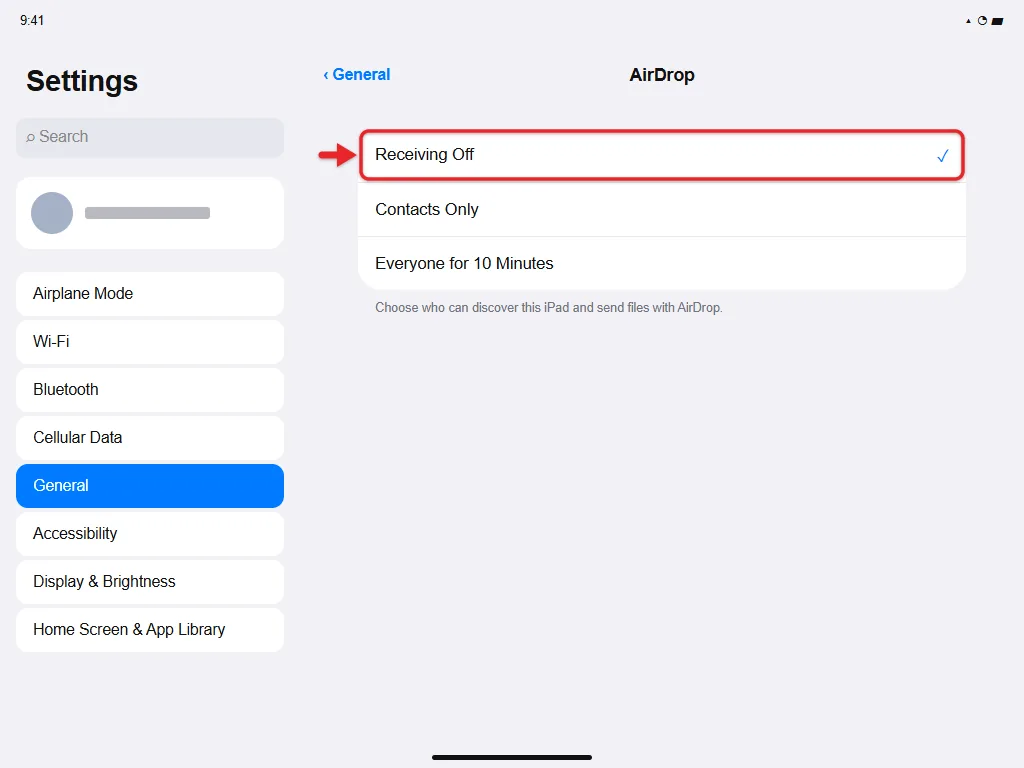
The change takes effect right away, and there is no Save button. Your iPad no longer shows up as a destination when people nearby open the AirDrop share sheet. The setting stays in place after a restart and doesn’t switch back on by itself.
Turn Off AirDrop Receiving in Control Center
This is quicker when you’re in the middle of something.
- Swipe down from the top-right corner of the screen to open Control Center. This works the same way on iPads with a Home button.
- Touch and hold the group of connectivity controls in the top-left corner (the box with Airplane Mode, Wi-Fi, and Bluetooth). The group expands.

- Tap the AirDrop button.
- Tap Receiving Off. The AirDrop icon turns gray.

Swipe up or tap an empty area to close Control Center. Apple describes this same Control Center route in its AirDrop support article. If you don’t see the connectivity group, it may have been removed from your Control Center layout. Use the Settings method instead, or add the controls back by editing Control Center.
What Each AirDrop Receiving Option Does
- Receiving Off: No one can send you anything with AirDrop. You can still send items to other people.
- Contacts Only: Only people saved in your Contacts app can send to you. For this to work, the contact card needs the email address or phone number linked to their Apple Account.
- Everyone for 10 Minutes: Anyone nearby can send to you for 10 minutes. After that, your iPad switches back to Contacts Only if you’re signed in to an Apple Account, or to Receiving Off if you’re not.
Contacts Only is a good middle ground if your goal is to stop strangers from sending you things in a classroom, office, or airport, but you still share photos with family.
How to Check That It Worked
Open Settings > General > AirDrop and look for the check mark next to Receiving Off. In Control Center, the AirDrop button in the expanded connectivity group should be gray and say Receiving Off under its name.
If you want to test it, ask someone nearby with an iPhone or Mac to open the Share sheet and tap AirDrop. Your iPad shouldn’t appear in their list of people and devices.
Can You Still Send Files With Receiving Off?
Yes. Receiving Off only controls whether other devices can send to your iPad. You can still open the Share sheet in Photos, Files, or another app, tap AirDrop, and send to a nearby iPhone, iPad, or Mac, as long as Wi-Fi and Bluetooth are on. The person you’re sending to needs their own receiving setting to allow you. Apple also says to disconnect Personal Hotspot if either device is using it.
AirDrop only reaches Apple devices, so for a PC, use one of the AirDrop alternatives for Windows 11.
Other Ways to Block AirDrop on an iPad
Turn off Wi-Fi or Bluetooth. AirDrop needs both, so turning either one off in Settings stops AirDrop completely, including sending. Turning off Bluetooth also disconnects AirPods, keyboards, and the Apple Pencil, so this is usually overkill. If you still want to do it, here’s how to turn Bluetooth on or off on an iPad.
Block AirDrop with Screen Time. On a child’s iPad, or any iPad where you don’t want someone switching AirDrop back on, use Screen Time’s content and privacy restrictions. On the iPad itself, start in Settings > Screen Time. If you manage a child’s iPad through Family Sharing, Apple now starts this from Settings > Family, then your child’s name.
Open Content & Privacy Restrictions, enter your Screen Time passcode if asked, and turn off AirDrop in the list of allowed apps and features. Once AirDrop is blocked, the option disappears from Settings and Control Center until someone enters the Screen Time passcode to change it. For help setting a Screen Time passcode, read about Screen Time restrictions on iPhone and iPad.
How AirDrop Protects You When Receiving Is On
If you decide to leave AirDrop on, a few safeguards apply:
- You choose whether to accept. When someone sends you an item, your iPad shows a preview with Accept and Decline buttons. Nothing is saved until you accept, unless the item comes from another device signed in to your own Apple Account.
- Strangers need a code. When both devices run iPadOS 26.2 or iOS 26.2 or later, someone who isn’t in your contacts is asked for an AirDrop code. You tap Get AirDrop Code and tell them the code to enter. After that, they’re added to the Other Known list in Contacts for 30 days, and you can mark them as unknown sooner in Contacts. Apple’s AirDrop support article has more about the code.
- Everyone mode times out. Everyone for 10 Minutes turns itself off, so you don’t stay open to strangers by accident.
If AirDrop Receiving Won’t Stay Off or the Option Is Missing
The setting changed back on its own. Check that you chose Receiving Off and not Everyone for 10 Minutes. The 10-minute option always changes back to Contacts Only or Receiving Off after it times out. If someone else uses the iPad, they may have switched it back; a Screen Time restriction stops that.
AirDrop is grayed out or missing. A Screen Time restriction or a school or work management profile may be controlling it. Check the Screen Time restrictions described above. On a school-managed or work-managed iPad, ask the administrator, because the setting may be locked on purpose.
People can still see your iPad’s name. Your iPad may still show up in other places, such as Find My or a Bluetooth list, but it won’t appear as an AirDrop destination once receiving is off. To pick the name others see when you do share, change your AirDrop name. On an iPad, the AirDrop name comes from Settings > General > About > Name.
iPad AirDrop Questions
Does turning off AirDrop receiving turn off Wi-Fi or Bluetooth?
No. Receiving Off only affects AirDrop. Wi-Fi, Bluetooth, and your connected accessories keep working.
Why does my AirDrop keep switching to Contacts Only?
You probably chose Everyone for 10 Minutes. When the 10 minutes end, your iPad switches to Contacts Only if you’re signed in to an Apple Account. Choose Receiving Off if you want AirDrop to stay off.
Will I lose files people already sent me?
No. Items you already accepted stay in Photos, Files, or whichever app opened them. Turning off receiving only blocks new transfers.
Does turning off AirDrop stop other ways of sharing?
No. Messages, Mail, shared albums, and iCloud Drive work the same as before. Only nearby AirDrop transfers to your iPad are blocked.
How do I turn AirDrop receiving back on?
Go back to Settings > General > AirDrop or the AirDrop button in Control Center and choose Contacts Only or Everyone for 10 Minutes.

Matthew Burleigh is the founder, head writer, and editor of Solve Your Tech, which he launched in 2012. He has written technology tutorials since 2008 and worked in IT since 2003, including small-business support, IT management, and consulting. He holds Bachelor’s and Master’s degrees in Computer Science from Arizona State University.
Matthew writes practical guides for Windows, iPhone and iPad, Microsoft Office, Outlook, Google apps, and Android. Solve Your Tech’s guides are checked step by step against the device or app maker’s own documentation and tested on his own devices whenever he has the hardware or software, with clear steps, sources, and update dates.
Read more about Matthew and how Solve Your Tech writes and updates its guides, or report a correction.