To stop notifications from one iPhone app, open Settings > Notifications, tap the app, and turn off Allow Notifications. To quiet everything for a while instead, open Control Center, tap Focus, and turn on Do Not Disturb.
These steps use the menu names in iOS 27. The same paths work in iOS 26 and iOS 18, and Apple Intelligence options are noted where they apply.
Each method silences something different. Turning off an app’s notifications stops its alerts until you turn them back on. Turning off its sound keeps the alerts but makes them quiet. A Focus such as Do Not Disturb quiets many apps for a set time and lets you pick exceptions. Silent Mode only mutes sounds, so the screen still lights up.
Choose How Much to Silence
| Your goal | Setting to use | How to undo it |
|---|---|---|
| No alerts at all from one app | Allow Notifications off for that app | Turn Allow Notifications back on. |
| A short break from one noisy app | Mute for 1 Hour or Mute for Today on one of its notifications | Wait for it to end, or tap Unmute. |
| Alerts without the app’s sound | Sounds off for that app | Turn Sounds back on or pick a tone again. |
| Fewer interruptions, but read them later | Scheduled Summary | Turn Scheduled Summary off. |
| Quiet for a meeting, a night, or a set schedule | Do Not Disturb or another Focus | Turn off the Focus and check its schedule. |
| Quiet for one text conversation | Hide Alerts in that conversation | Turn Hide Alerts off. |
| No ringing or alert sounds, but the screen still shows alerts | Silent Mode | Turn Silent Mode off. |
Turn Off Notifications for One App
- Open Settings on your iPhone, then tap Notifications.
- Scroll to the list of apps and tap the one whose alerts you want to stop.
- Turn Allow Notifications off. The other options on the screen disappear, and the app stops sending alerts right away. Repeat for any other app you want to quiet. Some apps also have their own alert settings, such as Instagram notifications and ESPN Fantasy Football app notifications.

Turning this permission off does not stop the app from working, and it does not create a quiet queue of new notifications in Notification Center. You may still find messages, updates, or activity inside the app itself, depending on how that app works. Alerts you missed while it was off usually won’t show up when you turn it back on. On an Android phone, the matching switch is under Settings, Notifications, App notifications, as explained in the Android notification bar guide.
For a worked example with a streaming app, the article on turning off Netflix notifications on iPhone also covers Netflix’s own category settings.
Some apps let you quiet one part instead of the whole app. For example, you can turn off notifications from one Discord server and keep direct messages coming.
To resume alerts, return to the same app’s notification settings, turn on Allow Notifications, and choose the alert locations and sound you want. Apple documents the app-level controls in its notification settings guide.
Mute an App for an Hour or the Rest of the Day
When one app is noisy right now but you still want its alerts tomorrow, mute it from one of its notifications. You don’t need to open Settings. Facebook also has its own in-app sound and push sound switches, covered in muting sounds in the Facebook app.
- Find a notification from that app on the Lock Screen or in Notification Center. To open Notification Center, swipe down from the top left of the screen.
- Swipe left on the notification (or the stack of notifications), then tap Options.
- Tap Mute for 1 Hour or Mute for Today. The app’s alerts go quietly to Notification Center until the time is up.
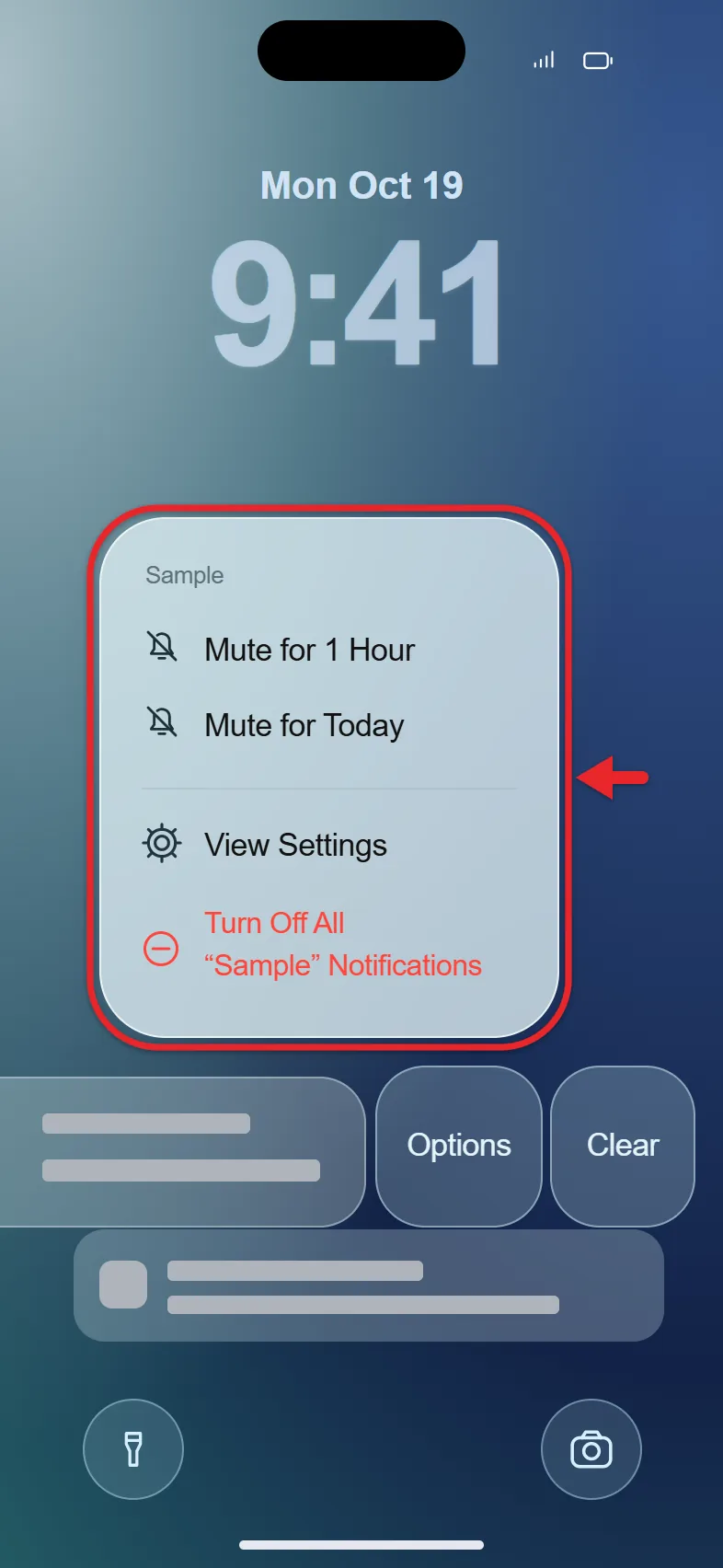
The same Options menu also has Turn Off, which does the same thing as turning off Allow Notifications, and View Settings, which opens that app’s notification page. These choices also appear in Apple’s guide to using notifications on iPhone. To end a mute early, swipe left on one of the app’s notifications, tap Options, then tap Unmute.
Keep Notifications but Remove Sound or Banners
Under Settings > Notifications, tap the app and keep Allow Notifications on. Turn off Sounds if that control is available, or choose None for apps that offer a tone picker, such as Messages. Sounds also stay off while your iPhone is in Silent Mode or the volume is all the way down.
If the red number on the app icon is what bothers you, you can turn off badges for that app and keep its alerts.
For the App Store, the badge counts waiting updates, so you can also clear the number on the App Store icon by installing them.
To keep alerts in Notification Center without showing a pop-up or a Lock Screen alert, leave Notification Center selected and deselect Banners and Lock Screen. Adjust Badges separately if you also want to remove the number on the app icon.
This is the closest thing to “deliver quietly”: the alerts wait for you without making noise or lighting up the screen. Available options differ between apps. Mail also has separate alert settings for VIP senders, so you may also want to try turning off VIP mail alerts on the Lock Screen.
To read those quiet alerts later, find out where Notification Center is on iPhone.
If the problem is that alerts show your message text to anyone near your phone, go to Settings > Notifications > Show Previews and choose When Unlocked or Never. The alerts still arrive, but the Lock Screen hides what they say.
Get Notifications in a Few Batches With Scheduled Summary
Scheduled Summary collects alerts from the apps you choose and delivers them together at set times, such as 8:00 AM and 6:00 PM. It suits social, shopping, and news apps you want to check, just not all day.
- Go to Settings > Notifications > Scheduled Summary and turn on Scheduled Summary.
- Pick the apps you want included.
- Set the delivery times. You can add more than one summary per day.
Alerts from apps outside the summary keep arriving as usual. Notifications an app marks as Time Sensitive can still come right away, so check that app’s Time Sensitive Notifications switch if one keeps slipping through.
Use Do Not Disturb for Temporary Quiet
- Open Control Center: swipe down from the top-right corner on an iPhone with Face ID, or up from the bottom edge on an iPhone with a Home button.
- Touch and hold Focus, then tap Do Not Disturb to turn it on. A moon icon appears in the status bar.
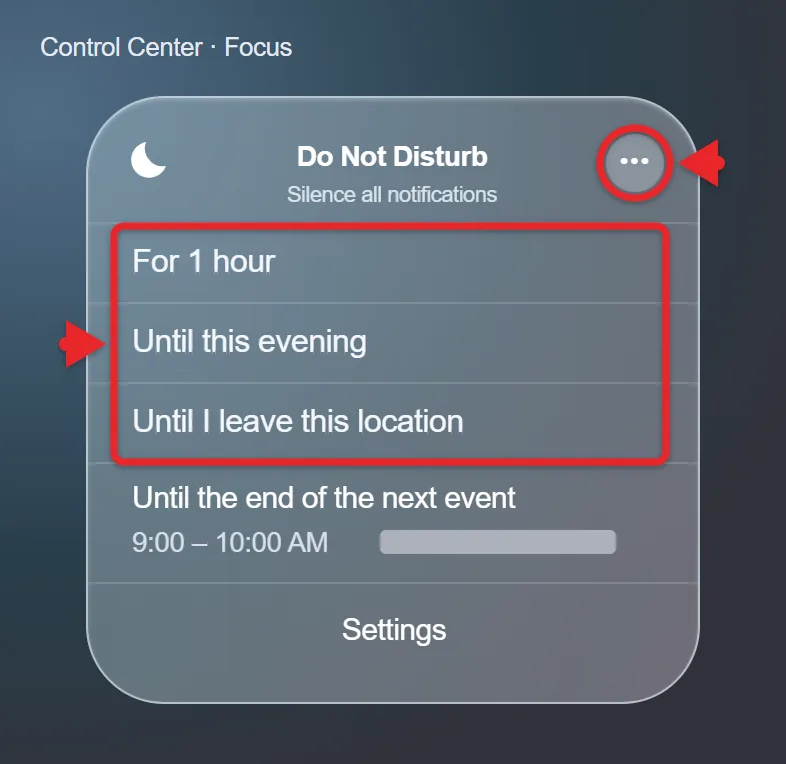
- To set a time limit, tap the More button (three dots) next to Do Not Disturb and choose an option such as For 1 hour or Until this evening.
To turn it off, open Control Center and tap the Do Not Disturb icon on the Focus button. Apple’s Do Not Disturb support article covers both routes.
For repeated quiet periods, go to Settings > Focus > Do Not Disturb and tap Set a Schedule to choose on and off times. The Do Not Disturb setup instructions cover schedules and exceptions. If Do Not Disturb keeps turning on by itself, a schedule is the usual reason, so turn it off on that same screen. A Lock Screen linked to a Focus can also turn it on when you switch to that wallpaper.
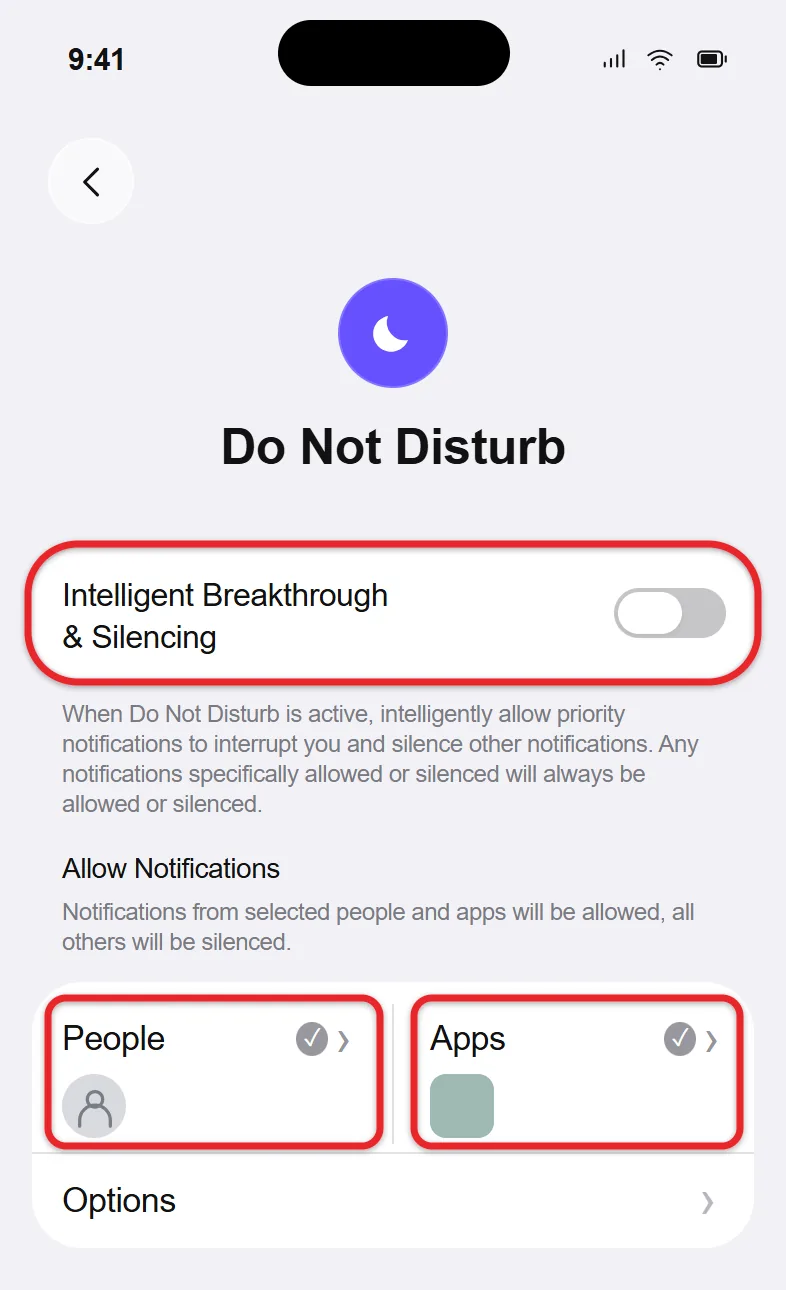
Review People and Apps in that Focus before you count on it for quiet. Allowed contacts, calls, or apps can still interrupt you. A Silence Notifications From list silences the selected entries; an Allow Notifications From list permits only the selected entries instead. If you rely on Sound Recognition alerts, check that the Focus you use lets them through.
If Share Across Devices is on in Settings > Focus, turning on Do Not Disturb on your iPhone also turns it on for your iPad, Mac, and Apple Watch signed in with the same Apple Account. Turn it off if you want each device to stay separate.
Why Some Alerts Still Get Through a Focus
If your phone keeps buzzing during Do Not Disturb, check these settings in order:
- Allowed people and apps. Open Settings > Focus, tap the Focus, and review People and Apps. Anyone on an allow list can reach you.
- Calls. Under People, check Allow Calls From and Allow Repeated Calls. With repeated calls allowed, a second call from the same number within three minutes rings through.
- Time Sensitive notifications. Apps can mark some alerts as Time Sensitive. Turn off Time Sensitive Notifications in the Focus’s Apps settings, or in a single app’s notification settings.
- Emergency Bypass. In Contacts, open a person, tap Edit, then Ringtone or Text Tone. If Emergency Bypass is on, that person’s calls or texts make sound even during a Focus or Silent Mode.
- Critical Alerts. Some health, home security, and safety apps can request Critical Alerts, which play a sound even when your iPhone is muted. Turn it off in that app’s notification settings if you don’t want it.
- Intelligent Breakthrough & Silencing. On iPhones with Apple Intelligence, this option in Settings > Focus > Do Not Disturb lets alerts it judges important interrupt you. Turn it off for a strict Focus.
- Notify Anyway. If Focus Status is shared, people texting you in Messages can see that you have notifications silenced and choose to send an urgent alert anyway. Turn off Focus Status in Settings > Focus to remove that option.
Mute Only One Messages Conversation
Open the chat in Messages, tap the contact or group name at the top, and turn Hide Alerts on. You can also swipe left on the conversation in your list and tap the bell button. New messages still arrive, but that conversation stops making alerts, and a crossed-out bell appears next to it. Turn the same switch off to undo it. The article on muting a text conversation has more Messages options.
If a text alert keeps repeating after you’ve seen it, the Repeat Alerts setting for Messages is the cause. The article on repeat text message alerts on iPhone shows where to set it to Never. To keep text sounds but change the buzz, pick a different text message vibration.
Silence Calls From Numbers You Don’t Know
Spam calls are a different setting from app notifications. Turn on Silence Unknown Callers in the Phone app’s settings to send numbers that aren’t in your contacts, your recent outgoing calls, or Siri Suggestions to voicemail without ringing. The article on silencing unknown callers on iPhone shows where it is in current iOS. Calls still appear in your recent list, so you can call back anyone you missed.
Does Silent Mode Stop Everything?
No. Silent Mode mutes ringtones and alert sounds, but notifications still appear on the screen and the phone can still vibrate. How you turn it on depends on your model:
- iPhone with an Action button (iPhone 15 Pro and later Pro models, iPhone 16 and later, iPhone 16e, and iPhone 17e): press and hold the Action button. Apple sets it to Silent Mode by default. If it opens something else, go to Settings > Sounds & Haptics > Silent Mode instead, or reassign the button in Settings > Action Button.
- iPhone with a Ring/Silent switch: push the switch toward the back of the phone so orange is visible.
Which models have each control is shown in Apple’s guide to the Action button, side button, and other controls. Calls have their own options for silencing or unsilencing iPhone calls. If the phone blinks when an alert arrives, that is a separate setting, covered in how to turn flash notifications off on iPhone.
To keep a buzz for calls and texts while silenced, put your iPhone on vibrate mode with the Haptics setting.
Haptics can still occur according to your settings (the article on turning off vibration on an iPhone covers those switches), and media, games, and some app sounds may still play. These limits are spelled out in Apple’s Silent Mode guide. Clock alarms are separate: Do Not Disturb and Silent Mode do not disable their sound, as described in Apple’s alarm guide.
Turning the volume down is not the same as Silent Mode. A low volume can still let alerts chime quietly, while Silent Mode stops ringtones and alert sounds entirely.
Stop Siri Announcing Notifications on AirPods
Go to Settings > Notifications > Announce Notifications and turn it off. Siri stops reading notifications aloud through AirPods and other compatible headphones, but your notifications themselves don’t change. You can also turn it off for single apps on that same screen, or turn off announcements in CarPlay. Apple’s Announce Notifications guide also covers the Control Center shortcut.
Turn Off AMBER Alerts
AMBER and other government alerts have their own switches. Go to Settings > Notifications, scroll to Government Alerts at the bottom, and turn off AMBER Alerts. Some alert types can’t be turned off, and the options depend on your country and carrier. Focus and Silent Mode don’t control these alerts. Leave emergency and public safety alerts on unless you have a good reason to turn them off.
If You Later Want Alerts Back
Undo the setting you changed: the app’s notification permission, Sounds, a temporary mute, Scheduled Summary, Hide Alerts, or the active Focus. If quiet periods keep returning, review Focus schedules and Share Across Devices. Steps for fixing notifications silenced on iPhone help identify which setting is responsible.
To confirm it worked, ask someone to send you a text or wait for the app’s next alert. If it still doesn’t show up, restart your iPhone and check the app’s own settings, since some apps have a separate notification switch inside the app.
iPhone Notification Questions
Will silencing notifications stop my alarm?
No. Alarms you set in the Clock app still sound during Do Not Disturb, any other Focus, and Silent Mode.
Can I silence notifications from every app at once?
There is no single switch that turns off Allow Notifications for all apps. For quiet across everything, turn on Do Not Disturb, or create a Focus that allows no people or apps. You still need to visit each app in Settings > Notifications to turn its notifications off for good.
Can people tell that I silenced my notifications?
Only if Focus Status is shared. Then Messages can show “has notifications silenced” to people who text you. Turn off Focus Status in Settings > Focus if you don’t want to share it. Hiding alerts for one conversation or turning off an app’s notifications doesn’t tell anyone.
Do notification settings sync to my iPad?
A Focus syncs when Share Across Devices is on. Per-app settings in Settings > Notifications do not sync, so change them on each device.
Does turning off notifications for an app stop it from working?
No. The app keeps working, syncing, and receiving messages. You just won’t get alerts until you open it.

Matthew Burleigh is the founder, head writer, and editor of Solve Your Tech, which he launched in 2012. He has written technology tutorials since 2008 and worked in IT since 2003, including small-business support, IT management, and consulting. He holds Bachelor’s and Master’s degrees in Computer Science from Arizona State University.
Matthew writes practical guides for Windows, iPhone and iPad, Microsoft Office, Outlook, Google apps, and Android. Solve Your Tech’s guides are checked step by step against the device or app maker’s own documentation and tested on his own devices whenever he has the hardware or software, with clear steps, sources, and update dates.
Read more about Matthew and how Solve Your Tech writes and updates its guides, or report a correction.