If you are still signed in to Facebook anywhere, open Settings & privacy > Settings > Accounts Center > Personal details > Contact info to see every email and phone number on the account. If you are signed out, search your inboxes for mail from Facebook and try each address on the Find your account page.
You need to log in to Facebook on a new phone or reset your password, but you can’t remember which email address is tied to the account.
Start From Where You Are Signed In
The fastest answer depends on one question: is Facebook still logged in on any phone, tablet or computer you own? Check the Facebook app on your phone, any other browser you use, a work laptop or an old tablet in a drawer. Facebook often stays signed in on a device until someone logs out, so there may be a session you’ve forgotten about.
- Signed in somewhere: the contact info section lists the account’s email addresses directly. Use the steps in the next two sections.
- Signed out everywhere: Facebook won’t display the email to you, so you work it out from your inboxes and the Find your account screen. Skip to the signed-out section.
Facebook is moving people to a newer settings area. According to Facebook’s Help Center, some accounts see Accounts Center and others see Meta Account settings as the place to manage account details, so your screen may use either name. The contact info lives inside whichever one you have.
Find the Email on a Computer
- Go to facebook.com in your browser and confirm you are on your own account.
- Click your profile picture in the top right corner.
- Click Settings & privacy, then Settings.
- Click Accounts Center (or Meta Account settings if that is what you see).
- Click Personal details.
- Click Contact info. Every email address and mobile number connected to the account appears in the list.
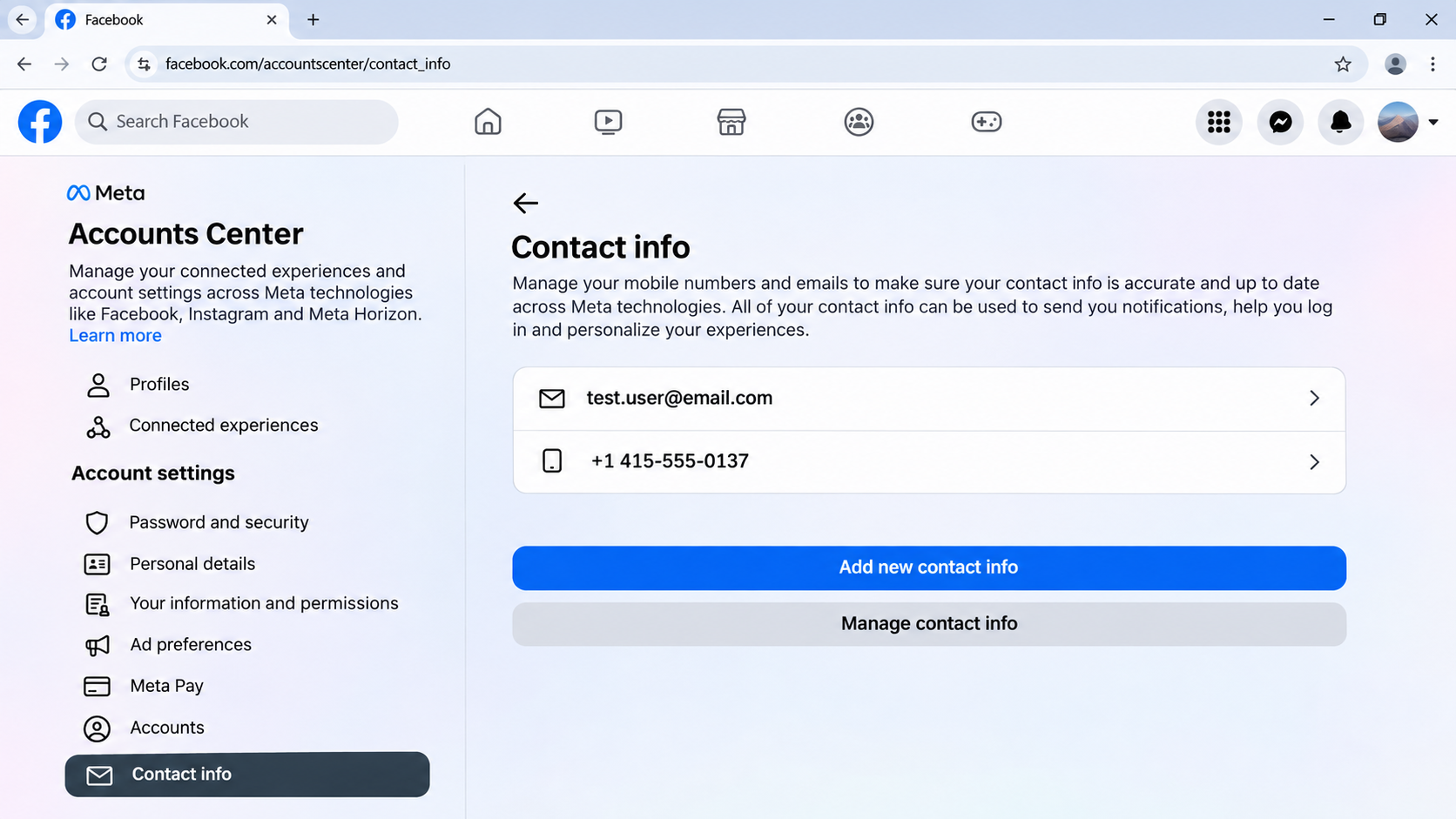
Facebook’s help page on how to add or remove an email from your Facebook profile uses the same path and has the add and delete steps covered below. Write the address down or save it in a password manager before you leave the page.
Find the Email in the Facebook App
The app on iPhone and Android leads to the same Accounts Center screen. Where the menu button sits depends on your phone and app version (it is usually your profile picture or a three-line icon at the top or bottom of the screen), so look for that first.
- Open the Facebook app and tap the menu.
- Tap Settings & privacy, then Settings.
- Tap Accounts Center (or Meta Account settings). It is usually near the top of the settings screen.
- Tap Personal details, then Contact info.
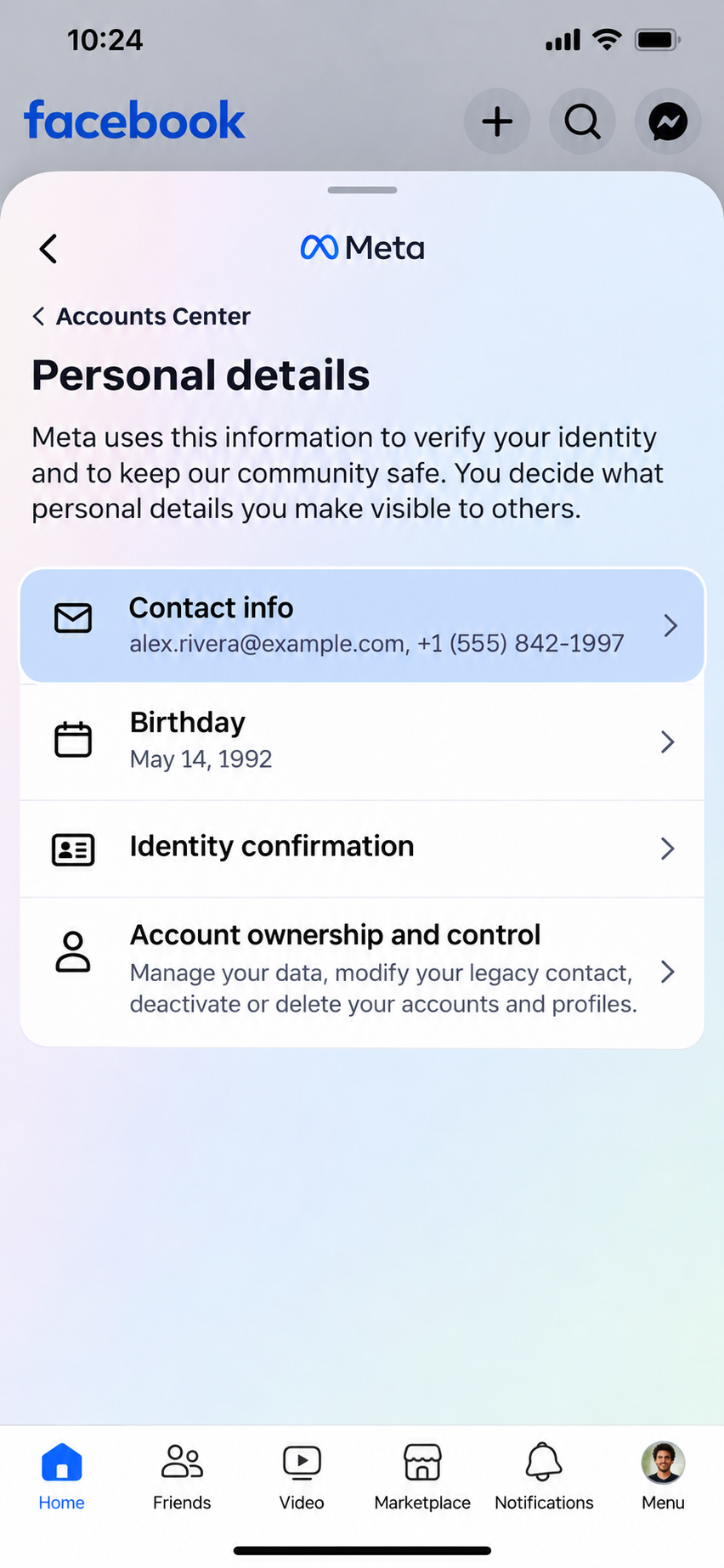
If you can’t find Accounts Center and your settings screen has a search box, type “contact info” or “email” into it.
If Contact Info Shows No Email or Several
No email at all. Many people sign up with a mobile number only. If Contact info lists a phone number and no email, the account has no email to remember. You log in and reset your password with that number instead. It is still worth adding an email as a backup in case you change numbers.
More than one email. Any confirmed address on the list should work on Find your account. Facebook lets you choose which one is the primary email. If you see an old school or work address you no longer control, remove it so a stranger who later gets that address can’t use it to reset your password.
An address you don’t recognize. If the list includes an email you never added, someone else may have had access to the account. Change your password right away and follow the steps to secure a hacked Facebook account before you do anything else.
If You Are Signed Out Everywhere
Facebook doesn’t reveal the email on an account to someone who isn’t signed in, which protects you from strangers fishing for your address. Instead, narrow it down from your side, then let Facebook confirm the match.
Search Every Inbox for Mail From Facebook
The address that receives Facebook’s emails is almost certainly the one on the account. In each email account you have ever used (Gmail, Outlook, Yahoo, an old internet provider address, a work account), search for “Facebook.” Look for a sign-up confirmation message, password reset emails, login alerts or notification digests. Facebook’s Help Center also has a page about finding your signup confirmation email.
Here’s how that plays out. Darius has three addresses: a current Gmail, a Hotmail address from college and a work account. A search for “Facebook” in Gmail finds nothing, but the Hotmail inbox has years of birthday reminders. That tells him which address to try first. Check spam and archive folders too, since automatic filters often hide these messages.
Be careful with what you find. Scammers send fake “Facebook security” emails, so don’t click a link in an old message to reset anything. Facebook has a help page on checking whether an email is really from Facebook, and the safe habit is to type facebook.com into the browser yourself.
Try Each Address on Find Your Account
- Open the Find your account page in a browser.
- In the Mobile number or email box, type one address you suspect.
- Click Continue.
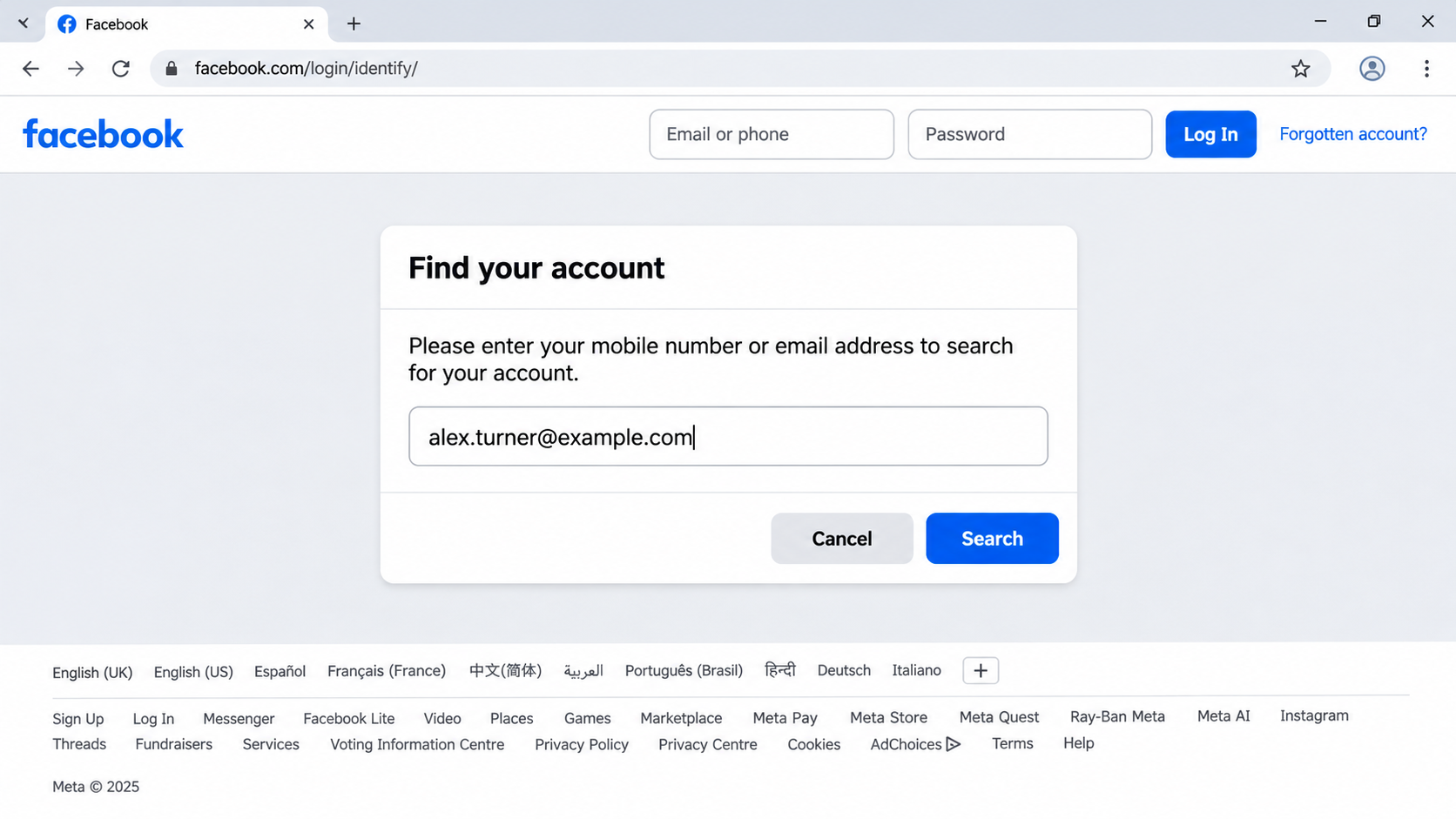
- If Facebook finds an account, you have your answer: that address is on it. Follow the prompts to get a code and reset your password.
- If nothing is found, try the next address, then your mobile number.
This screen asks only for a mobile number or email. It doesn’t search by your name, so you can’t look up an account from a name here. Type addresses carefully, since a single wrong letter (gmail versus gmial) returns no match.
Check Saved Passwords and Other Devices
- Browser or phone password manager: open the saved passwords list in Chrome, Edge, Safari, Firefox or your phone’s password settings, and search for “facebook.” The saved entry shows the username, which is often the email.
- A separate password manager: search the vault for Facebook in the same way.
- A family member’s device: if you once logged in on someone else’s tablet, the session might still be open there. Use it only to check your own Contact info.
Avoid websites that offer to look up the email behind a Facebook profile. They can’t see your private account details, and typing your information into them only exposes it to more people. Facebook’s own screens are the only reliable source.
If You Can’t Get Into That Email Anymore
Sometimes you figure out the address but the inbox is gone: a deleted Hotmail account, an old job or an internet provider you left. Try the mobile number on Find your account instead, since a code by text works just as well. If neither the email nor the phone works, Facebook’s help page points people who lost access to both toward its account access help, and the walkthrough on recovering a locked Facebook account covers identity checks and what to expect when codes don’t arrive.
If you used the wrong email when you created the account (a typo, for example), Facebook has a separate help article for changing an email that was entered incorrectly at sign-up.
Add, Change or Remove the Email
Once you are back in, update the list so this doesn’t happen again. All of these start at Accounts Center > Personal details > Contact info.
Add an Email
- Click Add new contact, then Add email.
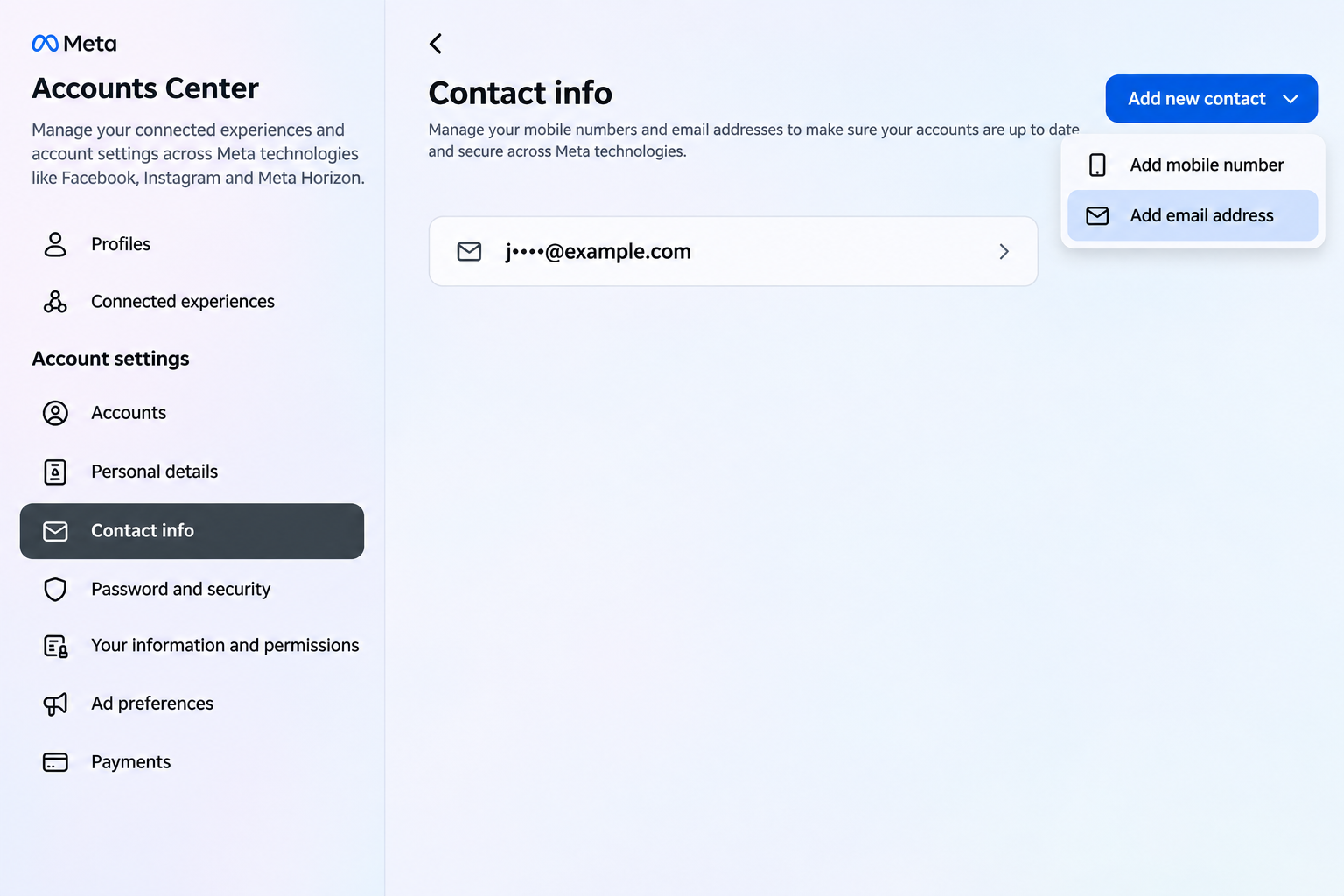
- Type the address, select the account it should be added to, and click Next.
- Check that inbox for the confirmation code, enter it and click Next, then Close.
Remove an Email
- Click the email you want to remove.
- Click Delete email, then Delete to confirm.
- If Facebook asks for your password, enter it and click Submit, then Close.
There is no single “change email” button. To switch addresses, add the new one first, confirm it, make it primary if you like, then delete the old one. Doing it in that order means the account always has at least one working address.
Keep Your Email Private
The same Contact info area lets you change who can see each email on your profile. For most people, the most private audience option is the sensible choice, since friends rarely need it and a visible address invites spam and phishing. The broader settings for making a Facebook account private include who can look you up by email or phone.
Facebook Email Questions
Will Facebook tell me my email if I contact support?
Don’t count on it. Facebook’s recovery tools work by sending a code to an email or number you already have, not by reading account details out to you. Treat anyone on social media who offers to “retrieve” your email for a fee as a likely scammer.
Can I find the email from my profile page?
Only if you chose to show it there, and many people hide it. Contact info in Accounts Center is the complete list, including addresses no one else can see.
I get Facebook emails at an address I don’t use for Facebook. Why?
That address is probably listed on the account, even if it isn’t the one you think of as your login. Check Contact info; any confirmed address on the list should work on Find your account. If the emails seem to belong to an account that isn’t yours, someone may have typed your address by mistake. Don’t click links in those messages; go to facebook.com yourself if you need to check.
Does Instagram use the same email?
Not necessarily. If both accounts are in the same Accounts Center, Contact info may show details for each, and the add email step asks which account to add the address to. Check which account each address belongs to before deleting anything.
Once you know the address, save it with your Facebook password in a password manager, and make sure at least one current email and phone number stay on the account.

Matthew Burleigh is the founder, head writer, and editor of Solve Your Tech, which he launched in 2012. He has written technology tutorials since 2008 and worked in IT since 2003, including small-business support, IT management, and consulting. He holds Bachelor’s and Master’s degrees in Computer Science from Arizona State University.
Matthew writes practical guides for Windows, iPhone and iPad, Microsoft Office, Outlook, Google apps, and Android. Solve Your Tech’s guides are checked step by step against the device or app maker’s own documentation and tested on his own devices whenever he has the hardware or software, with clear steps, sources, and update dates.
Read more about Matthew and how Solve Your Tech writes and updates its guides, or report a correction.