To get a Word document back to the normal view, select the View tab and choose Print Layout. Print Layout is the default view that shows each page with its margins, headers, and footers as they will print. If the document opened full screen with no ribbon, press Esc first. If the text looks too big or small, select View > 100%.
The main steps cover the Windows desktop version of Word, including Microsoft 365, Word 2024, and Word 2021. Separate sections below cover Word for Mac and Word for the web, where some menus differ.
Switch Back to Print Layout
- Select the View tab at the top of the window.
- In the Views group on the left, select Print Layout. The document shows separate pages with gaps between them.
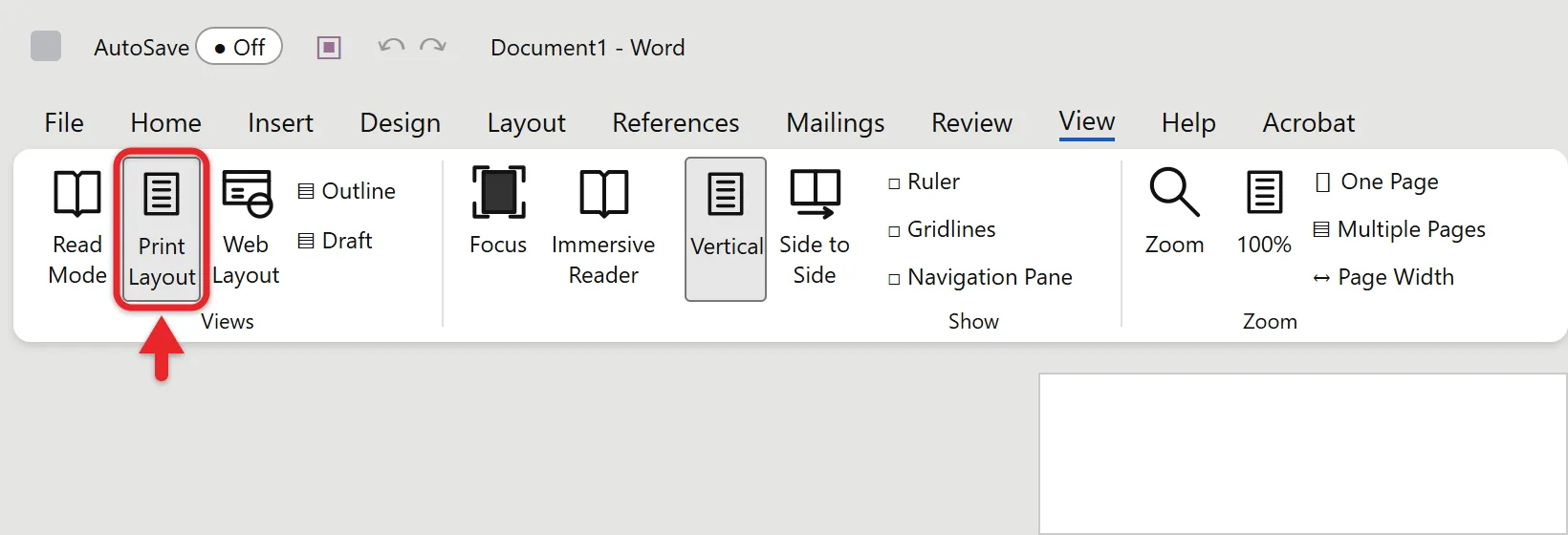
You can also use the small view buttons in the status bar at the bottom right of the window, next to the zoom slider. The middle button is Print Layout.
For a keyboard shortcut in Word for Windows, press Ctrl + Alt + P to switch to Print Layout. Microsoft lists it with the other view shortcuts in its Word keyboard shortcuts: Ctrl + Alt + N for Draft and Ctrl + Alt + O for Outline.
Which View Are You In?
Most “my document looks weird” problems come from landing in a different view by accident. Changing the view never changes the text or formatting in the file. Use this table to identify what you’re seeing and how to leave it.
| What you see | View or mode | How to get back |
|---|---|---|
| No ribbon, pages side by side like a book | Read Mode | Press Esc, or select View > Edit Document |
| One long sheet with no page edges, text fills the window | Web Layout | View > Print Layout |
| Bullets or headings only, with plus and minus signs | Outline | Select Close Outline View on the Outlining tab |
| Plain text, no headers, footers, or page edges | Draft | View > Print Layout |
| Only the page, no ribbon or status bar | Focus | Press Esc |
| A narrow column of widely spaced text | Immersive Reader | Select Close Immersive Reader |
| Pages flip left to right and zoom is grayed out | Side to Side page movement | View > Vertical |
| Black page with white text | Dark Mode | View > Switch Modes |
Older versions of Word had a view called Normal. It’s now called Draft, and it hides headers, footers, and page edges. When people ask for the normal view today, they almost always mean Print Layout.
Immersive Reader on the View tab is another reading view, and it can also have Word read your document aloud.
Outline view, also on the View tab, is useful when you want to rearrange pages in Word by moving whole sections.
Turn Off Side to Side Page Movement
If pages scroll left and right instead of up and down, and you can’t change the zoom, Word is using Side to Side page movement. Side to Side turns off the zoom setting.
- Select the View tab.
- In the Page Movement group, select Vertical. Pages scroll up and down again, and the zoom controls work.
Don’t confuse this with View Side by Side in the Window group. That one shows two open documents next to each other for comparison. Select it again to turn it off. Microsoft’s guide to viewing a page at a time or side by side explains page movement.
Fix a Black Page (Dark Mode)
In Microsoft 365, Word 2024, and Word 2021, Dark Mode can turn the page black with white text. It doesn’t change how the document prints.
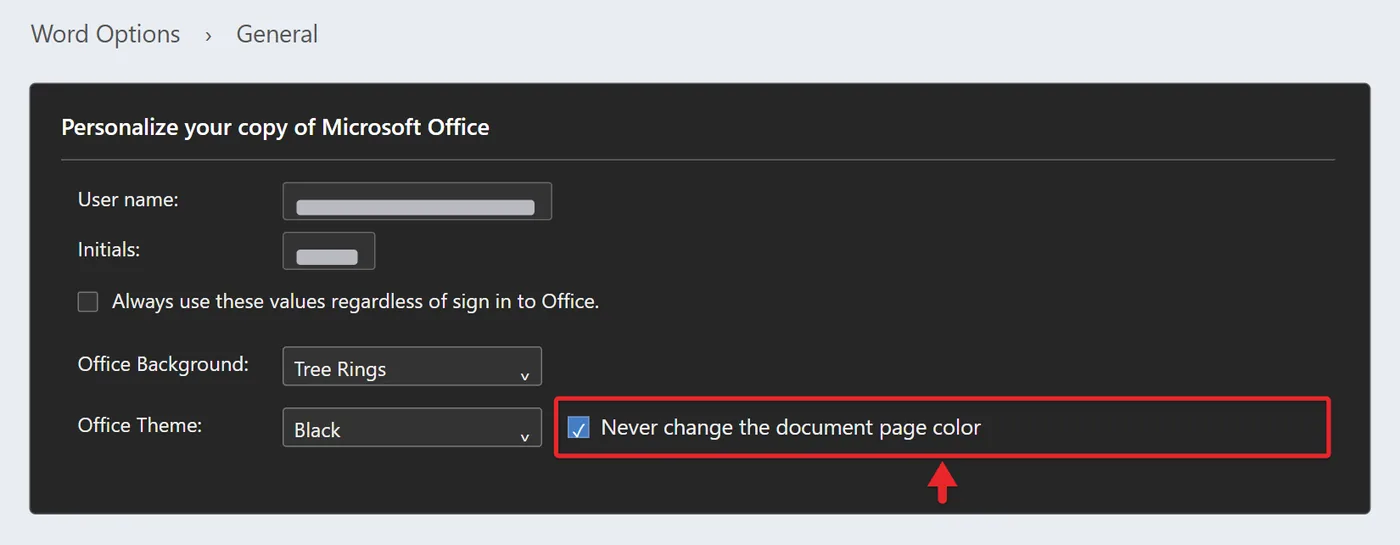
- To show a white page while keeping the dark ribbon, select View > Switch Modes. Word remembers this choice.
- To keep the page white all the time, open File > Options > General, check Never change the document page color under Personalize your copy of Microsoft Office, and select OK.
- To turn the dark theme off completely, open File > Account and change Office Theme to anything other than Black. If it says Use system setting, Word follows your Windows color mode.
See Microsoft’s Dark Mode in Word page for details.
Stop Documents From Opening in Draft View
Choosing a view on the View tab changes the document you have open. Word has no setting that forces every document to open in Print Layout. If documents keep opening in Draft view, turn off the option that allows it:
- Open File > Options. The Word Options dialog opens.
- Select Advanced, then scroll down to the General section.
- Clear the Allow opening a document in Draft view check box.
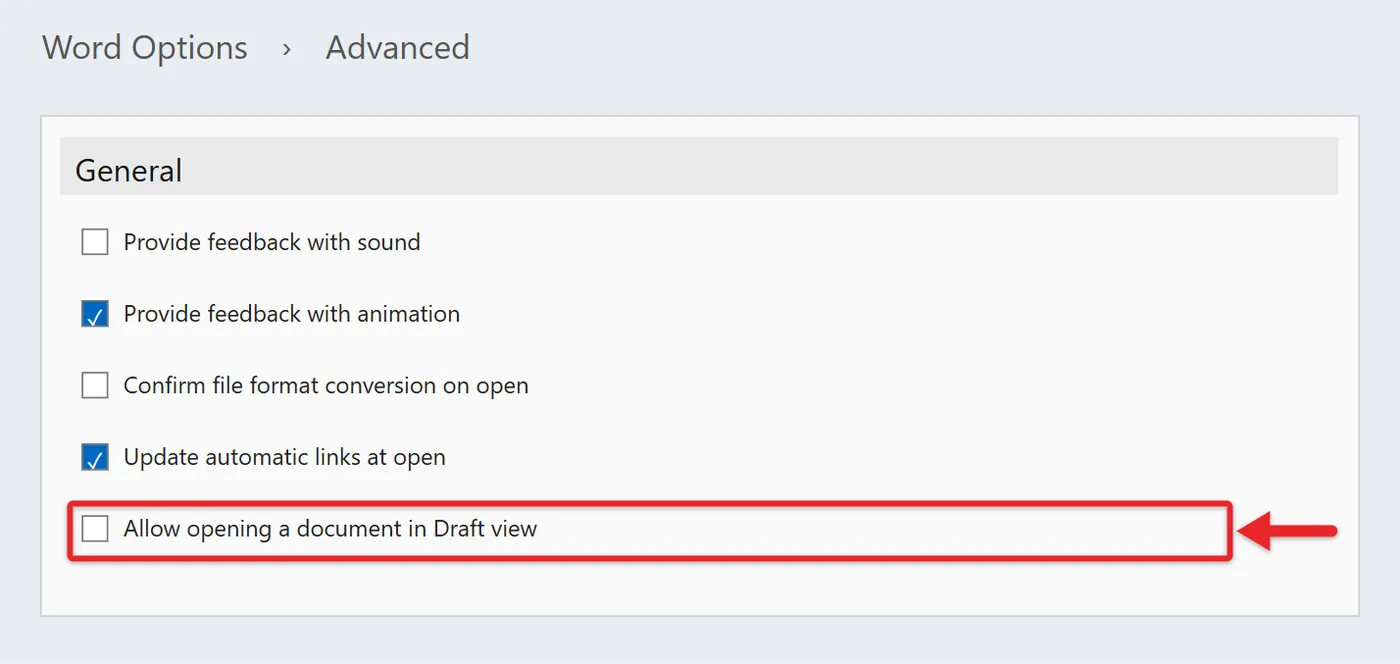
- Select OK, then close and reopen the document. If it is still in Draft, select View > Print Layout.
Microsoft’s Advanced options guide lists the Draft view setting under General.
Fix Other Common Display Problems
- Ribbon is missing: press Ctrl + F1 to show or hide it, or double-click any tab name. The steps for restoring a missing toolbar or ribbon in Word cover the other ribbon settings.
- Text is too big or small: select View > 100%, or drag the zoom slider in the bottom-right corner. Page Width fits the page to the window.
- Ruler is gone: check Ruler in the Show group on the View tab.
- Gaps between pages are gone: open File > Options > Display, check Show white space between pages in Print Layout view, and select OK. You can also double-click the line between two pages to bring the gap back.
- Dots and ¶ marks everywhere: select Home > Show/Hide ¶, or press Ctrl + Shift + 8 on the main keyboard (not the number pad). If some marks remain, clear the individual boxes under Always show these formatting marks on the screen in File > Options > Display.
Microsoft’s Word Display options guide covers the white space and formatting mark options.
Show One Page at a Time
In desktop Word, select View > Print Layout, then View > One Page in the Zoom group to fit a whole page in the window. Multiple Pages shows two or more pages at once. This only changes what you see on screen, not the printed page. Select 100% or Page Width to go back to a larger view.
If the page looks right on screen but comes out tiny on paper, see why your Word document prints so small.
Word for Mac
Word for Mac uses the same view names. Select the View tab and choose Print Layout, or click the Print Layout button in the view controls at the bottom right of the window. If the ribbon has disappeared because you’re in Focus view, press Esc to leave it. Microsoft’s Mac view list includes Print Layout, Web Layout, Outline, and Draft.
The Windows File > Options steps above don’t apply on a Mac. Mac settings are under Word > Preferences (Settings on newer macOS versions).
Word for the Web
Word in a browser has no Print Layout button. If the document opened in a read-only reading view, select Edit Document > Edit in the upper-right corner to switch to editing, a step also shown in Edit a document in Word for the web. If you can’t edit, the owner may have restricted the file.
To see separate pages instead of one continuous sheet, select the View tab and turn on Separate Pages. For more on that setting, read about turning page ends on or off in Word Online.
Frequently Asked Questions
Why does Word keep opening documents in Read Mode?
Some email attachments and protected documents open in Read Mode automatically. Press Esc, or select View > Edit Document, to leave it. Switching views doesn’t override the file’s editing permissions.
Why does my document say Protected View?
Files from the internet and email open in Protected View for safety. Only select Enable Editing for a file whose source and contents you trust. Changing to Print Layout doesn’t grant editing permission, and restrictions set by the owner or your organization may still apply.
Is there a button to reset Word to its default view?
No. Word has no single reset button for views or display settings, and Microsoft community moderators have confirmed there isn’t one under File > Options > Advanced. Fix the specific setting instead: the view on the View tab, the zoom level, Dark Mode, or the Display options above. Try those before you consider repairing or reinstalling Office.
Does changing the view change my document?
No. Views only change how the document appears on your screen. The text, formatting, and printed result stay the same. Word saves the view you last used with some documents, so a file may open in that view next time.
How do I remove extra blank pages?
Switch to Print Layout so you can see the page edges, then delete the page in Word.

Matthew Burleigh is the founder, head writer, and editor of Solve Your Tech, which he launched in 2012. He has written technology tutorials since 2008 and worked in IT since 2003, including small-business support, IT management, and consulting. He holds Bachelor’s and Master’s degrees in Computer Science from Arizona State University.
Matthew writes practical guides for Windows, iPhone and iPad, Microsoft Office, Outlook, Google apps, and Android. Solve Your Tech’s guides are checked step by step against the device or app maker’s own documentation and tested on his own devices whenever he has the hardware or software, with clear steps, sources, and update dates.
Read more about Matthew and how Solve Your Tech writes and updates its guides, or report a correction.