To hide an app on iPhone, touch and hold the app, tap Require Face ID (or Touch ID or Passcode), tap Hide and Require Face ID, authenticate, and then tap Hide App. The app disappears from the Home Screen, App Library and search, and moves to a locked Hidden folder at the bottom of App Library. To lock an app without hiding it, tap Require Face ID instead.
The steps come from Apple’s Lock or hide an app on iPhone and If you can’t find an app on the Home Screen.
The locking and Hidden-folder controls require iOS 18 or later. For decluttering without an app lock, use Remove from Home Screen below. The app remains installed and can still appear in App Library and Search.
How to Hide an App
- Touch and hold the app on the Home Screen until the Quick Actions menu opens.
- Tap Require Face ID (or Touch ID or Passcode).
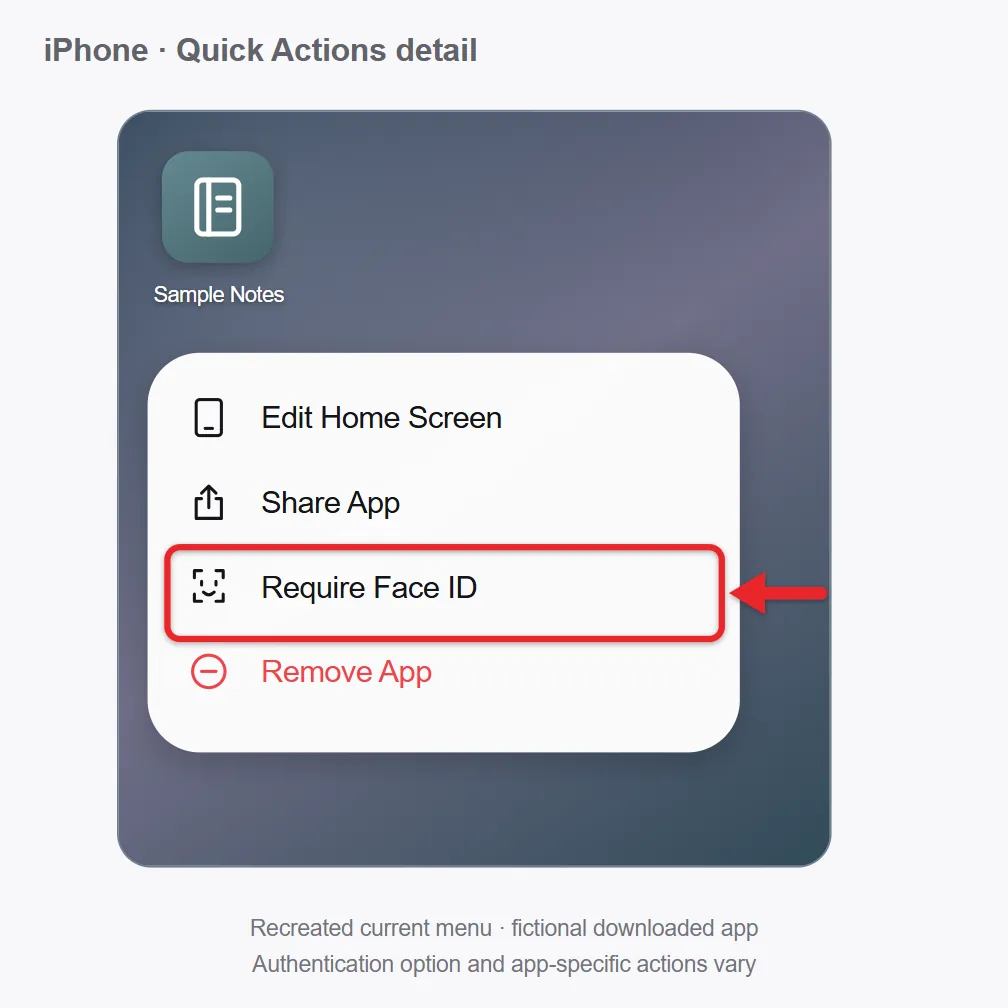
- Tap Hide and Require Face ID.
- Confirm with Face ID, Touch ID, or your passcode.
- Tap Hide App.
The app moves to the Hidden folder at the bottom of App Library, and Apple says it no longer shows up in search results. Hidden apps don’t send you notifications, including incoming calls from calling apps, and their Home Screen widgets disappear too.

Which Apps Can’t Be Hidden?
Only apps you downloaded from the App Store can be hidden. Apps that came with your iPhone can’t be, and neither can an app you set as your default web browser or (in the EU) your app marketplace. Children under 13 in a Family Sharing group can’t lock or hide apps at all.
Hiding an app doesn’t change what it’s allowed to access. Hidden apps still appear in Settings > Privacy, so you can still check which apps can access your photos and other data.
How to Lock an App Without Hiding It
- Touch and hold the app.
- Tap Require Face ID (or Touch ID or Passcode).
- Tap Require Face ID again to confirm.
The app stays on your Home Screen but needs Face ID, Touch ID or your passcode each time it opens. It relocks automatically after you quit it, and information from a locked app won’t appear in places like notification previews, search, or Siri suggestions.
Lock Messages on iPhone and Check Passcode Access
Built-in apps such as Messages can be locked but not hidden. Touch and hold Messages, tap Require Face ID, then tap Require Face ID again. Anyone who knows your iPhone passcode can still open it, and the lock applies only to this iPhone. To undo it, hold the icon and tap Don’t Require Face ID.
How to Find or Unhide a Hidden App
- Swipe left past your last Home Screen page to open App Library.
- Tap the Hidden folder at the bottom and authenticate.
- Tap the app to open it, or touch and hold it and tap Don’t Require Face ID to unhide it.
An unhidden app appears near the top of App Library. To see a list of everything you’ve hidden, go to Settings > Apps > Hidden Apps.

To unlock a locked app, touch and hold it on the Home Screen, tap Don’t Require Face ID (or Touch ID or Passcode), and authenticate.
A Lighter Option: Remove It From the Home Screen
If you just want an app out of sight, touch and hold it, tap Remove App, and choose Remove from Home Screen. Removed apps stay in App Library, and they still show up in Search. Nothing extra is needed to open them.
Freeing up space this way also leaves room to add a Weather widget on your iPhone.
On iOS 17 and Earlier
Older iOS versions have no Hide App option. Touch and hold the app, tap Remove App > Remove from Home Screen, then go to Settings > Siri & Search, tap the app, and turn off Show App in Search. The app stays installed and in App Library, and nothing requires Face ID to open it.
App Locks Are Different From Screen Time Limits
Screen Time is not an app lock. The old workaround of setting a one-minute App Limit only limits usage: the app opens normally until the time runs out. A Screen Time passcode protects Screen Time settings, not each app. On iOS 17 and earlier, check whether the app has its own passcode or Face ID setting instead. Hiding an icon alone doesn’t protect what’s inside the app.
Hidden and Locked App Questions
Does hiding an app on my iPhone hide it on my iPad too?
No. The locked or hidden status applies only to that device and doesn’t sync through iCloud.
Can someone else see that I hid an app?
Opening the Hidden folder or Settings > Apps > Hidden Apps requires Face ID, Touch ID, or passcode authentication. Hiding an app does not conceal every trace: Apple’s personal-safety guide lists Screen Time, battery information, and App Store purchase history as other places its name may appear. Apple also notes that for teens 13 to 17 in Family Sharing, a parent can still see that the app was downloaded and how much it’s used.
More iPhone Guides

Matthew Burleigh is the founder, head writer, and editor of Solve Your Tech, which he launched in 2012. He has written technology tutorials since 2008 and worked in IT since 2003, including small-business support, IT management, and consulting. He holds Bachelor’s and Master’s degrees in Computer Science from Arizona State University.
Matthew writes practical guides for Windows, iPhone and iPad, Microsoft Office, Outlook, Google apps, and Android. Solve Your Tech’s guides are checked step by step against the device or app maker’s own documentation and tested on his own devices whenever he has the hardware or software, with clear steps, sources, and update dates.
Read more about Matthew and how Solve Your Tech writes and updates its guides, or report a correction.