To exit full screen mode in Photoshop, press Esc, or press F until the menu bar, panels, and document tabs come back. If you can see the menu bar, you can also choose View > Screen Mode > Standard Screen Mode. If the toolbar and panels are still missing, press Tab.
Switching screen modes doesn’t change your layers, selections, or unsaved edits. Adobe’s View images in Photoshop page describes the three screen modes and the F shortcut.
Which versions this covers
These steps apply to Photoshop on desktop for Windows and Mac. The same three screen modes exist in older releases such as Photoshop CS5 and CS6.
You do not need any special setting or permission to change screen modes. You only need Photoshop to be the active app, so that it receives the keys you press.
How to exit full screen mode in Photoshop
Work through these steps in order and stop as soon as the normal Photoshop window is back.
- Click once on your image. This makes sure Photoshop, and not another app or a text box, is receiving your key presses. If you were typing with the Type tool, finish or cancel the text first.
- Press Esc. In Full Screen Mode, this is the quickest key to try. Photoshop should return to Standard Screen Mode, the normal view with the menu bar, document tab, and scroll bars.
- If nothing changes, press F. Adobe documents F as the key that cycles through the screen modes. Each press moves to the next mode, so press it once, look at the screen, and press it again if needed. You are back in Standard Screen Mode when you can see the document tab with the file name and the scroll bars.
- If the menu bar is visible, use the menu instead. Choose View > Screen Mode > Standard Screen Mode. This goes straight to the normal view without cycling.
- If the toolbar and panels are still missing, press Tab. Tab shows or hides all panels, including the Tools panel and the Options bar. It works separately from screen modes, so panels can stay hidden even after you leave full screen.
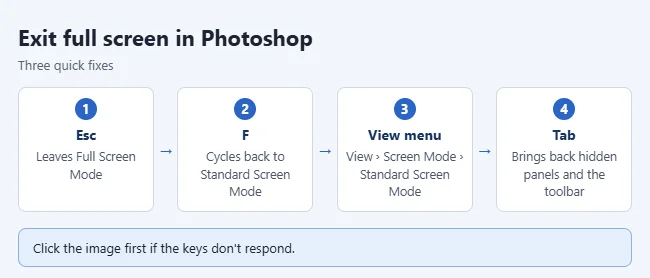
A note on the two keys: F is the shortcut listed in Adobe’s help pages. Esc also works in Full Screen Mode. The message Photoshop shows when you enter Full Screen Mode says to press F or Esc to return to Standard Screen Mode.
How to tell which screen mode you are in
Photoshop has three screen modes. Knowing which one you are looking at tells you which fix to use. The descriptions below follow Adobe’s guide.
| Screen mode | What you see | How to get back to normal |
|---|---|---|
| Standard Screen Mode | The default view, with the menu bar at the top and scroll bars at the side | You are already there |
| Full Screen Mode With Menu Bar | A full-screen window with the menu bar and a gray background, but no title bar or scroll bars | View > Screen Mode > Standard Screen Mode, or press F until it returns |
| Full Screen Mode | Only your image on a black background, with no title bar, menu bar, or scroll bars | Press Esc, or press F |
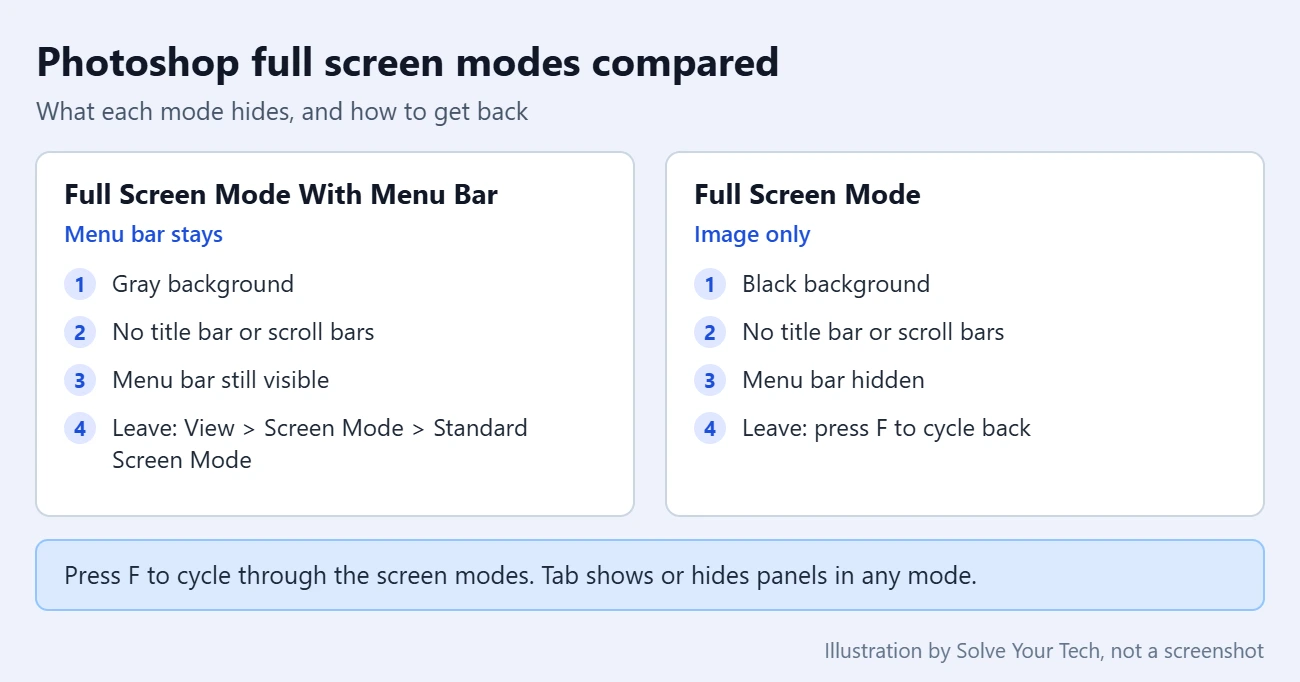
Full Screen Mode With Menu Bar is the one that catches people out. It looks almost normal, because the menus, toolbar, and panels are still there. The clues are that the document tab is gone and there are no scroll bars around the image.
Hidden panels are a different setting from full screen, but they are often the real cause of an empty-looking Photoshop window. Adobe’s Hide or show panels page lists two shortcuts:
- Tab hides all panels, including the Tools panel and Options bar. Press Tab again to show them.
- Shift + Tab hides all panels except the Tools panel and Options bar. Press Shift + Tab again to show them.
Adobe also describes an option called Auto-Show Hidden Panels in Preferences > Workspace. When it is turned on, you can display hidden panels temporarily by moving the pointer near the edge of the application window on Windows, or the edge of the monitor on a Mac. This is why panels sometimes slide into view at the side of the screen and then disappear again. They are only being shown temporarily. Press Tab to bring them back for good.
The Interface page of the same Preferences window is where you change the theme in Photoshop if the panels look too dark or too light.
How to switch to full screen on purpose
Full screen is useful when you want to judge a photo without the interface around it. You can enter it the same ways you leave it:
- Press F to cycle from Standard Screen Mode to the next mode.
- Choose View > Screen Mode and pick Full Screen Mode With Menu Bar or Full Screen Mode.
- Use the Screen Mode button. Adobe’s guide mentions this button with a pop-up menu of the three modes. In recent versions it is usually found at the bottom of the toolbar.
When you choose Full Screen Mode, Photoshop shows a message that says you can press F or Esc to return to Standard Screen Mode. Select Full Screen to continue or Cancel to stay where you are.
To undo the change, repeat the steps at the top of this article. Switching modes back and forth does not alter your image or your saved workspace.
Troubleshooting: still stuck in full screen
Esc and F do nothing
First click on the image so Photoshop has focus. If a text layer is being edited, the F key types a letter instead of changing the mode, so finish or cancel the text and try again. Close any open dialog box too, because shortcuts are ignored while a dialog is waiting for an answer.
If the keys still do nothing, the shortcut may have been changed. Choose Edit > Keyboard Shortcuts, set Shortcuts For to Application Menus, and look under View for the Screen Mode commands. The View keyboard shortcuts in Photoshop page explains this dialog. If you cannot reach the menu bar because it is hidden, Adobe gives a direct shortcut for the dialog: Alt + Shift + Ctrl + K on Windows or Option + Shift + Command + K on a Mac.
No Photoshop shortcuts work at all
When every shortcut has stopped responding, the cause is usually outside the screen mode. Adobe’s Fix keyboard shortcuts not working page points to three common causes: corrupted preferences, another running application that conflicts with Photoshop, and third-party utilities. Its suggestions include saving your work, closing other applications one at a time, and testing the shortcut after each one.
Adobe’s last resort is to reset the Photoshop preferences. Warning: this returns your Photoshop settings to their defaults, so save your work and consider backing up your preferences first. Adobe’s steps are to close Photoshop, then hold Alt + Ctrl + Shift (Windows) or Option + Command + Shift (Mac) while starting it, and select Yes when asked to delete the settings file.
Full screen is off, but panels are in the wrong place
If the menu bar is back but panels are missing or scattered, restore the layout. Adobe’s Restore workspaces page says to choose Window > Workspace > Reset for the workspace you are using, such as Essentials (Default). For more detail, follow the steps for resetting the Photoshop workspace.
The Photoshop window itself fills the whole screen
That is the application window being maximized by Windows or macOS, not a Photoshop screen mode. Esc and F will not change it. Use the window buttons your operating system provides to restore or resize the window, the same way you would with any other app.
Frequently asked questions
What is the shortcut for full screen in Photoshop?
Press F. It cycles through Standard Screen Mode, Full Screen Mode With Menu Bar, and Full Screen Mode. Keep pressing it to come back around to the standard view.
Why did Photoshop suddenly go full screen?
The most likely reason is that F was pressed by accident while Photoshop was active. Because F is a single key with no modifier, it is easy to hit when reaching for another shortcut. Pressing F again, or Esc, puts things back.
Will I lose my work if I exit full screen mode?
No. Screen modes only change what is displayed around the image. Leaving or entering full screen does not close the file, undo edits, or change layers. It is still a good habit to save before troubleshooting anything in Photoshop.
How do I hide panels without going full screen?
Press Tab to hide all panels along with the Tools panel and Options bar, and press it again to show them. Press Shift + Tab to hide the panels but keep the Tools panel and Options bar. Both shortcuts work without changing the screen mode.
Why is the background gray or black around my image?
Full Screen Mode With Menu Bar has a gray background, and Full Screen Mode has a black one. If you see either with no scroll bars or document tab, you are in one of the full screen modes, and the steps above will take you back.
Does this work the same way on a Mac?
Yes. The F and Tab shortcuts and the View > Screen Mode menu are the same on Windows and Mac. Only the Preferences location differs: it’s under Edit > Preferences on Windows and Photoshop > Settings on a Mac.
Next step
Once the normal window is back, press F a few times on purpose to see all three modes, so the next accidental switch is easy to recognize. Back to text work? You can change fonts and text size in Photoshop from there.

Matthew Burleigh is the founder, head writer, and editor of Solve Your Tech, which he launched in 2012. He has written technology tutorials since 2008 and worked in IT since 2003, including small-business support, IT management, and consulting. He holds Bachelor’s and Master’s degrees in Computer Science from Arizona State University.
Matthew writes practical guides for Windows, iPhone and iPad, Microsoft Office, Outlook, Google apps, and Android. Solve Your Tech’s guides are checked step by step against the device or app maker’s own documentation and tested on his own devices whenever he has the hardware or software, with clear steps, sources, and update dates.
Read more about Matthew and how Solve Your Tech writes and updates its guides, or report a correction.