To delete Safari history on an iPad, open Safari, tap Show Sidebar, tap History, then tap More > Clear. Choose a time range and profile, and tap Clear History to confirm.
These steps cover Safari in current iPadOS (Apple’s iPad User Guide has versions for iPadOS 27 and iPadOS 26) plus the Settings route that also works on older iPads. If you browse in Chrome, Firefox or the Google app, each keeps its own history, so use the separate sections below.
What Clearing Safari History Removes
Before you delete anything, it helps to know what goes and what stays. Apple’s Safari history and website-data instructions describe two separate jobs: clearing history, and removing website data.
| Item | Clear History | Remove All Website Data |
|---|---|---|
| List of visited pages and recent Safari searches | Removed | Kept |
| Cookies and cached website files | Removed | Removed |
| Website permissions you granted | Removed | Kept |
| Bookmarks, Reading List and saved passwords | Kept | Kept |
| AutoFill information | Kept | Kept |
Because cookies go too, expect to sign in to websites again. If you only want to drop one embarrassing or outdated page, delete that single entry instead (see below).
View Safari History Without Deleting It
To revisit a page, open Safari > Show Sidebar > History. If History is missing, use the back arrow at the top of the sidebar to return to its main list. Scroll the history list, then tap an entry to open that website. You do not need to choose Clear or Clear History to view the entries. Apple documents the Safari sidebar route.
On older iPad layouts, open the bookmarks/sidebar control and choose History; a clock icon may identify it. Check the active Safari profile if the entry you expect is absent. Pages visited in Private Browsing do not appear in ordinary History, and already-cleared entries have no normal Undo recovery. Safari’s list is separate from Chrome history and Google Account search activity. Save a bookmark for a page you want to keep before using any deletion steps below.
Clear Safari History From the Sidebar
Follow these steps in Safari on a current iPad:
- Open Safari, then tap Show Sidebar near the top left of the window. The sidebar slides out with your tab groups and other lists.
- Tap History. If it is missing, use the back arrow at the top of the sidebar to return to its main list. You see a list of visited pages, newest first.
- Tap More, then Clear. In an older layout, look for Clear directly at the bottom of the History list.
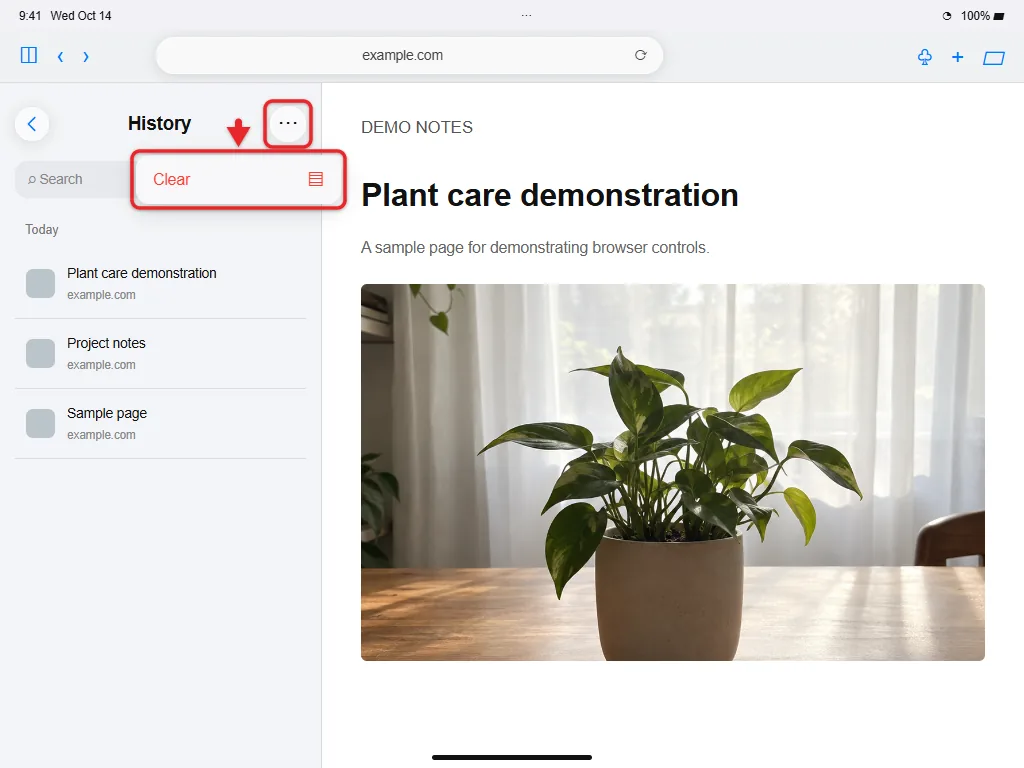
- Choose the Clear Timeframe: the last hour, today, today and yesterday, or all history. If you use Safari profiles, select the profile you want or All Profiles.

- Tap Clear History. The list empties for the period you picked.
Apple’s iPadOS 26 guide documents these sidebar controls. The action removes visited pages, recent Safari searches, cookies, and website permissions. It does not delete histories maintained independently by websites or other apps. To remove stored data for a single site instead, delete cookies for one website on iPad.
Delete One Page From Safari History
You do not have to wipe everything to hide one visit. Open Safari > Show Sidebar > History, find the page, then swipe left on it and tap Delete. You can also touch and hold the entry and choose the delete option from the menu. Only that visit goes away; your cookies and sign-ins stay as they were.
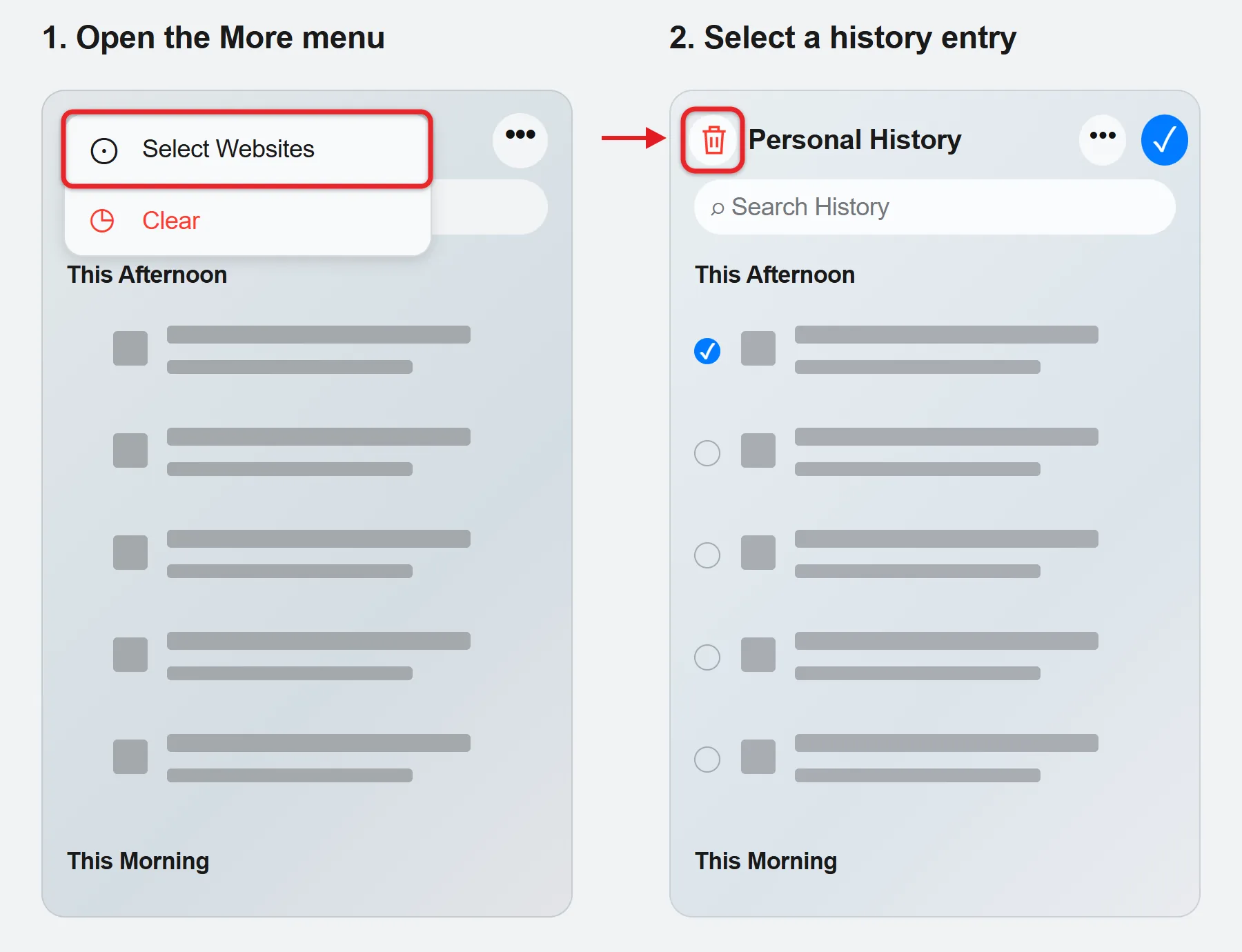
To remove several pages at once, tap More in the History list and look for a Select Websites option. That option appears in Safari on iPhone; pick the pages, then tap the trash button.
Use Settings, Including on Older iPads
Apple’s iPhone and iPad privacy guide also gives a Settings route. On versions with an Apps section (iPadOS 18 and later), open Settings > Apps > Safari > Clear History and Website Data. On iPadOS 17 and earlier, Safari is directly in Settings. Select the offered timeframe and profile, then confirm; older releases may use a different confirmation label.
Website cookies and cached data are affected, so expect some websites to ask you to sign in again. AutoFill information is retained. For the cookie-focused steps, read about clearing cookies and cache on iPad. For a website-data cleanup that keeps the history list, use Safari settings > Advanced > Website Data > Remove All Website Data, then tap Remove Now.
Check the Result Before Assuming Everything Is Gone
Reopen Safari’s History panel and check the chosen period and profile. If you removed only the last hour, older entries should remain. A saved bookmark or a search-engine suggestion is a different item; seeing it does not by itself mean the history clear failed. Reading List items and Favorites tiles on the Start Page also come from separate lists.
Save links you need before clearing. History is also one of the places you use to restore closed tabs on an iPad, so clearing it removes that option. Safari has no ordinary Undo button for this action. Clearing browser data is also not a substitute for erasing an iPad before giving it away.
How iCloud Sync Affects Your Other Devices
When Safari is turned on in iCloud, your history syncs between the iPad, iPhone and Mac that use the same Apple Account. Clearing it on the iPad clears it on those devices too. To check the setting, open Settings, tap your name, tap iCloud, tap Show All, and look at Safari.
If cleared pages come back a few minutes later, another device may still be syncing old data. Make sure every device is signed in to the same account and online, then clear history once more and check again. If several people share one Apple Account, a clear on one iPad removes everyone’s history, so it is better for each person to have their own account.
Clear Chrome History on iPad
Open Chrome, tap More (three dots), then Delete browsing data. Pick a Time range; Google sets the last 15 minutes by default. Tap Browsing data, check the types you want removed, tap Confirm, then tap Delete browsing data. If suggestions still appear as you type, you can reduce predictions in the Chrome address bar.
Check the boxes instead of assuming every category is selected. Leave cookies unchecked if you want to stay signed in. Chrome history and Google Account search activity are separate. Data saved to your Google Account can also be removed from other signed-in devices. See Google’s iPhone and iPad instructions and the Chrome iPad history guide.
Clear Firefox History on iPad
- Open Firefox and tap the menu button at the top right of the screen.
- Tap History.
- Tap the trash icon, then choose Today, Today and Yesterday, or Everything.
To remove one site, swipe across its entry in History and tap Delete. To remove cookies and other website data as well, open the menu, tap Settings > Data Management, and tap Clear Private Data; that step cannot be undone. These controls are listed on Mozilla’s Firefox for iOS history page, and the Firefox history and cookies walkthrough shows the same app on iPhone.
Clear Google Search History Separately
In the Google app, check the active account, tap your profile picture, choose Search history, then use Delete to choose all time, a custom range, or an individual entry. Erased account search history cannot be recovered.
If you searched while signed out, local Google app history can remain. Use profile picture > Settings > Privacy & Safety > Clear app history, then confirm Clear all. Google’s privacy settings are changing, so labels can differ. Its Search history help covers local and account records.
Troubleshooting and Privacy Limits
- Clear History is gray: there may be no data to clear, or Screen Time web-content restrictions may be set. If the iPad is managed by a parent, school or employer, ask that person rather than changing restrictions blindly.
- The wrong history remains: check the app, timeframe, and Safari profile. Clearing Safari does not clear Chrome, Firefox, Google activity, or YouTube history. For the latter, read the YouTube iPad history guide.
- Privacy: Private Browsing prevents those Safari tabs from appearing in History. It does not erase previous ordinary browsing or guarantee anonymity to websites and network operators. To switch it off later, follow the steps for turning off Private Browsing on iPhone or iPad. Private tabs also stay open until you close them, and you can close all Safari tabs on an iPad at once.
- Network records: deleting history on the iPad does not remove records kept by your internet provider, a school or work network, or the websites themselves.
- Performance: use this cleanup for a specific browser or privacy task. Clearing history won’t necessarily make your iPad faster.
Can You Recover Deleted iPad History?
Not really. Safari has no Undo for cleared history, and the deletion syncs to your other devices through iCloud. Check your bookmarks, Reading List and open tabs for the page you need. If you found it through Google while signed in, myactivity.google.com may still list the search. Restoring an older backup would replace everything added to the iPad since that backup, so it is not a practical way to get back a few pages, and recovery apps cannot reliably do it either.
More Questions About iPad History
Does clearing history sign me out of websites?
Yes, usually. Clearing Safari history also removes cookies and website data, so you’ll need to sign in again. Saved passwords and AutoFill info stay.
Does it also clear history on my iPhone and Mac?
Yes, if Safari is turned on in iCloud settings on those devices. The change syncs to every device signed in to the same Apple Account.
Can I delete just one website from my history?
Yes. In Safari’s History list, swipe left on the entry and tap Delete. Your other history, cookies and sign-ins stay in place.
How do I delete Chrome history on iPad?
In Chrome, tap the three dots, choose Delete browsing data, pick a time range, make sure Browsing history is checked, and tap Delete browsing data.
Does clearing history delete my bookmarks?
No. Bookmarks, Favorites and Reading List items stay. Delete those separately from the Bookmarks or Reading List section of the Safari sidebar if you want them gone.
Other apps keep their own stored files, and clearing app caches on iPad can free that space too.

Matthew Burleigh is the founder, head writer, and editor of Solve Your Tech, which he launched in 2012. He has written technology tutorials since 2008 and worked in IT since 2003, including small-business support, IT management, and consulting. He holds Bachelor’s and Master’s degrees in Computer Science from Arizona State University.
Matthew writes practical guides for Windows, iPhone and iPad, Microsoft Office, Outlook, Google apps, and Android. Solve Your Tech’s guides are checked step by step against the device or app maker’s own documentation and tested on his own devices whenever he has the hardware or software, with clear steps, sources, and update dates.
Read more about Matthew and how Solve Your Tech writes and updates its guides, or report a correction.