To add a website shortcut to your Android Home screen, open the site in Chrome, tap More (the three dots next to the address bar), tap Install and create shortcut, then Create shortcut, and tap Add. On older versions of Chrome the menu item is called Add to Home screen instead. If you want the Chrome app itself on your Home screen, swipe up to open your app list, touch and hold Chrome, and drag it into place.
These steps cover current Chrome on Android phones and tablets running Android 10 or later, including Pixel and Samsung Galaxy phones, plus the older Add to Home screen wording. You will also find how a shortcut differs from an installed web app, how to do the same thing in Firefox, how to remove either one, and what to check when the menu option is missing.
Before you start
- You need the Chrome app. Google lists Android 10 and up as the requirement for current versions of Chrome.
- Menu names depend on your Chrome version. Google’s current help page uses Install and create shortcut. Older Chrome versions, and many older guides, show Add to Home screen. Both lead to the same result.
- Home screens differ by phone. The steps for dragging, moving, and removing icons come from Google’s Android Help, which notes that some steps only work on Android 14 and up. Samsung and other manufacturers may word a few things differently.
- The shortcut is tied to Chrome. Shortcuts showing the Chrome logo open in Chrome, not in another browser.
How to add a website shortcut to your Android Home screen
These steps follow Google’s Create shortcuts for websites in Chrome help page.
- Open the Chrome app on your Android phone or tablet.
- Go to the website you want a shortcut for. Open the exact page you want the icon to load, such as a login page or a specific section, because the shortcut saves that address and not only the site’s home page.
- Tap More, the three dots to the right of the address bar. The address bar can sit at the top or the bottom of the screen, depending on how Chrome is set up.
- Tap Install and create shortcut. If you do not see it, look for Add to Home screen, the older name.

- Tap Create shortcut.
- In the dialog that appears, keep the suggested name or type a new one in the name field. Short names fit better under an icon.
- Tap Add.
Your phone may show one more prompt asking whether to place the icon automatically or let you touch and drag it to a spot yourself. That prompt comes from your Home screen app, so its wording varies by phone. On many phones, tapping Add automatically drops the icon into the next free space.

Shortcut to a bookmarked page: open the bookmark in Chrome first (More > Bookmarks, then tap the page), and then follow the steps above. The shortcut is created from whatever page is open.
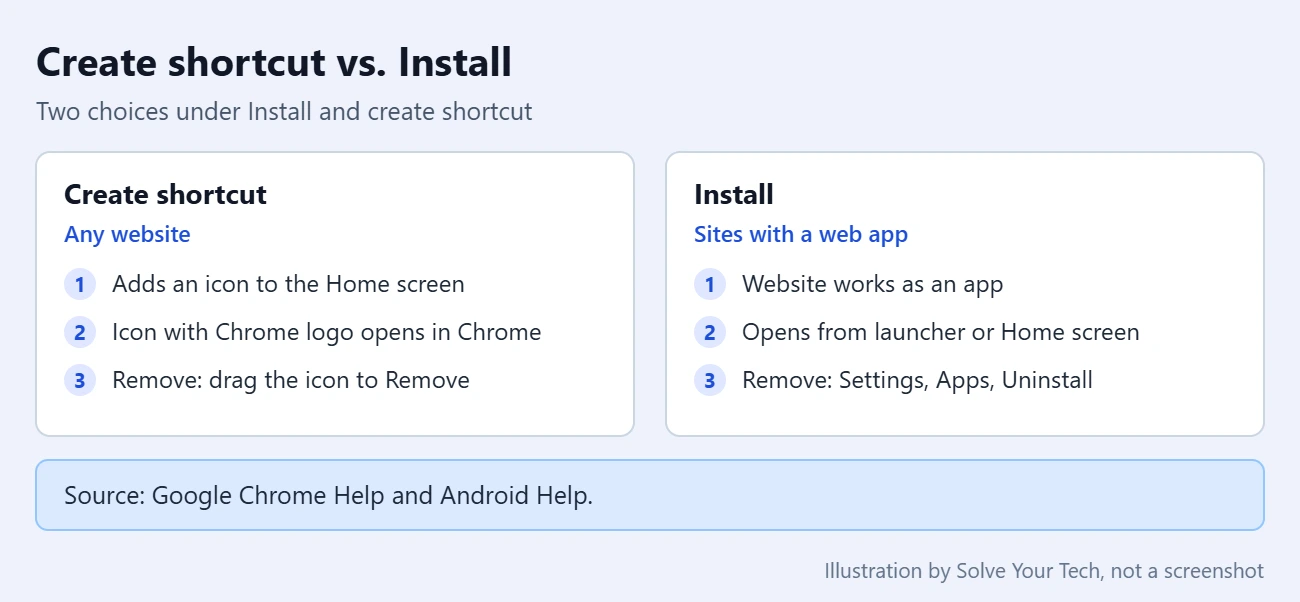
Create shortcut vs. Install
After you tap Install and create shortcut, Chrome can offer two choices. Which ones you see depends on the website.
- Create shortcut works for ordinary websites. It puts an icon on your Home screen that opens the page in Chrome.
- Install is for sites that offer a web app. A web app is an app built for the web that lets a website work as an app, opened from your launcher or Home screen. Some web apps add extras such as notifications, offline content, or icon badges, although some may not work completely without an internet connection.
To install a web app, follow the same path and tap Install instead of Create shortcut, then follow the on-screen instructions. Google’s Use web apps page covers the same steps. If you only want a quick link and nothing more, choose Create shortcut.
How to add the Chrome app itself to your Home screen
If the Chrome icon is missing from your Home screen, the browser is usually still installed. You only need to put its icon back.
- From the bottom of your Home screen, swipe up to open the list of all your apps.
- Find Chrome. If you have a lot of apps, type Chrome in the search bar at the top.
- Touch and hold the Chrome icon.
- Drag it to the spot you want on the Home screen and release it.
To keep Chrome in the row of favorite apps at the bottom of the screen, drag it into that row instead. If the row is full, drag one of the existing apps out first. These steps are from Google’s Create a shortcut for Chrome page. The same page mentions that touching and holding the Chrome icon shows quick options for a new tab, an Incognito tab, and Chrome widgets.
If Chrome or another app vanished from your Home screen, here’s how to get apps back on your Android home screen.
Using Firefox or another browser instead
A shortcut opens in the browser that created it. If you prefer Firefox, make the shortcut there. Mozilla’s Add a website shortcut to your home screen on Android page gives these steps:
- Open Firefox and go to the website.
- Tap the menu button (the three vertical dots).
- Tap Add to Home screen.
- Edit the suggested name if you want, then tap Add.
- Tap Add again to confirm.
Samsung Internet and other Android browsers have their own add-to-Home-screen option in their menus. The labels differ by browser, so look for an item that mentions the Home screen.
How to check that the shortcut works
Go to your Home screen and look for the new icon. A website shortcut shows the site’s icon, usually with a small Chrome logo on it. Tap it once. The page you saved should open in Chrome. If you installed a web app, look for it on the Home screen or in your app list and tap it to confirm it opens.
If the icon is not on the first Home screen, swipe sideways. Android places new icons wherever there is room, which can be a different page.
How to move, group, or remove a shortcut
Website shortcuts behave like app icons on the Home screen. Google’s Android Help describes these actions:
- Move: touch and drag the icon, slide it where you want it, and lift your finger. Drag it to the edge of the screen to reach another Home screen page.
- Group: drag one shortcut on top of another to make a folder. Tap the folder, then tap its name to rename it.
- Remove: touch and hold the icon, drag it up to Remove, and lift your finger.
You may see Remove, Uninstall, or both. Read the label before you let go. Remove only takes the icon off the Home screen. Uninstall takes the item off your device.
Removing a website shortcut does not delete the website, your bookmarks, or your browsing history. You can add the shortcut again at any time with the steps above. To change a shortcut’s name, remove it and create it again with the new name. To clear the history itself, you can delete search and browsing history on Android.
An installed web app is removed differently. Open Settings, tap Apps, tap See all apps, tap the web app, and tap Uninstall.
If you can’t find the option
- Look for the other name. Depending on your Chrome version, the item is Install and create shortcut or Add to Home screen. Scroll the menu, since it can be near the bottom.
- Update Chrome. Open the Play Store, tap your profile icon at the top right, tap Manage apps & device, and under Updates available tap Update next to Chrome. To see which version you have, open Chrome and tap More > Settings > About Chrome.
- Make sure you are in Chrome. Links opened inside another app, such as an email or social app, often load in that app’s built-in viewer, which has a different menu. Open the page in the Chrome app first.
- Open a real website. The option may not appear on Chrome’s own pages, such as the New Tab page.
- Check for restrictions. On a work phone or a supervised account, an administrator or your Home screen app may limit new shortcuts. Ask whoever manages the device.
- No Create shortcut choice? If Chrome only offers Install, the site is set up as a web app. Installing it still gives you a Home screen icon.
Frequently asked questions
Where did Add to Home screen go in Chrome on Android?
Google’s current Chrome Help steps use the label Install and create shortcut for this menu item, followed by a choice between Create shortcut and Install. If your Chrome menu still says Add to Home screen, you are on an older version and the option does the same job.
Will the shortcut open in my default browser?
No. A shortcut created in Chrome opens in Chrome. To have a site open from a different browser, create the shortcut from inside that browser instead.
Can I put several website shortcuts in one folder?
Yes. Drag one shortcut on top of another on the Home screen to create a folder, then drag more onto it. This keeps a set of sites, such as news or banking pages, in one spot.
Can I add the Google search bar too?
Yes. It is a widget, not a shortcut. Here’s how to add the Google search bar to your home screen.
Next steps
Add shortcuts for the two or three sites you open every day, then drag them into a folder to keep the Home screen tidy. Other handy Android tricks include screen recording on Android and finding your phone’s IP address.

Matthew Burleigh is the founder, head writer, and editor of Solve Your Tech, which he launched in 2012. He has written technology tutorials since 2008 and worked in IT since 2003, including small-business support, IT management, and consulting. He holds Bachelor’s and Master’s degrees in Computer Science from Arizona State University.
Matthew writes practical guides for Windows, iPhone and iPad, Microsoft Office, Outlook, Google apps, and Android. Solve Your Tech’s guides are checked step by step against the device or app maker’s own documentation and tested on his own devices whenever he has the hardware or software, with clear steps, sources, and update dates.
Read more about Matthew and how Solve Your Tech writes and updates its guides, or report a correction.