To convert a Word document to a Google Doc, upload the .docx file to Google Drive, double-click it to open it in Google Docs, then click File > Save as Google Docs. Google creates a new Google Docs copy and leaves your original Word file in Drive.
You need a free Google account and a web browser. These steps are for Google Drive and Google Docs on the web as of October 2026, and they work the same in Chrome, Edge, Safari, and Firefox on Windows or Mac. Google’s help page on working with Office files in Docs, Sheets, and Slides lists the supported formats.
Convert One Word File to a Google Doc
- Go to drive.google.com and sign in with your Google account.
- Click New at the top left, then click File upload. Select your Word file and click Open. You can also drag the file from File Explorer or Finder into the Drive window. A progress box appears at the bottom right, and the file shows up in My Drive when it finishes.
- Double-click the uploaded file. It opens in Google Docs with a blue .DOCX badge next to the file name. That badge means you’re still working in the Word file itself.
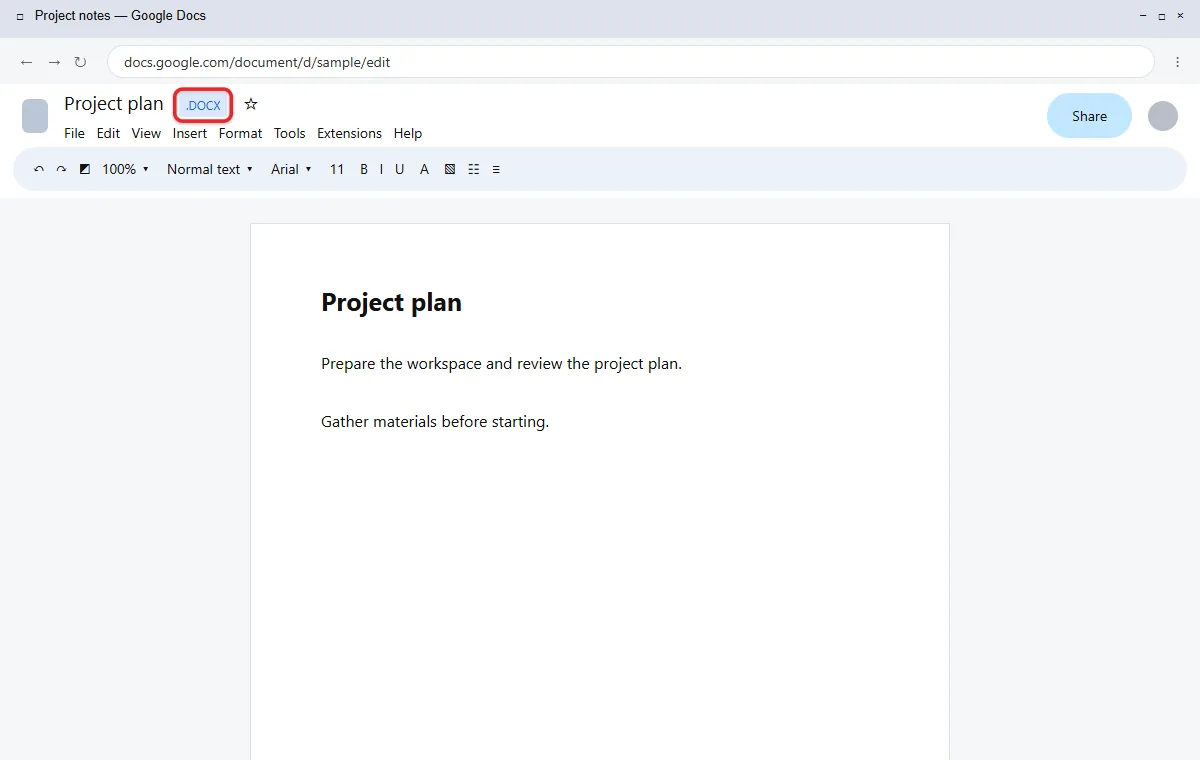
- Click File > Save as Google Docs. A new tab opens with the converted document. The .DOCX badge is gone, and Drive now holds two files with the same name: the Word original and the Google Doc.
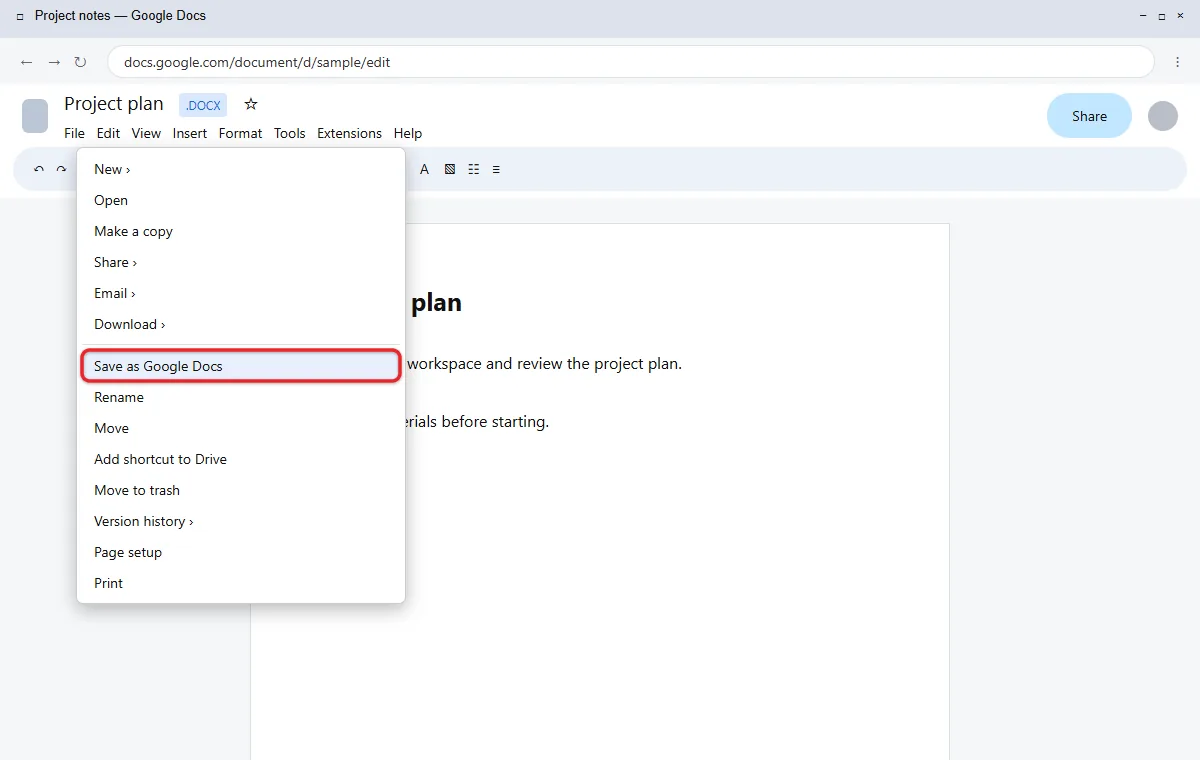
The Word file stays in Drive until you delete it. To avoid editing the wrong one later, rename or delete one of the two copies. In Drive, the Google Doc has a blue Docs icon, while the Word file shows a blue W icon.
Convert Every Word File You Upload
If you move a lot of Word files into Drive, you can have Drive convert them as they upload.
- On a computer, go to drive.google.com/drive/settings, or click the gear icon at the top right of Drive and choose Settings.
- On the General tab, check Convert uploads to Google Docs editor format.
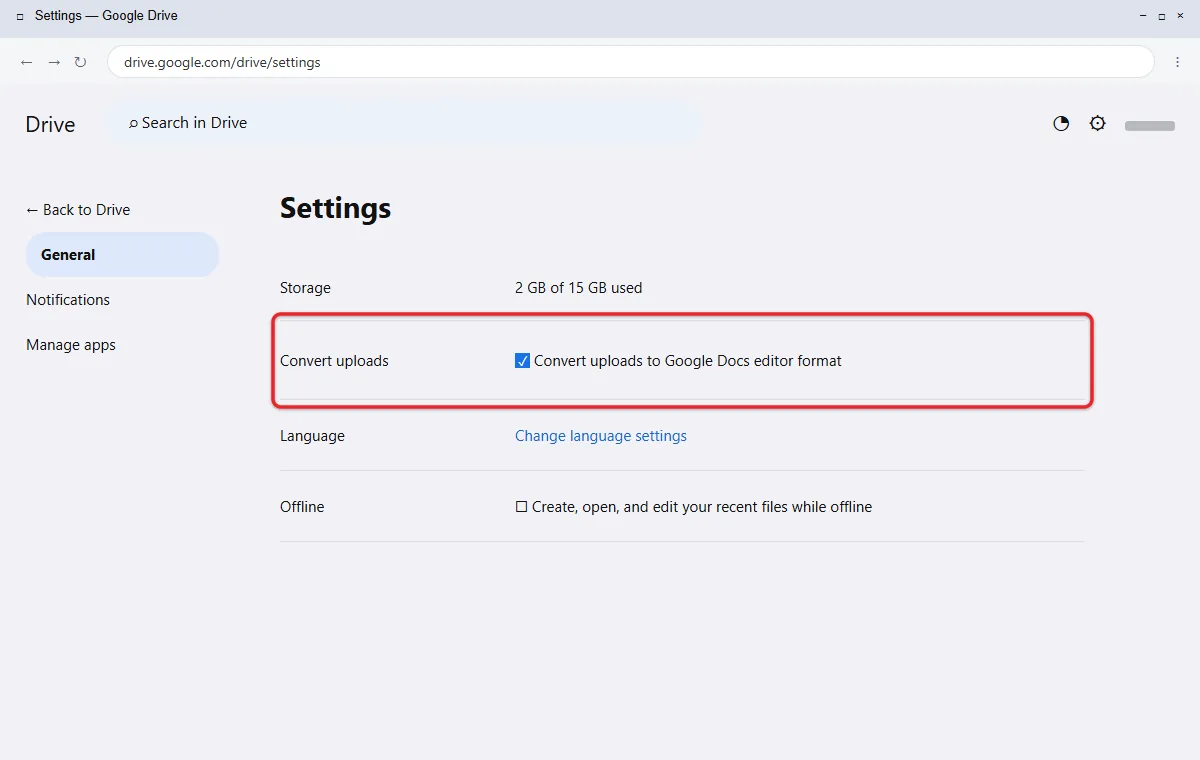
- Upload your Word files as usual. They arrive in Drive as Google Docs, with no .DOCX badge and no separate Word copy.
This setting can only be changed on a computer, and it only affects files you upload after turning it on. Files already in Drive still need the single-file steps above. Google explains the setting on its upload files to Google Drive page. The setting also converts Excel and PowerPoint uploads to Sheets and Slides, so turn it off again if you need those to stay in Office format.
Edit a Word File Without Converting It
You don’t have to convert a Word file to work on it. Double-click a .docx file in Drive and start typing. Your changes save back into the Word file, so it stays a .docx you can send to someone who uses Microsoft Word. Comments and real-time co-editing also work in this mode.
Which should you choose?
- Convert when the document will live in Google Docs from now on, or when you want the full set of Google Docs tools without the Office compatibility limits.
- Edit without converting when you’ll hand the file back to a Word user, or when the document has to stay a .docx for a school or work system. The .DOCX badge reminds you which format you’re in.
Convert a Word File on a Phone or Tablet
- Open the Google Drive app, tap the + button, tap Upload, and choose the Word file. Skip this step if the file is already in Drive.
- Tap the file to open it in the Google Docs app. Install Docs from the App Store or Google Play if you’re prompted.
- Tap More (three dots) at the top right. On Android, tap Share & export, then Save as Google Docs. On an iPhone or iPad, look for Save as Google Docs in the same menu.
If the option isn’t there on your device, finish the conversion on a computer with the steps above. The file is already in your Drive, so you only need to open it and click File > Save as Google Docs.
Convert a Word Attachment From Gmail
- Open the email in Gmail on a computer.
- Hover over the Word attachment and click the Edit with Google Docs icon (a blue Docs icon) that appears on it. Gmail saves a copy to your Drive and opens it in Docs.
- Click File > Save as Google Docs if you want a true Google Doc rather than an editable .docx copy.
What Doesn’t Convert Cleanly
Google lists a few Word features that Google Docs doesn’t support:
- Macros don’t carry over. Google suggests rebuilding them with Apps Script.
- Embedded charts and videos become static images.
- SmartArt becomes a Google Drawing, which you can still edit, but it won’t look identical.
Layouts can also shift. If Google Docs doesn’t have a font used in the document, it substitutes a similar one, which can change line breaks and page count. Text boxes, multi-column sections, and exact page breaks sometimes move. After converting, scroll through the whole document and fix anything that looks off. It’s also a good time to run the Google Docs spelling and grammar check on the new copy.
Password-Protected Word Files
When you open a password-protected .docx in Drive, Google asks for the password first. Choose Preview to read it with the password kept, or Edit to open it for editing. Editing removes the password from the file for everyone, because Google Docs files don’t support passwords. Access is then controlled by who you share the file with in Drive. This only works with .docx files, not older .doc files.
Which Files Google Docs Can Convert
Google Docs converts .docx, .doc (from Office 97 or later), .docm, .dot, .dotx, .dotm, .rtf, .odt, .txt, and .html files.
Troubleshooting
“Save as Google Docs” isn’t in the File menu
You’re probably previewing the file instead of editing it. Close the preview, then double-click the file in Drive or right-click it and choose Open with > Google Docs. If the file name has no .DOCX badge, it’s already a Google Doc and there’s nothing left to convert.
The upload fails or the file won’t open
Make sure the file opens in Word on your computer, which rules out a damaged file, and that it’s one of the supported types listed above. Files saved in Word 95 or earlier can’t be opened. Open them in Word, save them as .docx, and upload the new copy. Google Docs also has a size limit of about 1.02 million characters for a converted text document, so a very long file may need to be split into parts first.
The converted document looks different
Fonts and layout features are the usual cause. Select the affected text and choose a font Google Docs has, then check page breaks and text boxes. If the formatting matters more than editing in Docs, keep the file as a .docx and edit it without converting.
Frequently Asked Questions
Does converting delete my Word file?
No. Save as Google Docs creates a separate copy. The .docx stays in Drive until you delete it.
Can I convert a Google Doc back to Word?
Yes. Open the Google Doc and click File > Download > Microsoft Word (.docx). Our guide on saving a Google Docs file as a PDF or Word file covers the download options.
Can I upload from File Explorer instead of the browser?
Yes. With Google Drive for desktop installed, drag the file into the Google Drive folder in File Explorer or Finder, then open it on drive.google.com to convert it. See how to upload files to Google Drive for more ways to get files into Drive.
Is it free?
Yes. Uploading, converting, and editing in Google Docs all work with a free Google account. Keep in mind that both copies use Drive storage, so delete the Word original once you’re happy with the conversion if space is tight.
Can I share the converted document?
Yes. Click Share at the top right, add people by email, and choose Viewer, Commenter, or Editor. To track edits the way Word’s Track Changes does, switch the editing mode at the top right to Suggesting.

Matthew Burleigh is the founder, head writer, and editor of Solve Your Tech, which he launched in 2012. He has written technology tutorials since 2008 and worked in IT since 2003, including small-business support, IT management, and consulting. He holds Bachelor’s and Master’s degrees in Computer Science from Arizona State University.
Matthew writes practical guides for Windows, iPhone and iPad, Microsoft Office, Outlook, Google apps, and Android. Solve Your Tech’s guides are checked step by step against the device or app maker’s own documentation and tested on his own devices whenever he has the hardware or software, with clear steps, sources, and update dates.
Read more about Matthew and how Solve Your Tech writes and updates its guides, or report a correction.