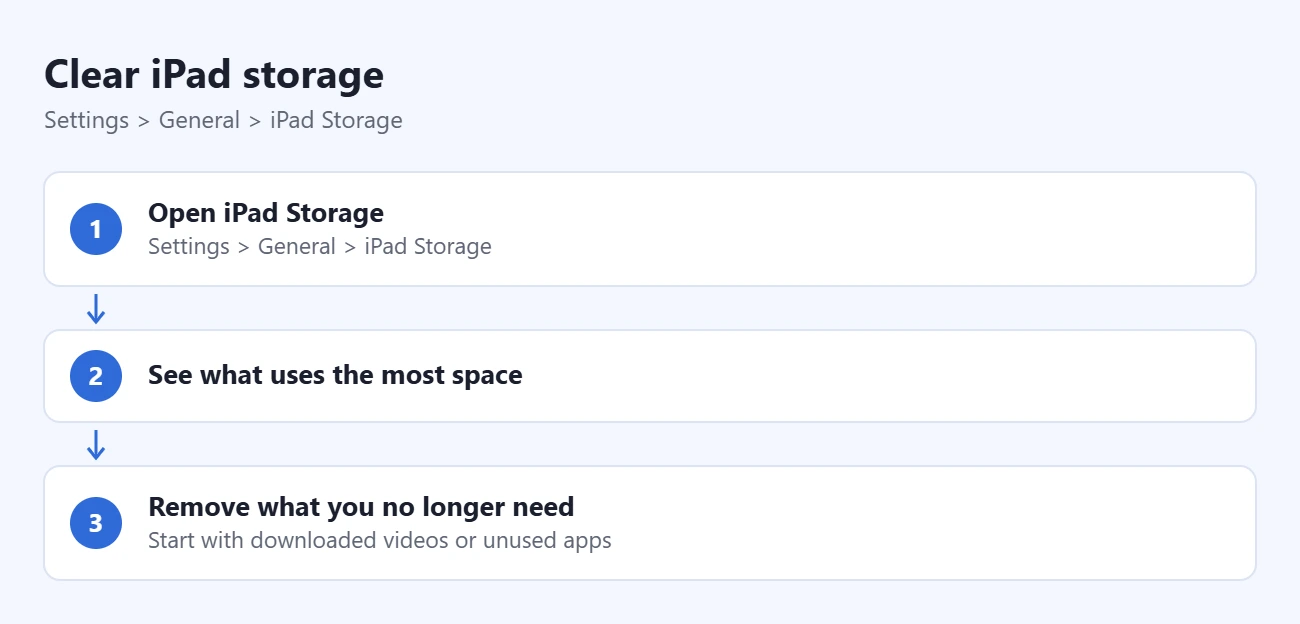
To clear iPad storage, open Settings > General > iPad Storage, identify what uses the most space, and remove content you no longer need. Start with downloaded videos or unused apps rather than deleting personal photos blindly. Offloading an app, optimizing iCloud Photos, and removing an iCloud Drive download can reduce local usage while retaining particular data elsewhere.
This guide covers the iPad’s built-in storage. iCloud storage is a separate allowance, and “memory” can also mean RAM, the working memory apps use while running. Buying more iCloud space does not increase the iPad’s built-in capacity. Before deleting anything important, confirm you have an independent copy you can actually open.
1. Find the largest storage users
Open Settings > General > iPad Storage and allow the breakdown to finish loading. Note the used space at the top, then review the largest apps and categories. Tap an app to inspect its size and documents and data. A small app with large saved files needs a different cleanup from a large app with little data.
Read each recommendation before enabling it or reviewing its suggested deletions. You can also follow our guide to checking iPad storage. Apple explains the categories and automatic cleanup in its storage support article.
2. Remove offline downloads you do not need
If a streaming or media app is near the top of the list, open that app and review its downloaded items. Remove watched episodes, movies, or other offline copies through the app’s own download controls. Check that you are removing the download rather than deleting an item from a synced library; the wording varies by app.
Keep anything you need without internet access. For example, removing several downloaded episodes after a trip may be more useful than deleting dozens of small documents. This is a cleanup example, not a measured storage-saving result. Apple’s iPad storage guide also identifies downloaded videos and app files as places to review.
3. Choose Offload App or Delete App deliberately
In Settings > General > iPad Storage, tap an app and choose the option that fits:
- Offload App: removes the app itself while retaining its documents and data. This helps when the app binary takes up substantial space; it does not remove the retained documents.
- Delete App: removes the app and its related local data. Export or verify important data first. An account login alone does not prove every document or game save is recoverable.
Confirm the action, then check storage again. An offloaded app needs to be downloaded before you can use it, and reinstalling depends on its continued availability and compatibility. Avoid offloading an essential travel app just before going offline.
For automatic offloading on current iPadOS, go to Settings > Apps > App Store > Offload Unused Apps. Older versions place App Store directly in Settings. Turn this on only if automatic removal suits how you use the iPad; you can turn it off later.
4. Use photo optimization without deleting your library
If you use iCloud Photos, check Settings > your name > iCloud > Photos and confirm Sync this iPad is enabled. Check the storage choice there; newer layouts put it under iPad Storage. Choose Optimize iPad Storage rather than Download and Keep Originals to let the iPad keep smaller versions while full-resolution originals remain in iCloud.
Apple’s iPad Photos guide documents the current layout and optimization behavior. Verify the library’s sync status in Photos. Uploads need sufficient iCloud space; optimization is managed over time, so it is not a promise of an immediate fixed reduction.
Do not delete photos simply because they appear in iCloud. With iCloud Photos, deletions sync to your other connected devices. It is a synchronized library, not an independent archive immune to deletion. Apple’s iCloud Photos explanation also notes that this library is not duplicated in iCloud Backup.
Delete only genuinely unwanted items or items with a verified independent copy. Deleted photos normally remain in Recently Deleted for 30 days. Check that album if you make a mistake. Permanently deleting them there ends that recovery option; do not empty it automatically as a routine cleanup step.
5. Distinguish removing a file download from deleting a file
Open Files and use the sidebar’s Locations to check where a file is stored. For a downloaded file in iCloud Drive, touch and hold it and choose Remove Download when available. This removes the iPad’s downloaded copy while retaining the cloud file. You will need a connection to download it again.
Delete does a different job. Deleting from iCloud Drive removes the file from other devices using that account as well. For files under On My iPad, verify another copy before deleting. Downloads from other cloud providers follow that provider’s controls; do not assume all locations behave like iCloud Drive.
Apple’s Files deletion and recovery guide explains these choices. Files deleted from iCloud Drive or On My iPad normally go to Recently Deleted for 30 days. Use Files > Recently Deleted, select the item, and choose Recover if needed. Deleting it permanently there removes that fallback.
6. Clear browser data only when it is useful
For Safari on current iPadOS, open Settings > Apps > Safari > Clear History and Website Data. Review the confirmation and selected timeframe before tapping Clear History. Older versions place Safari directly in Settings. Apple documents the current route in its Safari troubleshooting guide.
This affects Safari’s history, cookies, and website data; expect some sites to require a new sign-in. It does not clear every app’s cache, and the space saved may be small. Our guide on clearing cookies and cache on iPad covers the Safari options in more detail. For other apps, use their documented controls rather than deleting and reinstalling indiscriminately. See our iPad app-cache guide.
Check the result and investigate what remains
Return to Settings > General > iPad Storage after one cleanup action and let the figures refresh. Compare with your starting usage. Continue with another large category if necessary instead of performing every destructive action in sequence.
If System Data is the remaining concern, follow our System Data troubleshooting guide. There is no universal button to delete all system storage. The operating system and other managed components occupy space, and iPadOS handles many temporary files itself.
If plenty of storage is available but an app remains slow or crashes, storage cleanup may not address the cause. RAM and built-in storage are different resources. Start with that app’s troubleshooting advice rather than deleting personal files to “clean memory.” Choose your next action from the storage breakdown, and check the result before removing more.

Matthew Burleigh is the founder, head writer, and editor of Solve Your Tech, which he launched in 2012. He has written technology tutorials since 2008 and worked in IT since 2003, including small-business support, IT management, and consulting. He holds Bachelor’s and Master’s degrees in Computer Science from Arizona State University.
Matthew writes practical guides for Windows, iPhone and iPad, Microsoft Office, Outlook, Google apps, and Android. Solve Your Tech’s guides are tested on current devices or checked against official product documentation, with clear steps, sources, and update dates.
Read more about Matthew and how Solve Your Tech writes and updates its guides, or report a correction.