To resize a text box in Google Slides, click it and drag one of the square handles on its edges or corners. For an exact size, click the box, go to Format > Format options, open Size & Position, and type a new width and height.
These steps are for Google Slides in a web browser on a computer (Windows, Mac or Chromebook), with a separate section for the Slides app on a phone or tablet. You need edit access to the presentation. The steps follow Google Docs Editors Help: Insert and arrange text, shapes, diagrams, and lines, Change how text fits in placeholders & text boxes, and Keyboard shortcuts for Google Slides.
What Changes When You Resize a Text Box
Resizing changes the box, not the letters. When you drag a handle, the text inside rewraps to the new width, but the font size stays the same. If you want the words themselves to get bigger or smaller, change the font size or use the Shrink text on overflow setting described below.
Also check what you selected. A blue border with handles means the whole box is selected. A blinking cursor means you’re editing the text inside it, and some commands (like Delete) then act on the text instead of the box. Press Esc once to leave the text and keep the box selected.
How to Resize a Text Box by Dragging
- Click the text box to select it. Handles appear on its corners and edges.
- Hover over a handle until the pointer turns into a two-sided arrow.
- Drag a side handle to change only the width or only the height, or drag a corner handle to change both. Guide lines may appear to help you line the box up with other objects.
- Release the mouse button. The box keeps its new size, and the text rewraps to fit it.
Two keys change how the drag works, according to Google’s shortcut list:
- Hold Shift while you drag to keep the box’s proportions (aspect ratio).
- Hold Ctrl (Option on a Mac) while you drag to resize from the center, so the box grows or shrinks evenly on all sides.
If the box snaps back to a taller size when you let go, its text fitting is set to resize the shape around the text. See the text fitting section below.
How to Change the Scale of a Text Box to an Exact Size
Use the Format options sidebar when several boxes need to match or you want a precise measurement.
- Click the text box.
- In the menu at the top, click Format > Format options. You can also right-click the box and choose Format options. A sidebar opens on the right.
- Click Size & Position to expand it. In some versions of Slides this section is labeled Size & Rotation.
- Type a new value in Width and Height.
- To keep the height and width in proportion, click Lock aspect ratio before you change a value.
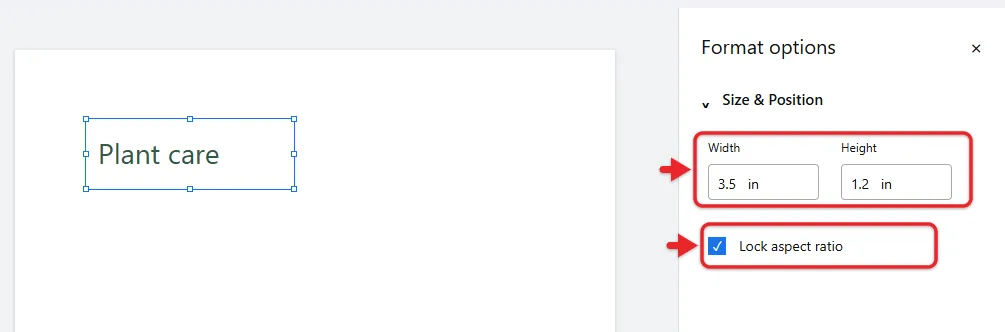
- Press Enter or click back on the slide. The text box changes to the exact dimensions you entered. With Lock aspect ratio on, changing one value changes the other to match.
To make several boxes the same size, select each one in turn and type the same Width and Height values. Pictures use the same Format options panel, and you can also crop and edit a picture in Google Slides before you resize it.
Set the size when you create the box
You can skip a resize step by drawing the box at the size you need. Click Insert > Text box, then click and drag on the slide to draw the box. Release the mouse and start typing.
Resize a Text Box With Keyboard Shortcuts
Select the box first (border selected, no blinking cursor). Google lists these shortcuts for Windows and ChromeOS:
| Action | Windows and ChromeOS | Mac |
|---|---|---|
| Resize larger | Ctrl + Alt + K | Cmd + Ctrl + K |
| Resize smaller | Ctrl + Alt + J | Cmd + Ctrl + J |
| Larger horizontally | Ctrl + Alt + B | Cmd + Ctrl + B |
| Smaller horizontally | Ctrl + Alt + W | Cmd + Ctrl + W |
| Larger vertically | Ctrl + Alt + I | Cmd + Ctrl + I |
| Smaller vertically | Ctrl + Alt + 9 | Not listed by Google |
Press a shortcut again to keep resizing in the same direction. To move the box instead, use the arrow keys to nudge it, or Shift + arrow keys for bigger steps.
How to Make a Text Box Fit Its Text
If a box keeps growing, won’t shrink, or your text spills out of it, change its text fitting setting. New text boxes use Resize shape to fit text by default, while theme placeholders (the title and body boxes that come with a layout) use Shrink text on overflow.
- Right-click the text box and click Text fitting. You can also go to Format > Format options and click Text fitting, or click the autofit icon that appears next to a new text box.
- Choose one of these options:
- Do not autofit keeps the box size and font size fixed, so long text can run past the edge.
- Shrink text on overflow keeps the box size and makes the font smaller when the text doesn’t fit.
- Resize shape to fit text keeps the font size and grows or shrinks the box around the text.
The box or the font adjusts as you type. Pick Do not autofit when you want full control of the box size, and Shrink text on overflow when the box has to stay put on a busy slide.
To change the default for new boxes, go to Tools > Preferences, check Use custom autofit preferences, and choose a setting. It only affects text boxes and placeholders you create afterward.
Resize a Text Box in the Google Slides App
On a phone or tablet, Google’s steps for Android are:
- Open the presentation and tap the text box once to select it.
- Drag one of the blue squares around the box to make it bigger or smaller.
- To move the box, drag it to a new spot. To rotate it, drag the blue circle at the top.
The app doesn’t have the full Format options sidebar, so use a computer when you need exact measurements.
How to Delete a Text Box
- Click the text box to select it. If you’re typing inside it, click its border so the whole box is selected, not just the text.
- Press Delete (or Backspace). You can also right-click and choose Delete, or click Edit > Delete. In the mobile app, tap the box, tap More, then tap Delete.
To delete several boxes at once, hold Shift while you click each one, then press Delete.

Troubleshooting
- The box won’t get smaller than its text: it’s set to Resize shape to fit text. Switch it to Do not autofit, then resize it.
- Text spills out the bottom: the box is set to Do not autofit. Make the box taller, or switch to Shrink text on overflow.
- You resized the wrong thing: press Ctrl + Z (Cmd + Z on a Mac) or click Edit > Undo. Undo steps back one action at a time.
- Only the text was deleted, not the box: the cursor was inside the box. Click the border once and press Delete again.
- You can’t select or resize the box: another object may be on top of it, so change the layer order in Google Slides to bring it forward. If the box belongs to the theme’s master or layout, open Slide > Edit theme to change it. If no handles appear at all, you may only have view or comment access, so ask the owner for edit access.
Frequently Asked Questions
Does resizing a text box change the font size?
No. Dragging handles or typing a new width and height changes the box only. The font changes size only when you pick a new size or when the box is set to Shrink text on overflow.
How do I make the text bigger without resizing the box?
Select the text and press Ctrl + Shift + > to increase the font size or Ctrl + Shift + < to decrease it (Cmd instead of Ctrl on a Mac). You can also type a size in the font size box on the toolbar.
Can I resize a text box by percentage?
Google’s help pages describe resizing by dragging, by typing a width and height in Format options, and by shortcuts. To scale by a set amount, work out the new width and height, turn on Lock aspect ratio, and type the new width.
How do I make all text in a box uppercase?
Select the text, then go to Format > Text > Capitalization and choose UPPERCASE, lowercase, or Title Case.
Related Guides
- How to add an arrow or line in Google Slides
- How to change layer order in Google Slides
- How to change the font on all slides in Google Slides
- How to change the theme in Google Slides

Matthew Burleigh is the founder, head writer, and editor of Solve Your Tech, which he launched in 2012. He has written technology tutorials since 2008 and worked in IT since 2003, including small-business support, IT management, and consulting. He holds Bachelor’s and Master’s degrees in Computer Science from Arizona State University.
Matthew writes practical guides for Windows, iPhone and iPad, Microsoft Office, Outlook, Google apps, and Android. Solve Your Tech’s guides are checked step by step against the device or app maker’s own documentation and tested on his own devices whenever he has the hardware or software, with clear steps, sources, and update dates.
Read more about Matthew and how Solve Your Tech writes and updates its guides, or report a correction.