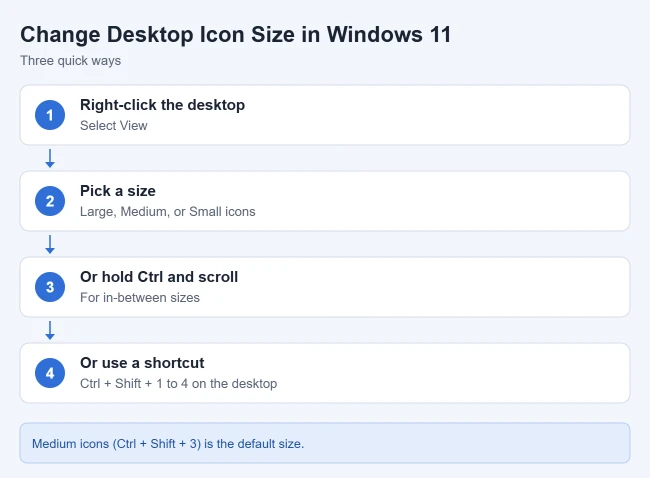
To change the size of desktop icons in Windows 11, right-click an empty area of the desktop, select View, then choose Large icons, Medium icons, or Small icons. For in-between sizes, click the desktop, hold Ctrl, and scroll the mouse wheel.
These steps cover Windows 11 versions 24H2, 25H2, and 26H2. The desktop and File Explorer methods work the same way in Windows 10. Desktop icons, File Explorer icons, and taskbar icons each have their own size setting, so pick the section that matches the icons you want to change.
Change Desktop Icon Size in Windows 11
This changes only the icons on your desktop. It doesn’t change text, apps, or the taskbar.
- Minimize open windows with Windows key + D so you can see the desktop.
- Right-click an empty area of the desktop, not an icon or the taskbar. A menu opens.
- Select View. A submenu shows the size choices and the arrangement options.
- Choose Large icons, Medium icons, or Small icons. The icons resize right away, and the current size has a dot next to it.
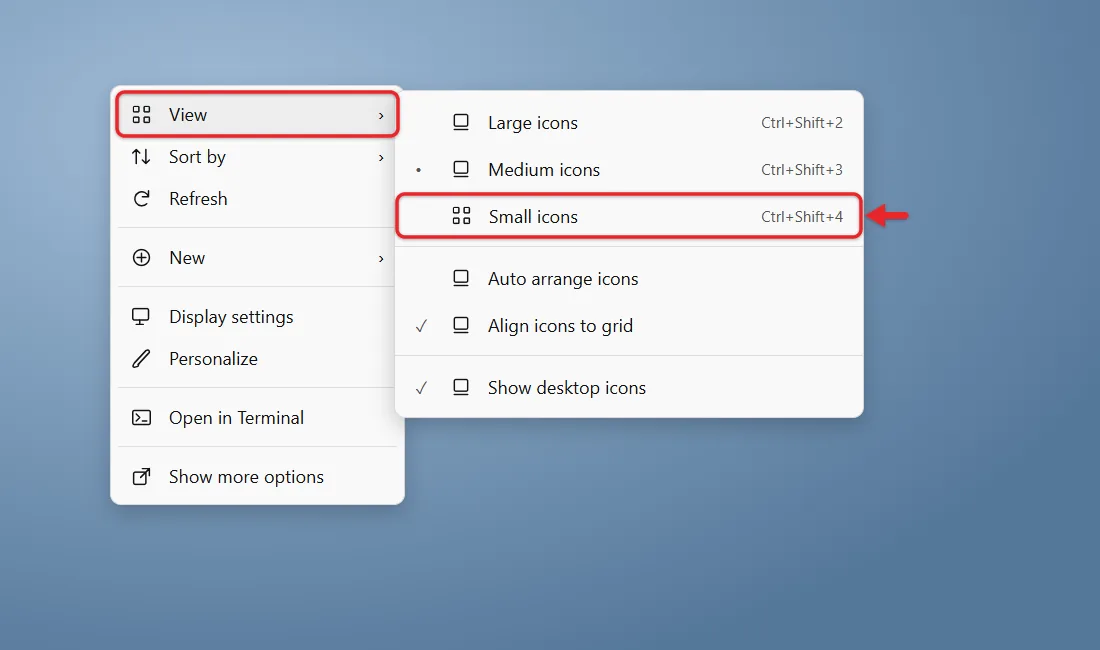
Medium icons is the Windows default. If you’re not sure which size you want, start with Large and go back to Medium if the icons crowd the screen. How big each preset looks depends on your monitor. On a 4K screen at its recommended scale, Small icons can be hard to read, while on a small laptop screen Large icons may fill most of the desktop.
Use Ctrl and the Mouse Wheel for a Custom Size
The View menu has only three sizes. The mouse wheel gives you many steps in between, plus sizes larger than Large.
- Click an empty area of the desktop so it’s the active window.
- Hold down Ctrl.
- Roll the mouse wheel up to make the icons larger, or down to make them smaller. Each notch changes the size a little.
- Release Ctrl when the icons look right.
On a laptop, hold Ctrl and use the touchpad’s two-finger scroll gesture instead. If the icons get smaller when you expect them to grow, your scroll direction is probably reversed in your touchpad or mouse settings, so roll the other way. Microsoft describes both the View menu and the Ctrl method in its guide to customizing desktop icons.
Use a Keyboard Shortcut
Click an empty spot on the desktop first, then press one of these. Use the number keys above the letters, not the number pad.
| Shortcut | Desktop icon size |
|---|---|
| Ctrl + Shift + 1 | Extra large |
| Ctrl + Shift + 2 | Large |
| Ctrl + Shift + 3 | Medium (default) |
| Ctrl + Shift + 4 | Small |
Extra large doesn’t appear in the View menu. You can reach it only with Ctrl + Shift + 1 or with Ctrl and the mouse wheel.
Keep Icons in Place After Resizing
When icons get bigger, Windows may shift them to keep them on a grid. Two options in the same View menu control this:
- Auto arrange icons lines up every icon in columns from the left edge. Uncheck it if you want to drag icons wherever you like.
- Align icons to grid snaps icons to evenly spaced spots. Leave it on for a tidy layout, or turn it off to place icons freely.
If you change the size often, turn on Align icons to grid so the icons don’t overlap when they grow.
Change Icon Size in File Explorer
Folder windows have their own icon size, separate from the desktop.
- Open File Explorer with Windows key + E and go to the folder.
- Select View on the command bar at the top of the window.
- Choose Extra large icons, Large icons, Medium icons, or Small icons. The files in that folder resize right away.

You can also hold Ctrl and scroll the mouse wheel inside the folder. In File Explorer, scrolling past the icon sizes switches to the List and Details layouts, which show file names in rows instead of icons. Scroll the other way to get back to icons.
Example: A Folder That Starts at Large Icons
On an Alienware m16 R2 running Windows 11 Home 25H2 (OS build 26200.9711), opening the Pictures folder (backed up to OneDrive) and selecting View showed it set to Large icons, not Medium. The menu listed Extra large icons, Large icons, Medium icons, Small icons, List, Details, Tiles and Content, followed by Details pane, Preview pane and a Show submenu.
Picture folders often open at a bigger size than other folders, because Windows uses a different folder template for them. If one folder looks different from the rest, check its View setting before changing anything else.
Use the Same Size in Every Folder
By default, the view you pick applies only to the folder you’re in.
- Set the icon size you want in one folder.
- Select the See more button (three dots) on the command bar, then Options.
- Open the View tab and select Apply to Folders.
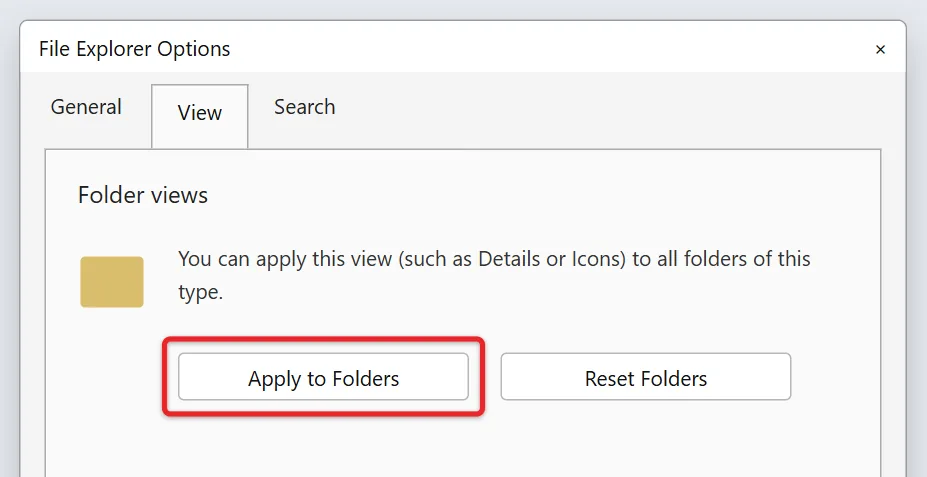
- Select Yes, then OK.
This applies the view to other folders of the same type, such as other general folders or other picture folders. To undo it, return to the same View tab and select Reset Folders, then Yes and OK. Every folder of that type goes back to the Windows default view.
Change Taskbar Icon Size and Height
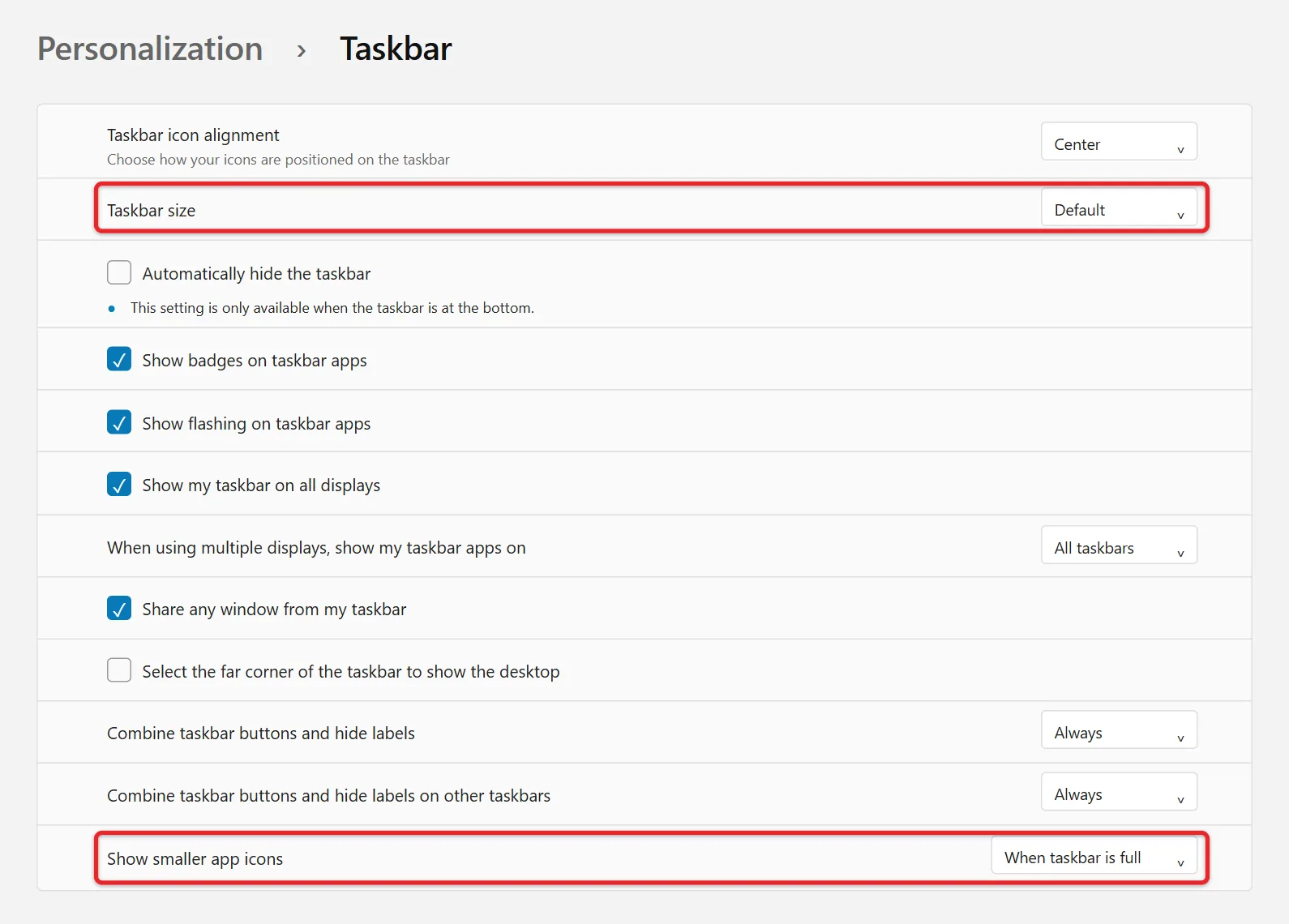
Open Settings > Personalization > Taskbar and expand Taskbar behaviors. You can also right-click an empty part of the taskbar and choose Taskbar settings.
Change the App-Button Size
Under Show smaller taskbar buttons, choose Always for small app icons, When taskbar is full to shrink them only when space runs out, or Never to keep the standard size. Microsoft introduced this choice in its June 2025 update for Windows 11 version 24H2.
Make the Whole Taskbar Smaller
If Taskbar size appears, choose Small to reduce both the bar’s height and its icons. Microsoft’s August 2026 release notes describe this option for Windows 11 24H2 and 25H2 as a gradual rollout, which means it reaches PCs in stages. The smaller taskbar works only when the bar is at the top or bottom of the screen, not the left or right edge.
If you don’t see Taskbar size, go to Settings > Windows Update, select Check for updates, and restart after the updates install. It can take a few weeks for the option to appear. Windows has no setting for a custom pixel height or a taskbar with several rows. You can change other taskbar settings, such as alignment and which buttons show, when you customize the Windows 11 taskbar.
Some sites suggest a registry value called TaskbarSi to change the taskbar size. It isn’t a Microsoft-supported setting in current Windows 11 versions, so use the Settings options above instead.
Make Icons and Text Bigger Everywhere
If everything on the screen looks too small, not just the icons, change the display scale instead of the icon size.
- Open Settings with Windows key + I and select System > Display.
- With more than one monitor, select the display you want to change at the top of the page.
- Under Scale & layout, open Scale and pick a larger percentage.
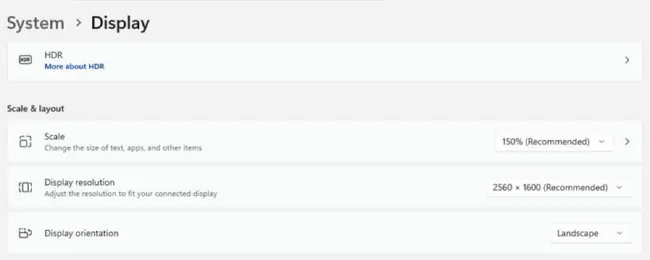
Scaling enlarges icons, text, menus, and apps together, and it’s the only built-in way to make Start menu and system tray icons larger. Most changes appear immediately, but Microsoft’s guide to making text and apps bigger notes that some apps need you to sign out and back in, so save your work first. To undo it, choose your previous percentage or the option marked (Recommended), which Microsoft’s display layout guide suggests for most screens.
Use icon size when only the desktop looks off, and scaling when you squint at everything. To enlarge only text, open Settings > Accessibility > Text size, drag the slider, and select Apply. For more on that setting, read how to increase text size in Windows 11.
If everything on a Windows 10 PC suddenly looks zoomed in, follow our steps to get your screen back to normal size.
If the View Menu Is Missing
- The View menu is missing: right-click a blank part of the desktop. Right-clicking an icon, a file, or the taskbar opens a different menu.
- The Ctrl shortcut does nothing: click the desktop first so it’s active, then hold Ctrl while you use a physical mouse wheel or touchpad scrolling.
- The icons disappeared: right-click the desktop, select View, and make sure Show desktop icons is checked. Hiding icons doesn’t delete them. To add system icons such as This PC or Recycle Bin, follow the steps to add desktop icons in Windows 11.
- The icons suddenly got huge: you may have held Ctrl while scrolling by accident. Press Ctrl + Shift + 3 on the desktop to return to Medium. If text and windows grew too, check Settings > System > Display and set Scale and Display resolution back to the values marked (Recommended), or follow our steps to reset display settings in Windows 11.
- The size won’t change or keeps resetting: restart Windows Explorer. Press Ctrl + Shift + Esc to open Task Manager, right-click Windows Explorer on the Processes tab, and select Restart. The desktop and taskbar disappear for a moment and come back.
- Icons look blurry after resizing: small icons stretched to extra large can look soft because the app’s icon file doesn’t include a big enough image. Choose a smaller size, or change the shortcut’s icon from its Properties window.
Windows Icon Size Questions
How do I restore the default icon size?
Right-click the desktop, select View, then choose Medium icons, or click the desktop and press Ctrl + Shift + 3. In File Explorer, use See more > Options > View > Reset Folders to return folders to their default view.
Does changing icon size change my screen resolution?
No. Desktop icon size only changes how the icons are drawn. Resolution and scale are separate settings under Settings > System > Display.
Can I change the spacing between desktop icons?
Windows 11 has no setting for icon spacing. Larger icons get more room automatically, and Align icons to grid keeps them evenly spaced. Some guides change spacing through the registry, but a wrong value can scramble the desktop layout, so we don’t recommend it for most people.
Can I make Start menu icons bigger?
Not on their own. The Start menu has no icon size control, so use display scaling to make its icons and text larger.
Why are my desktop icons a different size on my second monitor?
Each monitor can have its own scale. Select that monitor under Settings > System > Display and match its Scale to your main screen.
If your icons look right but you want fewer of them, the next step is to clean up the desktop by removing shortcuts you don’t use.

Matthew Burleigh is the founder, head writer, and editor of Solve Your Tech, which he launched in 2012. He has written technology tutorials since 2008 and worked in IT since 2003, including small-business support, IT management, and consulting. He holds Bachelor’s and Master’s degrees in Computer Science from Arizona State University.
Matthew writes practical guides for Windows, iPhone and iPad, Microsoft Office, Outlook, Google apps, and Android. Solve Your Tech’s guides are checked step by step against the device or app maker’s own documentation and tested on his own devices whenever he has the hardware or software, with clear steps, sources, and update dates.
Read more about Matthew and how Solve Your Tech writes and updates its guides, or report a correction.