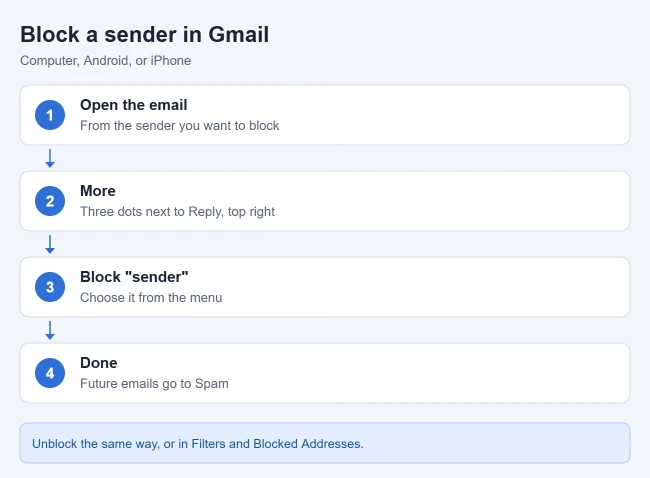
To block someone’s email address in Gmail, open an email from them, click More (the three dots) next to Reply at the top right, and choose Block followed by the sender’s name. Future emails from that address go straight to Spam. The same steps work in the Gmail app on Android and iPhone.
This guide covers blocking on a computer and phone, unblocking, reviewing your blocked list, and when a filter or unsubscribe is the better choice. It follows Google’s Block an email address in Gmail and Create rules to filter your emails help pages.
How to Block an Email Address in Gmail on a Computer
- Open Gmail on your computer.
- Open an email from the person you want to block.
- At the top right, next to Reply, click More (three dots).
- Click Block “[sender]”.
Result: Google says all future emails from that sender go to Spam. Gmail shows a confirmation banner, and you can also block from the inbox list by checking the email and using the More menu above your inbox.
How to Block Someone in the Gmail App
- Open the Gmail app on your Android phone, iPhone, or iPad.
- Open the message from the sender.
- At the top right, next to Reply, tap More.
- Tap Block “[sender]”.
Result: the block applies to your Gmail account, so their future emails go to Spam on every device.
How to Unblock Someone
- Open an email from them and click or tap More > Unblock “[sender]”.
- If you can’t find one of their emails, Google suggests checking Spam, or using the blocked list below.
Result: Google says future emails from that sender go back to your inbox. If they still land in Spam, Google points to its help on fixing valid emails in Spam, such as marking one as Not spam.
How to See Everyone You’ve Blocked
- On a computer, open Gmail and click Settings at the top right.
- Click See all settings.
- Click Filters and Blocked Addresses.
- To unblock, check the box next to each sender and click Unblock selected addresses.
Result: you get a full list of blocked addresses. Google lists these steps for Gmail on a computer.
What Happens When You Block Someone?
- Their future emails go to your Spam folder instead of your inbox.
- Google describes the block as applying to future emails.
- The sender can still send you messages. Google doesn’t describe notifying them; their emails just don’t reach your inbox.
- When you unblock them, their new emails go back to your inbox.
Block, Filter, or Unsubscribe?
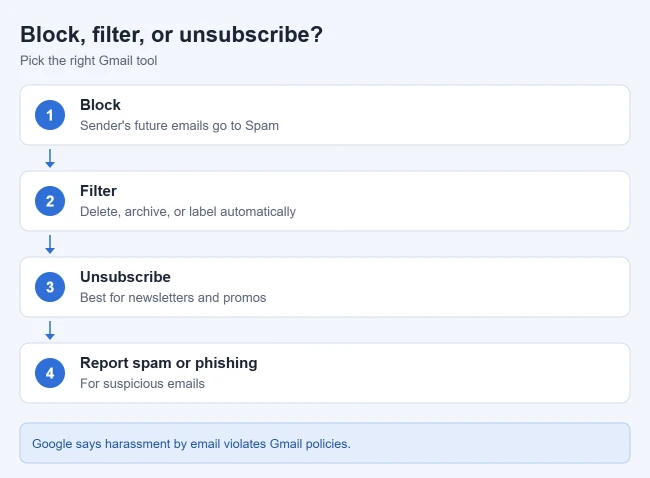
Blocking isn’t always the best tool. Google suggests unsubscribing from promotional emails and newsletters you don’t want, instead of blocking the sender. For more control, create a filter:
- In the Gmail search box, click Show search options.
- Enter the sender’s address in the From field.
- Click Create filter.
- Choose an action, such as Delete it, and click Create filter.
Result: matching emails are handled automatically. You can archive and mark them as read instead of deleting them if you want to keep a copy. To change a filter later, see how to delete or edit a filter in Gmail.
Harassment, Spam, and Phishing
- Google says using Gmail to harass, intimidate, or threaten someone violates Gmail’s Program Policies. If you feel you’re in danger, contact your local authorities.
- If spam reaches your inbox, report it as spam.
- If an email asks for personal information, report it as phishing.
Frequently Asked Questions
Will the person know I blocked them?
Google doesn’t describe any notification to the sender. Their emails simply go to your Spam folder. Chat is handled separately, so see how to block message requests from strangers in Google Chat if the same person contacts you there.
Can I block a whole domain?
Gmail’s Block option works one sender at a time. A filter with the domain in the From field can catch everything from that domain. Google Workspace admins can also block addresses or domains for their organization.
More Gmail guides: How to automatically forward emails in Gmail. To keep pictures in unwanted emails from loading on their own, see how to get Gmail to ask before displaying external images.

Matthew Burleigh is the founder, head writer, and editor of Solve Your Tech, which he launched in 2012. He has written technology tutorials since 2008 and worked in IT since 2003, including small-business support, IT management, and consulting. He holds Bachelor’s and Master’s degrees in Computer Science from Arizona State University.
Matthew writes practical guides for Windows, iPhone and iPad, Microsoft Office, Outlook, Google apps, and Android. Solve Your Tech’s guides are tested on current devices or checked against official product documentation, with clear steps, sources, and update dates.
Read more about Matthew and how Solve Your Tech writes and updates its guides, or report a correction.