To add a song to a playlist in Apple Music on an iPhone, touch and hold the song (or tap the More button with three dots next to it), tap Add to a Playlist, and choose the playlist. If the song is already playing, open the Now Playing screen, tap the More button, and tap Add to a Playlist.
These steps are for iOS 27 and iOS 26 and work the same on an iPad; later sections cover Mac, Windows, and the web. Apple covers playlists in Create, edit, and delete music playlists on iPhone.
Add a Song to a Playlist on iPhone
- Open the Music app.
- Find the song. Browse Library, or tap Search and type the song or artist name.
- Touch and hold the song until a menu appears. You can also tap the More button (three dots) on the right side of the song.
- Tap Add to a Playlist. A list of your playlists opens.
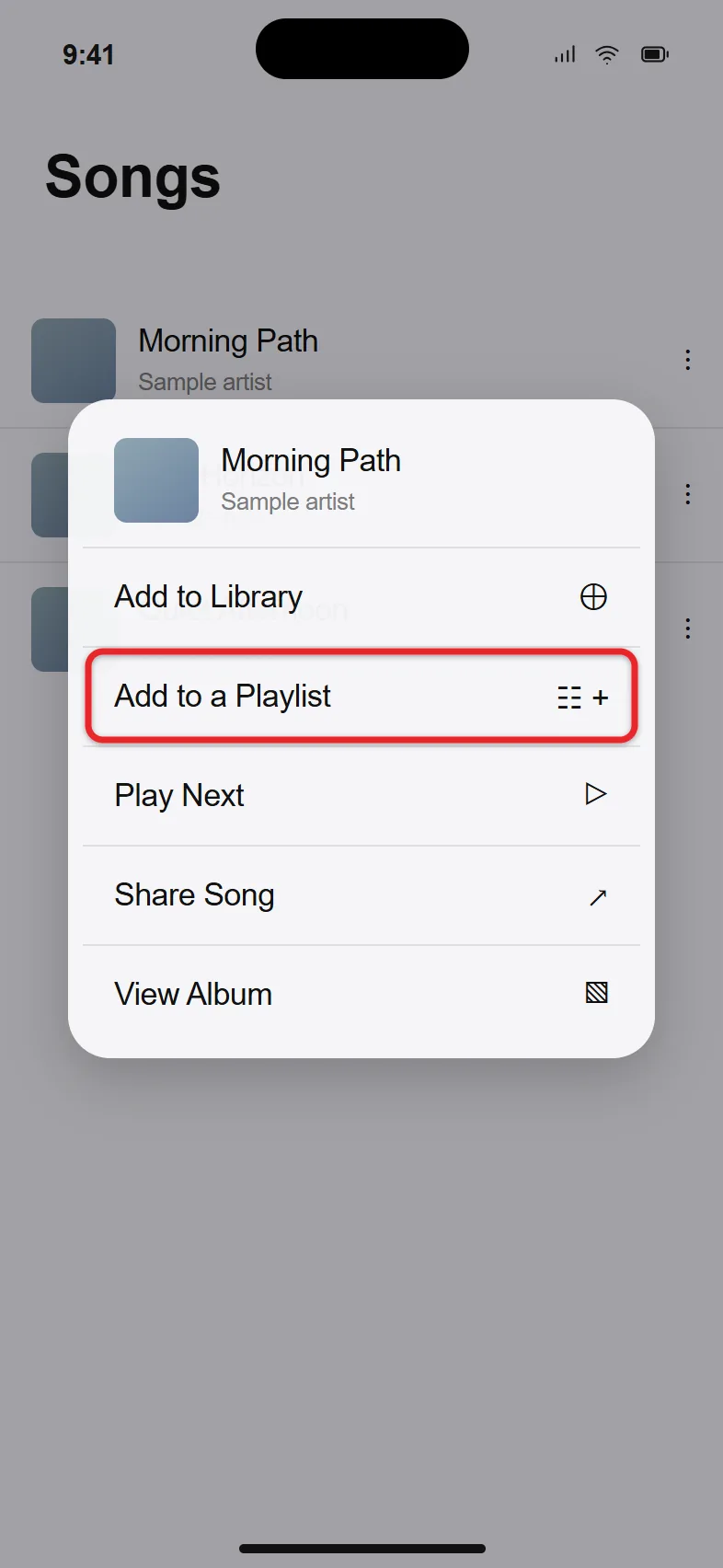
- Tap the playlist you want. The menu closes and the song is added to the end of that playlist.

If you haven’t made the playlist yet, tap New Playlist at the top of the list in step 5, give it a name, and the song goes into the new playlist.
To check that it worked, open Library > Playlists, tap the playlist, and scroll to the bottom. The new song should be the last track.
The same menu works for more than single songs. Touch and hold an album, another playlist, or a music video and tap Add to a Playlist to add every track in it at once.
Songs from your own files work too once they are in your library. To get one there, download an MP3 to iPhone and sync it to Music.
Add the Song That’s Playing Now
- While the song plays, tap the mini player at the bottom of the screen to open the Now Playing screen.
- Tap the More button (three dots).
- Tap Add to a Playlist and choose the playlist.
This is the quickest way to save a song you hear on the radio, in a station, or in someone else’s playlist.
Add Several Songs From Inside a Playlist
When you’re building a playlist, it’s faster to add songs from the playlist itself.
- Open Library > Playlists and tap the playlist.
- Tap the More button (three dots), then tap Edit.
- Tap Add Music. A search and browse screen opens.
- Find a song and tap the Add button (plus sign) next to it. A checkmark replaces the plus sign. Add as many songs as you want.

- Tap Done to return to the playlist, then tap Done again to save your changes.
You can also scroll to Suggested Songs at the bottom of many playlists and tap the Add button next to a suggestion.
A short playlist built this way is also an easy way to limit the music stored on your Apple Watch.
Create a New Playlist and Fill It at Once
Apple’s current steps for starting from scratch on iPhone:
- Open the Library tab and tap the New Playlist button.
- Tap Create New Playlist, type a name, and tap Add Songs.
- Tap each song you want, then tap the Save button (checkmark).

On an iPad, New Playlist is at the bottom of the sidebar instead.
Apple also lists Playlist Playground, which builds a playlist from a description such as a mood, genre, activity, or era, after which you can add or remove songs. Apple says it needs an Apple Music subscription with Sync Library turned on and an internet connection, is a beta available in the US in English, and is for subscribers 13 or older.
Choose Whether Playlist Songs Go Into Your Library
When you add a catalog song to a playlist, it doesn’t have to appear in your main song list. On iPhone, this is controlled by a setting:
- Open Settings and tap Apps, then Music.
- Turn on Add Playlist Songs if you want every song you add to a playlist to also appear in your library. Turn it off to keep those songs only in the playlist.
On iOS 17 and earlier, the Music settings are listed directly in Settings instead of under Apps.
Add a Song to a Playlist on a Mac
- Open the Music app.
- Find the song in your library or in Apple Music.
- Control-click the song, choose Add to Playlist, and pick the playlist. You can also drag the song onto a playlist in the sidebar.
To keep playlist songs out of your library on a Mac, choose Music > Settings, click Advanced, and turn off Add & Delete Playlist Songs. To put songs in a custom order, choose View > Sort By > Playlist Order, then drag them. To remove one, select it in the playlist and press Delete. For more detail, read Apple’s Create, edit, and delete playlists in Music on Mac. A playlist made on the iPhone reaches the Mac through Sync Library or Apple’s other routes, which are explained in how to copy a playlist from iPhone to iTunes or Apple Music.
Add a Song on Windows, Android, or the Web
- Apple Music app for Windows: drag the song onto a playlist under Playlists in the sidebar. To start a new one, click the Add button (plus sign) next to Playlists and click New Playlist.
- Apple Music for Android: tap the More button next to the song, tap Add to Playlist, and pick the playlist. The steps match the iPhone app closely.
- Web player at music.apple.com: move the pointer over a song, click the More button, choose Add to Playlist, and pick a playlist or New Playlist. You can also drag songs from your library onto a playlist in the sidebar. Apple’s Apple Music on the web guide covers these steps.
Remove a Song or Change the Order
- Open the playlist and tap the More button (three dots), then Edit.
- To remove a song, tap the red minus button next to it, then tap Delete. To move a song, drag the handle (three lines) on its right side up or down.
- Tap Done.
Removing a song from a playlist doesn’t delete it from your library. If you want it gone from the iPhone completely, delete songs on an iPhone.
If Add to a Playlist Isn’t Working
- The playlist isn’t in the list. Smart playlists made on a Mac, and playlists other people made that you’ve only added to your library, can’t be edited. Make your own playlist with New Playlist and add the song there.
- You can’t edit a shared playlist. In a collaborative playlist, other people can add, remove, and reorder songs, but only the owner can change everything else, such as the name and cover.
- The song shows up twice. Apple Music lets you add the same song to a playlist more than once. Open Edit and delete the extra copy.
- Changes don’t appear on your other devices. Open Settings > Apps > Music on each device and turn on Sync Library. All devices need to use the same Apple Account.
- Songs in the playlist are grayed out. Catalog songs need an active Apple Music subscription to play. If your subscription ended, those songs stay in the playlist but won’t play.
Your followers can see playlists you make, and you can make your Apple Music profile private if you’d rather keep them to approved friends.
Apple Music Playlist Questions
Can I add a song to more than one playlist?
Yes. Repeat the steps for each playlist. A song can be in as many playlists as you like.
Do I need an Apple Music subscription to make playlists?
No. You can build playlists from songs you bought or imported without a subscription. You need a subscription to add songs from the Apple Music catalog, to use Playlist Playground, and to play catalog songs in your playlists.
Does adding a song to a playlist download it?
No. Adding a song only puts it in the playlist. To play it without an internet connection, download the playlist or song. Then you can listen to Apple Music offline.
To pick the quality of the songs you download, turn on lossless audio in Apple Music.
Does deleting a playlist delete its songs?
No. Touch and hold the playlist in Library > Playlists and tap Delete from Library to remove it. The songs stay in your library.
Once your playlist is ready, you can also play Apple Music on Apple TV.

Matthew Burleigh is the founder, head writer, and editor of Solve Your Tech, which he launched in 2012. He has written technology tutorials since 2008 and worked in IT since 2003, including small-business support, IT management, and consulting. He holds Bachelor’s and Master’s degrees in Computer Science from Arizona State University.
Matthew writes practical guides for Windows, iPhone and iPad, Microsoft Office, Outlook, Google apps, and Android. Solve Your Tech’s guides are checked step by step against the device or app maker’s own documentation and tested on his own devices whenever he has the hardware or software, with clear steps, sources, and update dates.
Read more about Matthew and how Solve Your Tech writes and updates its guides, or report a correction.