To set a ringtone or text tone for one contact on an iPhone, open Contacts, tap the person’s name, tap Edit, then tap Ringtone (for calls) or Text Tone (for messages) and choose a sound. That person now gets their own sound, and everyone else keeps your default tone.
These steps follow Apple’s current instructions for iPhone, including iOS 26 and iOS 27. The same two fields have been on the contact card for many iOS versions, so older iPhones work in much the same way, although button positions can differ slightly.
Before you start
- The person must be saved as a contact. A phone number that is not in Contacts always uses your default tone.
- The setting belongs to one contact card. If the same person has two cards, a call or text from a number on the other card will not use your chosen tone.
- Any tone already on your iPhone can be used, including the built-in sounds and tones you bought or made.
Set a ringtone or text tone for one contact
- Open the Contacts app and tap the person’s name.
- Tap Edit in the upper-right corner of the contact card.
- Scroll down if needed and tap Ringtone to change the sound for calls, or Text Tone to change the sound for messages. Both normally show Default until you change them.
- Tap a sound in the list. Your iPhone plays a preview and marks the sound you picked.
- Tap Done to leave the tone list. On some iOS versions this button appears as a checkmark.
- If the card is still in edit mode, tap Done (or the checkmark) again to save the contact.
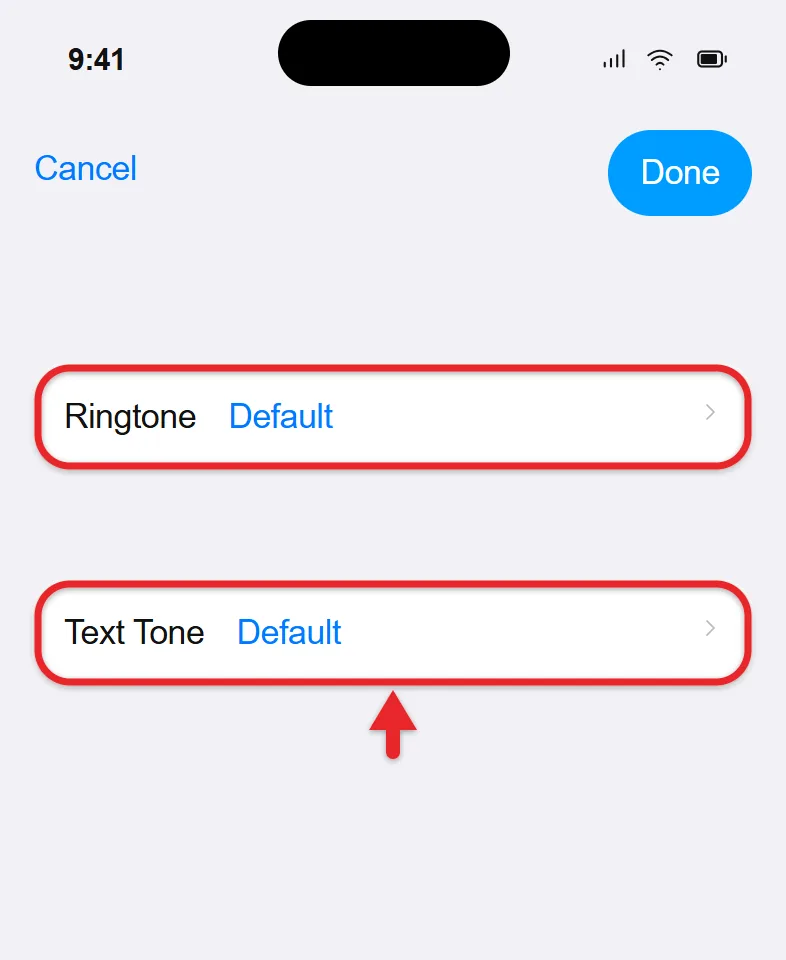
Ringtone and Text Tone are separate settings. To give one person a custom sound for both calls and texts, set each field. If you change only Ringtone, their messages keep using the default text tone. Apple lists these steps in Use tones and ringtones with your iPhone or iPad.
The tone list may also include a vibration choice, labeled Haptics on recent iOS versions. If you see it, you can pick a different vibration pattern there. The same choice exists for the phone-wide sounds in Settings, where you can also change or turn off text message vibrations.
For that pattern to play while the phone is silenced, put your iPhone on vibrate first.
Confirm the change or undo it
Open the contact card again. The Ringtone or Text Tone row should now show the name of the sound you chose instead of Default. The clearest check is to have that person call or text you while your iPhone is not silenced.
To undo the change, tap Edit on the card, tap the same field, choose Default in the list, and save. The contact goes back to whatever sound you use for everyone else. Changing a contact’s tone never alters the phone-wide setting, which lives in Settings > Sounds & Haptics. For that screen, read about changing your ringtone and sounds on an iPhone.
The same Edit screen holds every other detail on the card, so you can edit the contact to update a number, email, or photo while you are there.
If the contact has a photo, you can also make their incoming call picture full screen so it fills the display when they call.
Use a purchased or custom tone
You are not limited to the built-in sounds. There are two other sources:
- Tone Store: Go to Settings > Sounds & Haptics > Ringtone > Tone Store to buy a tone. This is a paid purchase charged to your Apple Account. Purchased tones appear at the top of the sound list, so you can then pick one on a contact card. If earlier purchases are missing, look for Download All Purchased Tones in the same list. Some older purchases may not be available to download again.
- GarageBand: Apple’s free GarageBand app can export an audio file or an unprotected song as a ringtone of up to 30 seconds. After the export, tap Use sound as and choose Assign to contact to attach it to one person straight away. The full process is in how to set an iPhone ringtone from an audio file.
Let one contact ring through Silent mode or a Focus
A custom tone does not make a contact louder than your other alerts. If the iPhone is silenced, that person’s tone is silenced too. Emergency Bypass is the exception. When it is turned on for a contact, their sounds and vibrations come through even when all other notifications have been silenced.
Think before turning it on: this contact will be able to make your iPhone sound in meetings, at night, and at any other time you have silenced it. Use it only for people you always need to hear from.
- Open Contacts, select the person, and tap Edit.
- Tap Ringtone to cover calls, or Text Tone to cover messages.
- Turn on Emergency Bypass, then save.
The switch is separate in each field, so turn it on in both if you want calls and texts to get through. To reverse it, return to the same screen and turn the switch off. Apple covers this in If you don’t receive Messages notifications on your iPhone or iPad.
Emergency Bypass is separate from your Phone favorites, so you can remove a contact from Favorites on iPhone without changing their tone.
If the contact’s tone does not play
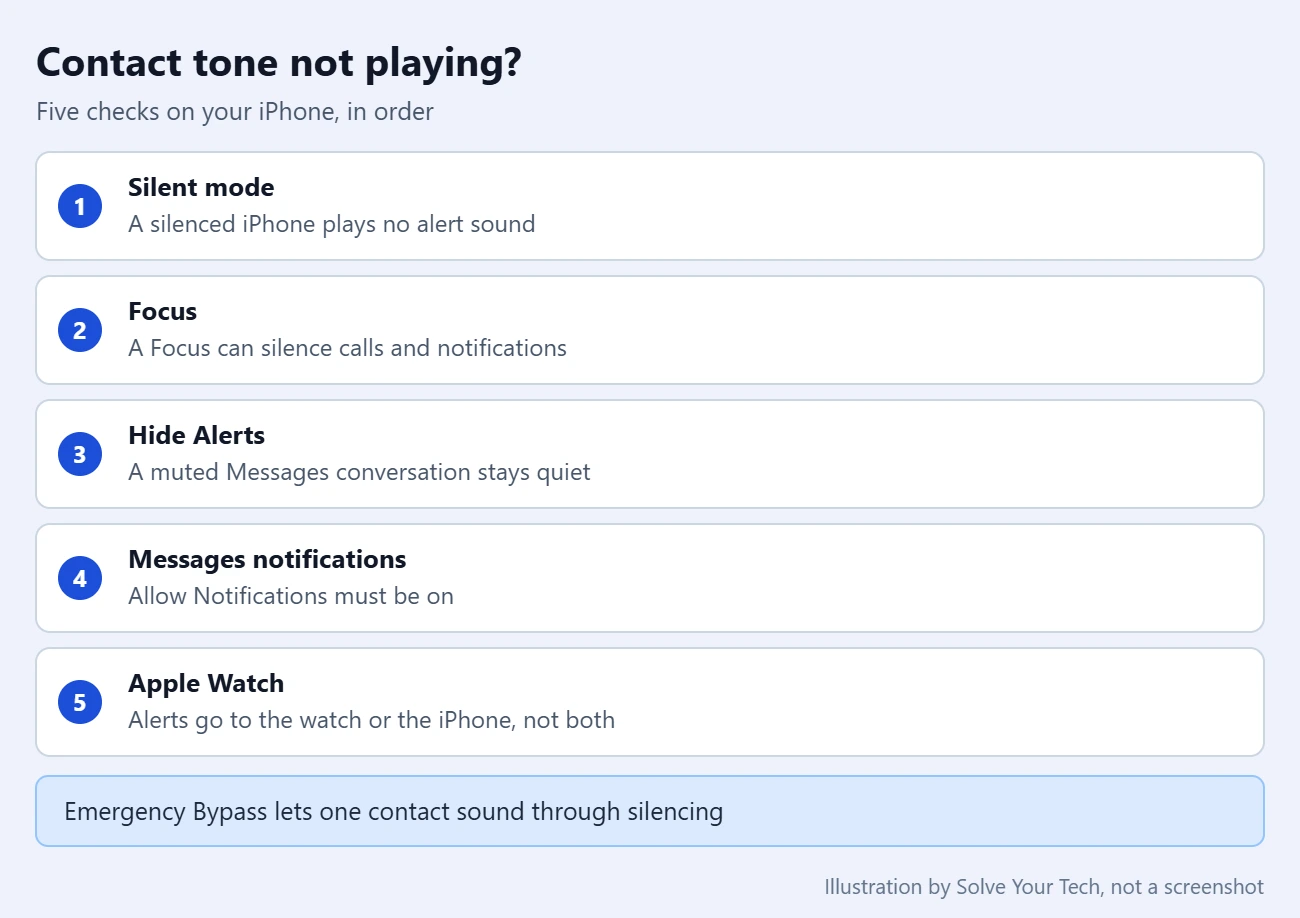
- Silent mode is on. On models with an Action button, open Control Center to check the ringer. On other models, check the Ring/Silent switch on the side.
- A Focus is active. A Focus such as Do Not Disturb can silence calls and notifications. Turn it off, or allow this person in that Focus.
- The conversation is muted. In Messages, open the conversation, tap the name or picture at the top, and turn off Hide Alerts. A muted thread stays quiet whatever text tone is set. To recognize a muted thread, read why there is a bell or moon next to a text message.
- Messages notifications are off. Go to Settings > Apps > Messages > Notifications and make sure Allow Notifications is on.
- You wear an Apple Watch. Notifications go to either the watch or the iPhone, not both, so the iPhone may stay quiet while the watch alerts you.
- Messages is open. You do not get a notification for each new message while the Messages app is open and active.
- The sender used a different number or email address. If it is not on the card you edited, the iPhone treats it as someone else and plays the default tone. Add the number or address to the card, or set the tone on the other card as well.
- The Ringtone or Text Tone row is missing. Make sure you tapped Edit first, then scroll down the card.
Frequently asked questions
Can I set a different text tone and ringtone for the same person?
Yes. Ringtone and Text Tone are two separate fields on the contact card. Tap Edit, set a sound in each field, and save. Calls from that person use the ringtone and messages use the text tone.
Can I set one ringtone for a whole group of contacts?
Apple’s instructions only describe setting a tone one contact at a time. To give several people the same sound, repeat the steps on each card. Everyone you do not change uses the default from Settings > Sounds & Haptics.
Does a contact’s custom tone work when my iPhone is on silent?
Not by default. Silent mode and Focus silence custom tones along with everything else. Only a contact with Emergency Bypass turned on can sound through.
Will the person know I gave them a custom tone?
No. The tone is a setting on your own contact card and only changes the sound your iPhone plays. Nothing is sent to the other person.
How do I remove a custom ringtone from a contact?
Open the contact, tap Edit, tap Ringtone or Text Tone, choose Default, and save. The contact then follows your phone-wide sound again.
Next step
If you still miss messages from this person, turn on repeat alerts for text messages so the tone plays more than once. Want fewer vibrations overall? You can turn off System Haptics to cut those down.
If one noisy group chat is the problem rather than one person, you can mute a text conversation on iPhone instead.

Matthew Burleigh is the founder, head writer, and editor of Solve Your Tech, which he launched in 2012. He has written technology tutorials since 2008 and worked in IT since 2003, including small-business support, IT management, and consulting. He holds Bachelor’s and Master’s degrees in Computer Science from Arizona State University.
Matthew writes practical guides for Windows, iPhone and iPad, Microsoft Office, Outlook, Google apps, and Android. Solve Your Tech’s guides are checked step by step against the device or app maker’s own documentation and tested on his own devices whenever he has the hardware or software, with clear steps, sources, and update dates.
Read more about Matthew and how Solve Your Tech writes and updates its guides, or report a correction.