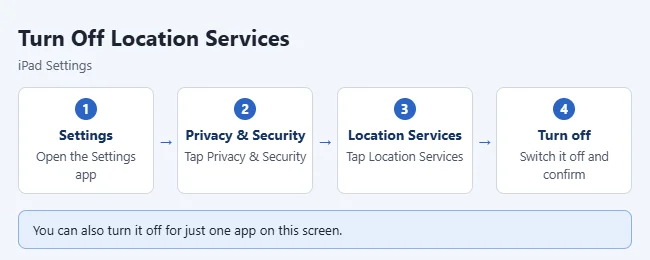
To turn off Location Services on iPad, open Settings, tap Privacy & Security › Location Services, and turn off Location Services. Apple warns that many iPad features stop working without it, so you may prefer to turn location off for specific apps instead: tap any app in the same list and choose Never.
This guide covers turning Location Services off completely, limiting it app by app, sharing only your approximate location, controlling system services, and telling when an app is using your location. The steps follow Apple’s guide to controlling location sharing on iPad and its Location Services support article.
How to Turn Off Location Services on iPad
- Open the Settings app.
- Tap Privacy & Security.
- Tap Location Services.
- Turn off Location Services, then tap Turn Off to confirm.
Result: No app or system feature can use your location. Apps that need it, such as Maps and Weather, will ask you to turn it back on when you open them.
Apple explains that Location Services on iPad uses Wi-Fi, Bluetooth and, on Wi-Fi + Cellular models, GPS and the cellular network to work out where you are.
How to Turn Off Location for One App
- Go to Settings › Privacy & Security › Location Services.
- Make sure Location Services is on, then scroll down and tap the app.
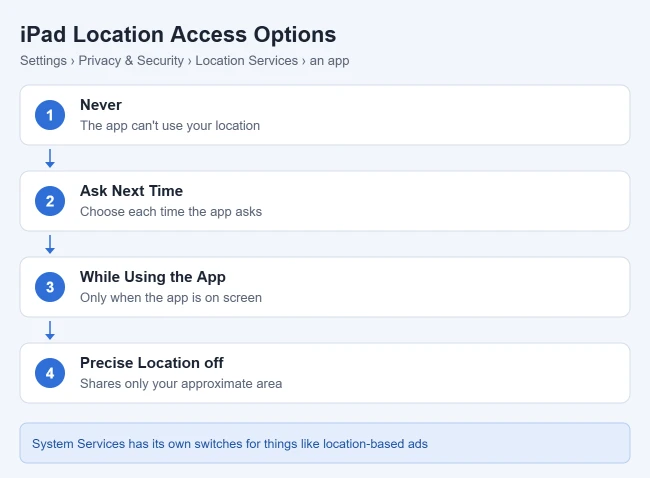
- Choose an option: Never, Ask Next Time Or When I Share, While Using the App or Always. Some apps offer only two choices.
Result: That app follows your choice while every other app keeps its own setting. Never blocks the app from your location entirely.
Share only your approximate location
In the same app screen, turn off Precise Location. Apple says this shares only your approximate location, which may be enough for apps like weather or local news that don’t need your exact spot.
How to Control System Services
Some iPadOS features also use your location, such as location-based suggestions and location-based ads. To see them, go to Settings › Privacy & Security › Location Services › System Services. Apple says you can turn location on or off for each service here and choose to show the location icon in the status bar when system services use it.
Result: You can keep useful features on while switching off ones you don’t want, like location-based ads.
How to Tell When an App Is Using Your Location
- An arrow appears in the status bar while an app uses Location Services.
- Apps you allow to use your location in the background may send alerts that let you change their permission. To hide the map in those alerts, go to Location Services › Location Alerts and turn off Show Map in Location Alerts.
Should You Turn It Off Completely?
For most people, limiting individual apps is the better choice. Turning everything off affects Maps, Find My, location-based reminders, weather for your current area and more. OS X Daily makes the same recommendation: leave Location Services on and strictly limit which apps can use it.
Frequently Asked Questions
Can apps still see my location if Location Services is off?
Apple says apps won’t use your location until they ask and you give permission, and turning Location Services off blocks that access. Websites can still estimate your general area from your internet connection.
How do I turn it back on?
Go to Settings › Privacy & Security › Location Services and turn it on. Then review the app list to check each app’s permission.
Related Guides
- How to turn off Background App Refresh on iPad
- How to turn off AirDrop receiving on iPad
- How to see your iPhone location history

Matthew Burleigh is the founder, head writer, and editor of Solve Your Tech, which he launched in 2012. He has written technology tutorials since 2008 and worked in IT since 2003, including small-business support, IT management, and consulting. He holds Bachelor’s and Master’s degrees in Computer Science from Arizona State University.
Matthew writes practical guides for Windows, iPhone and iPad, Microsoft Office, Outlook, Google apps, and Android. Solve Your Tech’s guides are tested on current devices or checked against official product documentation, with clear steps, sources, and update dates.
Read more about Matthew and how Solve Your Tech writes and updates its guides, or report a correction.