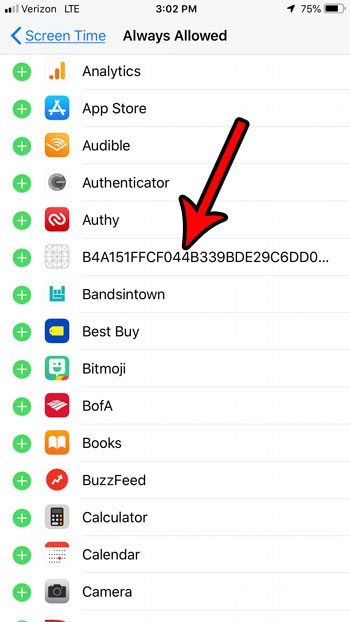
A weird app on the Always Allowed screen in Screen Time, such as a name made of random letters and numbers, is most often a website icon that was added to your iPhone Home Screen from Safari. Screen Time lists that icon alongside your real apps, but it has no proper app name to show. Removing the website icon from the Home Screen is the usual way to clear the entry.
Apple does not describe this behavior in its Screen Time documentation, so treat it as the most likely explanation and not a guarantee. This guide covers iPhones running iOS 27, and it notes where the menus differ in iOS 26 and earlier. It explains how to find the icon behind the entry, how to remove it, and what else to check if the entry stays.
What the Always Allowed Screen Does
Screen Time is the iPhone feature that reports how you use your device and lets you set limits. Always Allowed is the list of apps and contacts that stay available regardless of those limits. Apple gives family members and the Health app as examples of things you might keep reachable for emergencies.
The names of the limits changed in iOS 27. A Screen Time Schedule sets when apps are available, and Time Allowances set how long you can use app categories each day. In iOS 26 and earlier, the same ideas were called Downtime and App Limits. The Always Allowed name is the same in every version.

An important point: an app that appears on this screen is not automatically allowed. The screen shows apps you can choose from as well as apps you have already allowed. A strange name in the list of choices has no special access until you add it.
Why a Random-Looking App Name Appears
Safari lets you put a website on your Home Screen with the Add to Home Screen option. The result looks like an app icon, but it is really a shortcut to a web page. Since iOS 26 you can also turn on Open as Web App, which makes the site open like an app instead of in a Safari tab.
Because the shortcut sits on the Home Screen like an app, Screen Time can include it in its app list. A real app has a name from the App Store. A website shortcut may only have an internal identifier, so the list can show a string of letters and numbers in place of a readable name. That is why the entry looks alarming even though it points to something you added yourself.
You may not remember adding a website icon. They are easy to create by accident, and one can sit on a rarely used Home Screen page or inside a folder for years.
How to Find the Entry in Screen Time
Start by confirming exactly what the list shows. These steps follow Apple’s guide to Screen Time Schedules and Time Allowances.
- Open the Settings app.
- Tap Screen Time. If you set a Screen Time passcode, you may be asked for it before you can change anything.
- Tap Always Allowed.
- In iOS 27, tap Add Apps to see the apps you can choose from. In iOS 26 and earlier, look under Allowed Apps and Choose Apps.
- Note the odd name and which list it is in. If it is only among the choices, it is not currently allowed.
If you do not see Always Allowed at all, Screen Time may be off. In iOS 27, tap Manage Screen Time and then Turn On App & Website Activity. In older versions, tap App & Website Activity on the main Screen Time screen.
How to Remove the Website Icon From Your Home Screen
Before you delete anything, know what you are removing. Deleting a website icon only removes the shortcut. Your Safari bookmarks are stored separately. If the icon was added as a web app, deleting it may also sign you out of that site inside the web app, so make sure you know your login details first.
- Swipe through every Home Screen page and open each folder. Look for an icon that opens a website instead of an app.
- Tap an icon you are unsure about. If it opens a web page, it is a website shortcut.
- Go back to the Home Screen, then touch and hold that icon until a menu appears.
- Tap the option to remove or delete it. The wording depends on the kind of icon and your iOS version. A web app shows Remove App, then Delete App. A plain website shortcut usually offers a delete bookmark option.
- Tap Delete to confirm.
The steps are the same ones used for real apps. Our guide on how to delete icons on an iPhone walks through them in more detail, and Apple’s remove or delete apps page lists the current menu labels.
The original version of this article showed an older method, where you held the icon and tapped a small x in its corner. That design belonged to iOS 12. Current versions use the touch and hold menu instead.
How to Confirm It Worked and How to Undo It
Go back to Settings > Screen Time > Always Allowed and check the list again. If the website icon was the cause, the random name should no longer be there. If you had more than one website icon, more than one odd entry may have appeared, so repeat the steps for each icon.
If the list has not changed, close the Settings app and open it again. A restart of the iPhone is another simple thing to try before you move on to the checks below.
To undo the change, add the site again. Open the page in Safari, open the Share options, tap Add to Home Screen, and tap Add. Apple notes that the icon appears only on the device where you add it. See Apple’s steps for adding a website icon to the Home Screen.
What to Check If the Weird App Is Still Listed
A website icon is the most common explanation, but not the only possible one. Work through these checks in order.
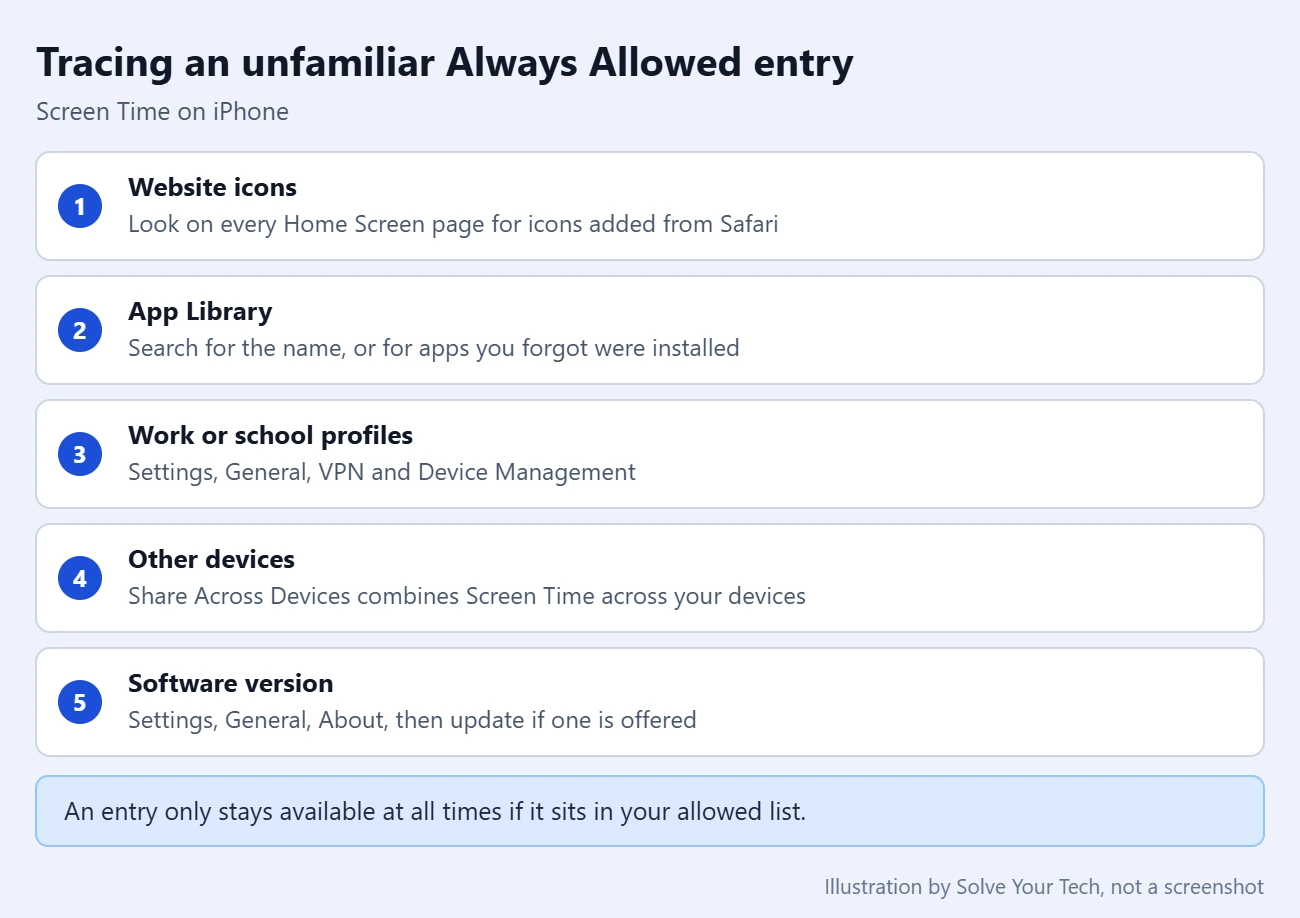
- App Library. Swipe left past your last Home Screen page and search for the name. Apple explains that an app removed from the Home Screen moves to App Library and is not deleted, so a forgotten app can still be installed.
- Work or school profiles. Go to Settings > General > VPN & Device Management. A configuration profile is a settings file from an employer or school, and it can add apps and web shortcuts. Do not remove a profile your organization requires. Apple warns that deleting a profile also deletes the settings, apps, and data that came with it.
- Test builds. If you are a developer or you test apps before release, an unfinished app can show an internal name.
- Other devices. When Share Across Devices is on, Screen Time settings and activity are combined across the iPhone, iPad, and Mac signed in to your Apple Account. It is possible that an unfamiliar entry relates to another device, although Apple does not say whether that affects this list.
- Software version. Go to Settings > General > About to see your iOS version, and install any available update. Whether newer versions still show website icons this way is not documented.
If the entry is among your allowed apps and you want it gone from that list without deleting anything, you can remove it there. In iOS 27, tap Edit on the Always Allowed screen and then tap the entry you want to remove. In iOS 26 and earlier, tap the remove button next to the entry under Allowed Apps.
Frequently Asked Questions
Is the random app name a sign of a virus or hacking?
On its own, no. The usual cause is a website shortcut you or someone using your iPhone added to the Home Screen. If you find a configuration profile you do not recognize in VPN & Device Management, that deserves a closer look, and you can ask your employer, school, or Apple Support about it.
Will deleting the website icon delete my Safari bookmark?
No. A Home Screen icon and a Safari bookmark are separate. Removing the icon leaves the bookmarks in Safari alone, and you can still reach the site by typing its address.
Why is the entry greyed out or why can I not change the list?
Screen Time settings can be locked with a Screen Time passcode. If a parent or guardian manages your Screen Time through Family Sharing, they control this list. Ask the person who set the passcode to make the change.
Does the weird entry get around my Screen Time limits?
Only entries in your allowed list stay available during a schedule or after an allowance runs out. An entry that is merely offered as a choice follows the same rules as everything else.
Why do some of my real apps not appear on the Always Allowed screen?
That is a different problem, and Apple’s documentation does not list a cause. Updating iOS and reinstalling the app are the general steps to try. If the iPhone is managed by an employer, contact its administrator.
Where did Downtime and App Limits go?
In iOS 27 they are called Screen Time Schedule and Time Allowances. Apple says every device you use needs iOS 27, iPadOS 27, macOS 27, or later to use the newest Screen Time features. If your iPhone still shows Downtime and App Limits, it is running an earlier version.
Next Step
Once the list looks right, review which apps you actually want available at all times. Our guide on how to check Screen Time on iPhone shows where to see the apps you spend the most time in.

Matthew Burleigh has been writing tech tutorials since 2008. His writing has appeared on dozens of different websites and been read hundreds of millions of times.
After receiving his Bachelor’s and Master’s degrees in Computer Science he spent several years working in IT management for small businesses. However, he now works full time writing content online and creating websites.
His main writing topics include iPhones, Microsoft Office, Google Apps, Android, and Photoshop, but he has also written about many other tech topics as well.