To use your iPhone as a Roku remote, install the free Roku app from the App Store, sign in, connect your iPhone to the same Wi-Fi network as your Roku, choose your Roku on the discovery screen, and tap Remote. For private listening, connect headphones to your iPhone and tap the Headphone icon on the remote screen.
This guide follows Roku’s current support articles on using the Roku remote app as a remote and using headphones with the app for Headphone Mode, as they read in October 2026. Roku now calls the app the Roku remote app and calls private listening Headphone Mode. Buttons can look different on your Roku model or app version.
- Before you start
- How to use the Roku remote app on iPhone
- What the remote buttons do
- How to use private listening (Headphone Mode)
- App cannot find your Roku?
- Fix Headphone Mode problems
- Frequently asked questions
Before You Start
- iPhone software: Roku says the app requires iOS 14.0 or newer.
- Roku software: the app supports Roku devices running Roku OS 6.2 or later, though some features are not available on every model.
- Same network: the iPhone and the Roku must be on the same Wi-Fi network. If the Roku is on the wrong one, see how to connect a Roku to a different Wi-Fi network.
- Roku already online: if the Roku is not connected to the internet, for example after a reset or during first-time setup, the app cannot detect it. Finish the steps in how to set up a Roku first.
- Roku account: Roku’s instructions have you sign in to the app before you connect it to your device.
- Age limit: Roku states that if the App Store lists you as under 18, you will not be able to access the app.
How to Use the Roku Remote App on iPhone
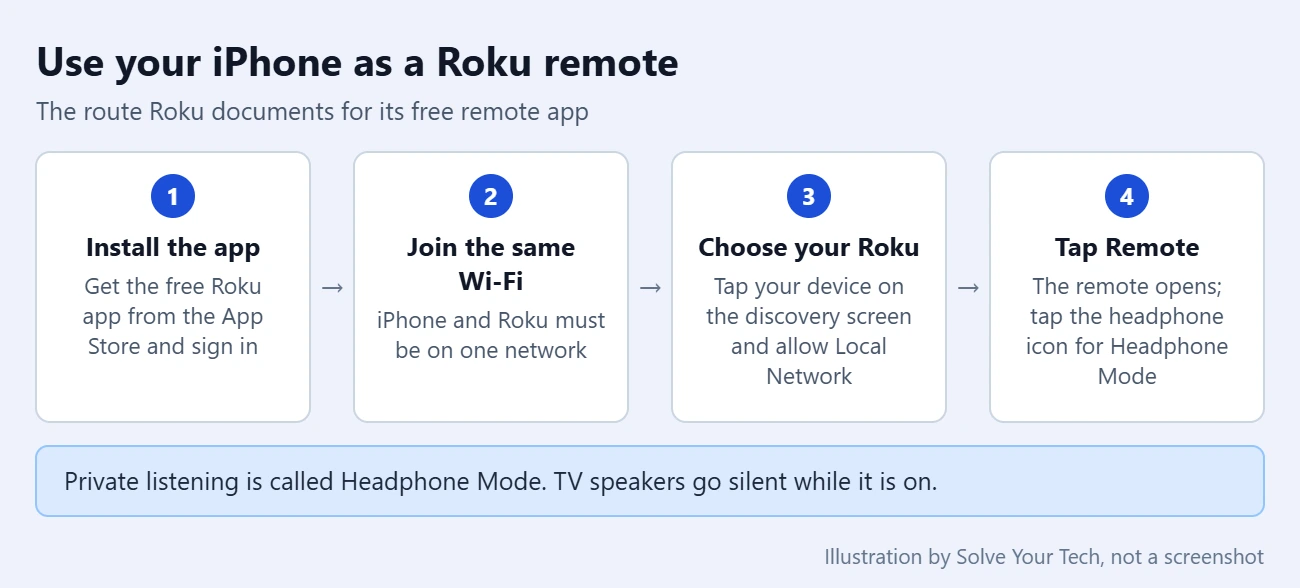
- Open the App Store on your iPhone, search for Roku, and download the free official app from Roku. Roku advises against third-party remote apps for security reasons.
- Connect your iPhone to the same Wi-Fi network as your Roku. To see which network the Roku uses, go to Settings > Network > About on the Roku.
- Open the Roku app and sign in with your Roku account.
- If your iPhone asks whether the app can find and connect to devices on your local network, tap Allow. Without this permission the app cannot see your Roku.
- Wait for the discovery screen to load. The app searches your network automatically and lists the Roku devices it finds.
- Tap your Roku in the list to connect.
- Tap Remote in the navigation bar. The on-screen remote appears, and your iPhone now controls the Roku.
To confirm it worked, tap an arrow on the app’s remote and watch the highlight move on your TV. The remote also opens by itself whenever you launch a streaming app from the Roku app.
What the Remote Buttons Do
Roku lists these controls on the app’s Remote screen. Some may be missing depending on which Roku you own.
| Button | What it does |
|---|---|
| Private (headphone icon) | Turns Headphone Mode on or off |
| Microphone | Opens voice search and voice control |
| Keyboard | Opens your iPhone keyboard so you can type in search boxes |
| Play/Pause | Shows playback controls, including instant replay, rewind and fast forward |
| Options | Opens the options menu |
| Guide and Channels | Open the Live TV Channel Guide and channel number entry when you use the Live TV input on a Roku TV |
| Volume and Mute | Change the volume output of the Roku device |
| Power | Turns the Roku device on or off |
Switch Between the Traditional and Swipe Remote
The app offers two layouts. Traditional copies the buttons of a physical Roku remote. Swipe lets you move around with finger gestures and tap the highlighted area to select. To change it, tap Settings in the app and choose the Remote type.
Control TV Power and Volume From a Roku Player
With a Roku streaming player (a stick or box plugged into a TV), the app controls the player, not the TV. Roku says to turn on HDMI-CEC on your TV, a feature that lets devices connected by HDMI control each other. Then, on the Roku, go to Settings > System > Control other devices and make sure 1-Touch Play, TV power and TV volume are turned on. Roku notes that the app may not be able to turn the TV on if the player is powered by the TV’s USB port.
How to Use Private Listening (Headphone Mode)
Headphone Mode sends the sound from your Roku to headphones connected to your iPhone. While it is on, you will not hear audio from the TV speakers.
Important: Roku warns not to put your headphones on until the volume is at a safe level.
- Plug wired headphones into your iPhone, or pair and connect Bluetooth headphones to the iPhone.
- Open the Roku app and make sure it is connected to the right Roku.
- Tap Remote in the navigation bar.
- Tap the Headphone icon to turn on Headphone Mode.
- Set a comfortable volume, then put your headphones on.
To turn it off, tap the Headphone icon again and sound returns to the TV. With wired headphones, Roku says you can also turn Headphone Mode on and off by plugging in or unplugging them while the app is open.
Start Headphone Mode before you press play. Roku explains that if you turn it on while a video is already playing, playback stops and restarts while the picture is synced with the audio.
Limits to Know
- Not every Roku supports Headphone Mode through the app. Check Roku’s device comparison chart for current models.
- Up to four phones or tablets can use Headphone Mode on one Roku at the same time.
- If someone plugs headphones into a compatible Roku voice remote, Headphone Mode stops on every connected phone.
- On a Roku TV, live broadcast TV works with Headphone Mode only for digital channels from a connected HDTV antenna. Analog broadcasts are not supported.
- On a Roku Streambar or Roku Smart Soundbar, it works only with the built-in streaming player, not with a game console, Blu-ray player or cable box connected to it.
Some Roku models can also pair Bluetooth headphones directly, with no phone involved. Roku lists the supported models in How to use Bluetooth headphones for Headphone Mode.
App Can’t Find Your Roku?
Work through these checks from Roku’s article on connecting your phone to a Roku streaming device.
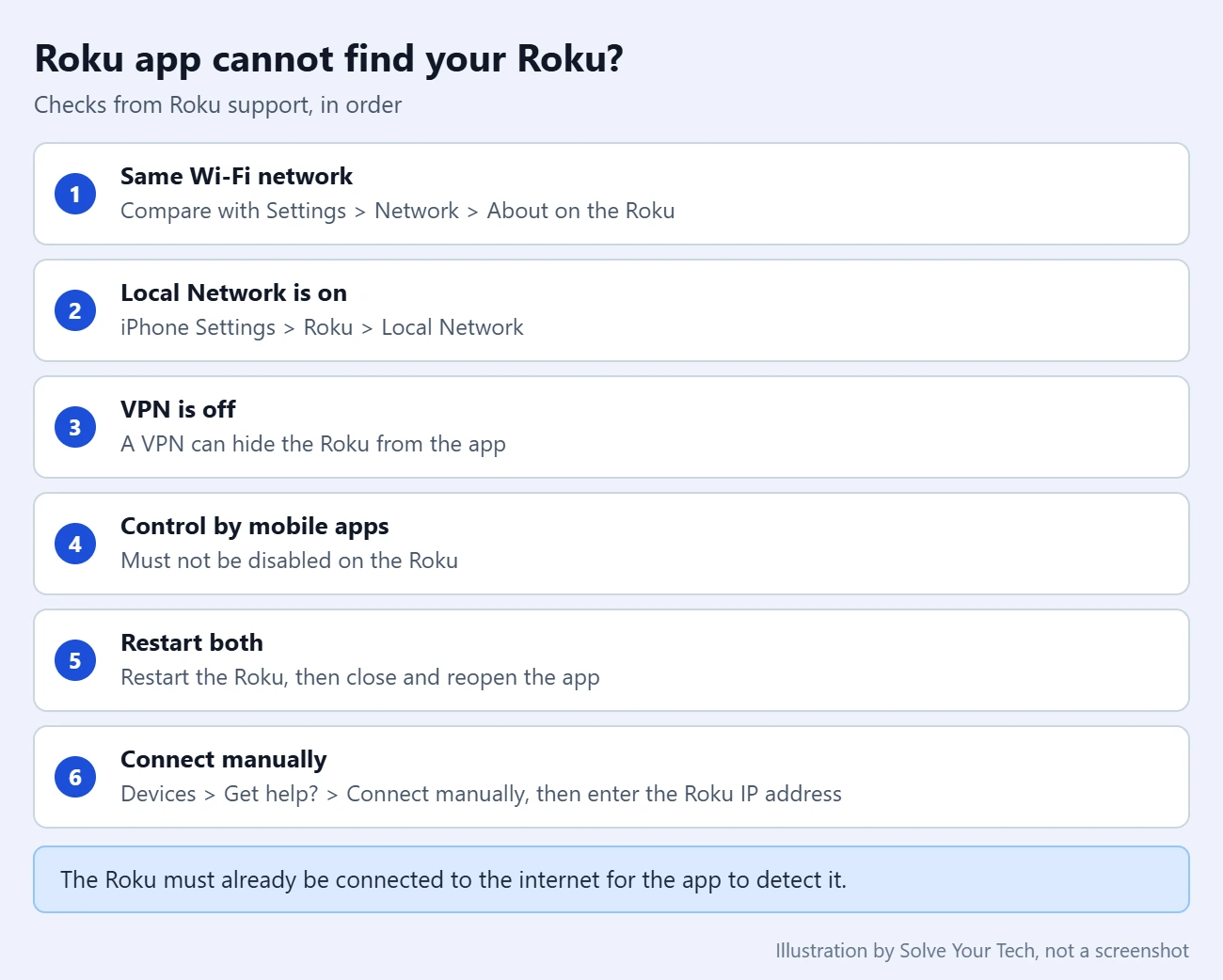
- Check the network name. Many routers show two similar names, such as one ending in 2.4GHz and one ending in 5GHz. Roku says to confirm that both devices use the same band and network name.
- Turn on Local Network. On your iPhone, open Settings, find Roku in the list of apps, tap Local Network, and turn it on. Apple also puts this switch in Settings > Privacy & Security > Local Network, as described in Apple’s local network article. On recent iOS versions the app list may sit inside an Apps section of Settings.
- Turn off your VPN. A VPN (virtual private network) can route all traffic away from your home network, which hides the Roku from the app.
- Check Control by mobile apps. On the Roku, go to Settings > System > Advanced system settings > Control by mobile apps. If it is disabled, the app cannot talk to the Roku, and you need a physical Roku remote to turn it back on.
- Restart the Roku. Go to Settings > System > Power > System restart, or unplug the power cable, wait a moment, and plug it back in. See how to restart a Roku for more detail.
- Restart the app. Swipe up from the bottom of the iPhone screen (or double-click the Home button) and swipe the Roku app away, then open it again.
- Connect manually. Find the Roku’s IP address in Settings > Network > About. In the app, tap Devices, tap Get help?, select Connect manually, enter the IP address, and tap Connect.
If the Roku uses a wired Ethernet connection, or your router blocks devices from talking to each other, the app may still fail to connect. Roku suggests trying Wi-Fi for both devices and checking your router’s documentation.
Fix Headphone Mode Problems
These fixes come from Roku’s guide to resolving an issue with Headphone Mode.
- The Headphone icon is missing. Update the Roku app. If the icon still does not appear, Roku says your device does not support Headphone Mode through the app.
- No sound. Check that the iPhone volume is not muted or very low, that wired headphones are pushed in firmly, and that Bluetooth headphones are connected to the iPhone. If you own more than one Roku, open Devices in the app and confirm you are connected to the right one.
- Sound does not match the picture. With Headphone Mode on, tap the Gear icon, tap Adjust audio delay, tap Get started, and follow the on-screen instructions. If it is still off, repeat the steps and choose Advanced adjustment to fine-tune with a slider.
- Sound stutters or pops. Turn Headphone Mode off and on again, close and reopen the app, restart the Roku, or try a different pair of headphones. Headphone Mode shares your Wi-Fi, so pausing downloads and streams on other devices can help.
Frequently Asked Questions
Is the Roku remote app free?
Yes. Roku describes the Roku remote app as a free download for iOS and Android. The remote, voice search, keyboard and Headphone Mode features do not need a subscription.
Can I use my iPhone as a Roku remote without Wi-Fi?
No. Roku requires the iPhone and the Roku to be on the same Wi-Fi network, and the Roku must already be connected to the internet. If the Roku has been reset or was never set up, Roku says you may need a physical remote to finish setup first. Keep that in mind before you factory reset a Roku.
Can I use the app if I lost my Roku remote?
Yes, as long as the Roku is still connected to the same Wi-Fi network as your iPhone and Control by mobile apps has not been disabled. Open the app, tap your Roku, and tap Remote.
How many people can use private listening at once?
Roku says up to four mobile devices can be connected to one Roku for Headphone Mode at the same time. Each person needs the Roku app on their own phone or tablet.
Why can’t I hear the TV speakers?
Headphone Mode is probably still on. Tap the Headphone icon on the app’s Remote screen to turn it off, and sound returns to the TV.
More Roku Guides
Using a shared Roku? Here’s how to sign out of Netflix on a Roku.

Matthew Burleigh is the founder, head writer, and editor of Solve Your Tech, which he launched in 2012. He has written technology tutorials since 2008 and worked in IT since 2003, including small-business support, IT management, and consulting. He holds Bachelor’s and Master’s degrees in Computer Science from Arizona State University.
Matthew writes practical guides for Windows, iPhone and iPad, Microsoft Office, Outlook, Google apps, and Android. Solve Your Tech’s guides are tested on current devices or checked against official product documentation, with clear steps, sources, and update dates.
Read more about Matthew and how Solve Your Tech writes and updates its guides, or report a correction.