To reconnect a Roku voice remote, restart the Roku, then hold the remote’s pairing button for 5 seconds (or hold Back + Home for 5 seconds if it has no pairing button) until its status light flashes. A simple infrared remote does not pair at all, and if only the TV’s power or volume fails, you need the separate TV-control setup instead.
These steps cover Roku-brand remotes (the simple remote, the Roku Voice Remote, and the rechargeable Roku Voice Remote Pro) on Roku streaming players and Roku TVs, using the menu labels in Roku’s support pages. A third-party universal remote uses its maker’s setup codes instead.
Identify Your Remote and the Problem
“Reprogram” can mean three different jobs, so start by matching your remote and symptom to the right fix.
| What you see | Remote type | What to do |
|---|---|---|
| No microphone or magnifying-glass button | Simple (infrared) remote | Check batteries and line of sight; there is no pairing step |
| Microphone button; Home, arrows and OK do nothing | Voice remote | Pair or re-pair it |
| Roku menus work, but TV power or volume does not | Voice remote | Set up TV controls |
| Remote charges with a USB-C cable | Voice Remote Pro (rechargeable) | Charge it first, then pair |
A voice remote has a microphone or magnifying-glass button near the purple directional pad and talks to the Roku over a wireless signal, so you do not have to point it. A simple remote uses infrared (IR) light, so it needs a clear line of sight to the front of the Roku. Some voice remotes have no pairing button and pair with Back + Home instead.
If nothing works, put in fresh batteries or charge the remote before anything else. Before buying a replacement, check Roku’s voice-remote compatibility guide, which lists supported device models. You can find your model in Settings > System > About using any working control, including the Roku mobile app.
If the remote works but the Roku reads every menu aloud, the Star button was probably pressed four times; here is how to turn off the Roku screen reader.
Pair or Re-pair a Roku Voice Remote
These steps follow Roku’s voice-remote pairing instructions. The key is that the Roku and the remote must both be in pairing mode at the same time. On a brand-new device, follow the pairing prompts during setup. For a Roku that is already set up, start with step 1 if you have another way to control it, or step 2 if you do not.
- With another working remote or the Roku mobile app, press Home and go to Settings > Remotes & devices > Add devices > Remote > Continue. The Roku shows pairing instructions on screen. Skip to step 3.
- With no working control, unplug the power cord from the Roku player or Roku TV, wait at least 5 seconds, and plug it back in. Wait until the Home screen appears. Do not unplug a Roku that is in the middle of a software update.
- Put the voice remote into pairing mode. Hold its pairing button, found on the back or under the battery cover, for 5 seconds until the status light flashes. If there is no pairing button, hold Back + Home together for 5 seconds until the light flashes.
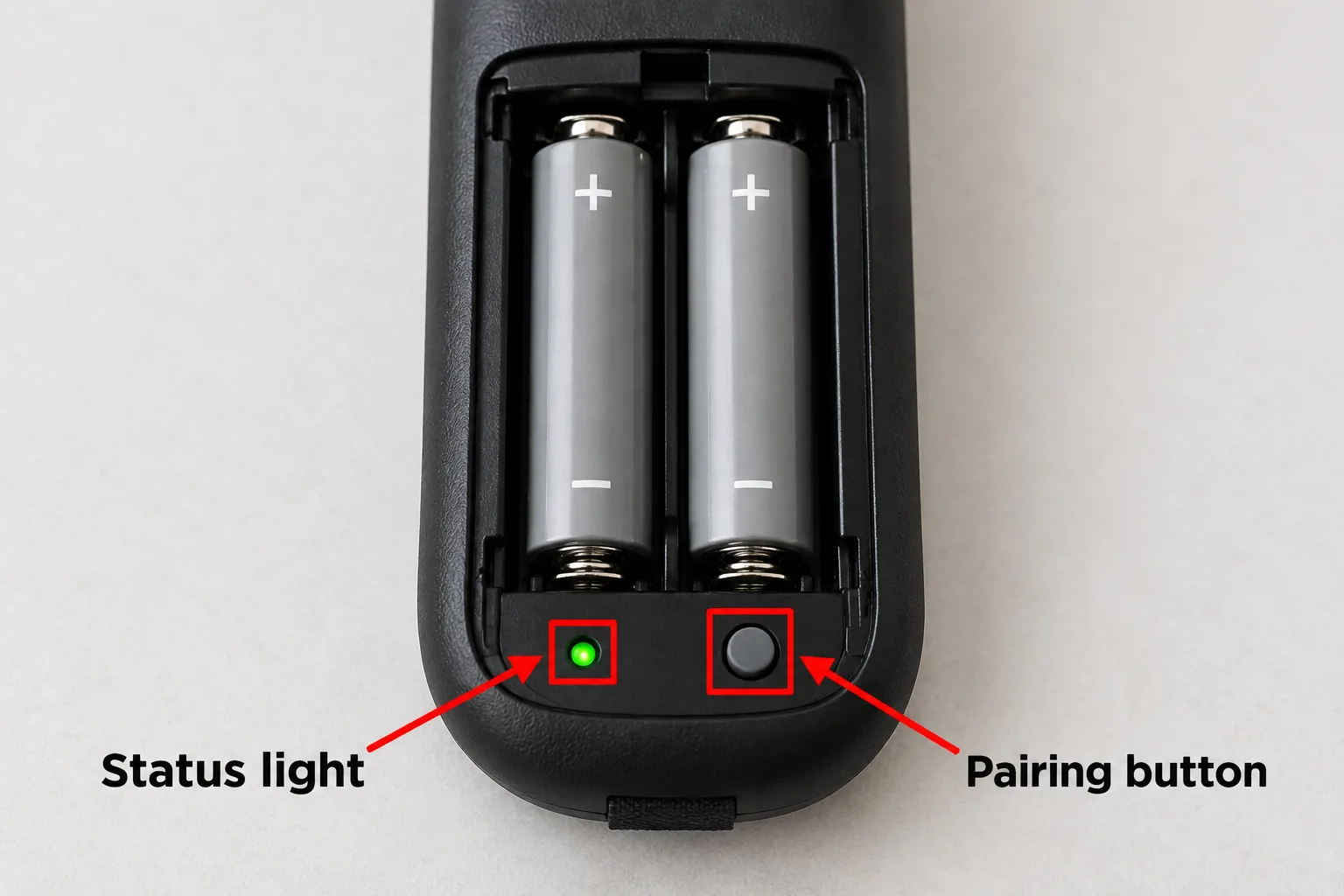
- Keep the remote close to the Roku and wait. After a short wait, a pairing message appears on the TV.
- Test Home, the directional pad, and OK. If the Roku menus respond, pairing worked. If TV volume or power still fails, set those up in the next section.

Use the pairing button on the remote, not the reset button on the Roku. The reset button on a player erases its settings. You can use the same Add devices route to pair a second or replacement voice remote while the old one still works.
Set Up a Simple Infrared Remote
Roku’s simple-remote setup guide says these remotes are ready to use as soon as you insert fresh, matching batteries or pull out the battery tab. There is no wireless pairing step.
- Insert the batteries with the + and – ends matching the marks in the battery compartment.
- Point the remote at the front of the Roku device or Roku TV.
- Move anything between the remote and the Roku, such as a cabinet door, soundbar or decorations.
- Press the arrows and OK. The highlight on screen should move.
IR light cannot pass through a closed cabinet, and a Roku player hidden behind the TV may not see it. If a new simple remote does nothing, check that it is made for your model, since Roku TV and Roku player remotes are not always interchangeable.
To check whether a simple remote sends a signal, point it at your phone’s front (selfie) camera with the camera app open and press a button. Many phone cameras show the IR light as a faint flicker. If you see it, the remote is sending, and the problem is more likely the line of sight or the Roku itself.
Set Up TV Power and Volume Controls
A paired voice remote can run the Roku menus while its TV buttons still need setup. This applies mostly to Roku streaming players. A Roku TV’s own remote already controls that TV, so you only need this if you use a Roku voice remote with a player plugged into another brand of TV. Roku’s TV-control instructions list the Roku Voice Remote, Voice Remote Pro and Voice Remote Pro (2nd edition) as remotes that support it.
- Turn up the TV volume and make sure it is not muted. Point the voice remote directly at the TV.
- Press Home, then go to Settings > Remotes & devices > Remotes.
- Choose your voice remote and select Set up remote for TV control.
- Follow the prompts. The Roku plays music and asks whether you can still hear it; answer each question honestly so it can find the right TV signals.
- When setup ends, test the remote’s power, volume and mute buttons.
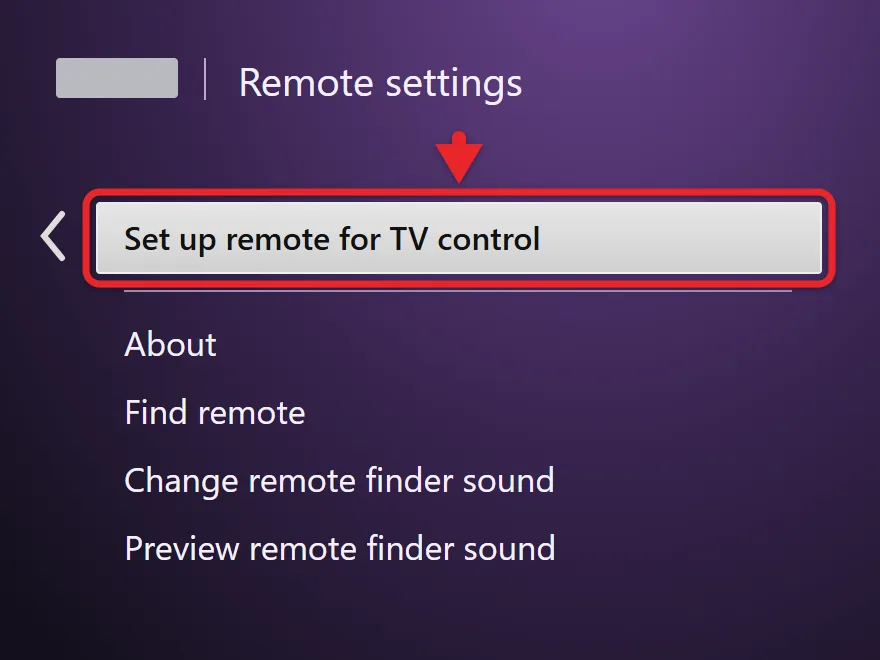
Some TVs allow volume control from a Roku remote but not power. If the buttons still fail, turn on HDMI-CEC in your TV’s settings. CEC lets HDMI devices control each other, and TV brands give it their own names, such as Anynet+ on Samsung or SIMPLINK on LG. Then run the setup again. If a soundbar or receiver sits between the Roku and the TV, Roku recommends connecting the Roku directly to the TV during setup so it can identify the TV brand.
Voice commands such as “Hey Roku, turn off the TV” on a Voice Remote Pro work only through CEC. Older TVs may not respond to Roku TV controls at all; see using a Roku with an old TV for other compatibility limits.
If the Voice Remote Still Does Not Respond
Roku’s remote troubleshooting guide separates restarting a remote from the 5-second pairing command. Restart the remote first, then pair it again.
Battery remotes: remove both batteries, press any two buttons, reinsert the batteries negative end first, and replace the cover. Use a fresh, matching pair if the remote responds slowly.
Rechargeable remotes: hold the pairing button for 20 seconds, or hold Back + Home for 20 seconds if there is no pairing button. Wait for the light to stop flashing. Roku then recommends charging with the included cable for at least 5 hours before pairing again with the 5-second steps above.
Other checks that help:
- Battery level. Use the app or a working remote to open Settings > Remotes & devices > Remotes, select your remote, and choose About to see its battery level.
- Streaming sticks. Use the included USB power cable, which contains a wireless receiver. A free HDMI extender from Roku can also move the stick away from the TV and reduce interference.
- Range and obstacles. Sit closer to the Roku while pairing and clear obstacles between the remote and the device.
- Restart and retry. Unplug the Roku for 5 seconds again, then repeat the pairing steps.
If a remote feels hot, stop using it. Do not remove hot batteries. Disconnect the charging cable if one is attached and let the remote cool on a hard, non-flammable surface, such as tile. Contact Roku if it does not cool down. For ongoing problems, note your remote model, Roku model, which buttons fail, and whether the pairing light flashes before you contact support.
Find a Lost Roku Remote
If the remote is missing rather than broken, Roku’s lost remote finder can make it play a sound for up to 60 seconds. It works only with voice remotes that have a built-in speaker (look for small speaker holes on the back), such as the Voice Remote Pro.
- In the Roku mobile app, tap Devices, tap the three dots next to your Roku, and select Ping Remote.
- On a Voice Remote Pro with hands-free voice turned on, say “Hey Roku, where’s my remote?”
- On some players, such as the Roku Ultra, press the lost remote finder button on the player.
The remote will not play a sound if its battery is dead or it is out of range.
Use the Roku App as a Temporary Control
The Roku mobile app works as a remote when your phone and Roku are on the same Wi-Fi network. Install it, open it, and select your Roku, as Roku’s mobile-app guide explains. The app is also the easiest way to reach Add devices when you have no working remote. It cannot help if the Roku is not connected to Wi-Fi yet. iPhone owners can follow the steps for using the Roku remote app on iPhone.
For first-time setup, internet connection, and activation, see the Roku setup guide. You do not need a factory reset to pair a remote.
Roku Remote Questions
Why does my remote have no pairing button?
It may be a voice remote that pairs with Back + Home, or a simple IR remote that does not pair at all. Look for the microphone button to tell which one you have.
Should I factory reset the Roku?
No. Try restarting, pairing, or the IR checks first. A factory reset erases your settings and makes you set up the Roku again, and it does not fix a dead remote.
Can I use a Roku voice remote with any Roku?
Not always. Some players don’t support voice remotes, and some older ones only work with simple IR remotes. Check your model in Settings > System > About first.
Which Roku comes with the rechargeable remote?
The current Roku Ultra includes the rechargeable Voice Remote Pro (2nd edition). You can also buy that remote separately. See which Roku to buy to compare models.
How can I tell the repair worked?
Test the Roku menus first, then TV power and volume separately. If navigation works but TV buttons do not, pairing worked and the remaining problem is TV-control setup. Input switching is a separate setting that lets you make your TV switch to the Roku input when you press a remote button.
Once the remote works, run Set up remote for TV control so one remote handles both the Roku and your TV.

Matthew Burleigh is the founder, head writer, and editor of Solve Your Tech, which he launched in 2012. He has written technology tutorials since 2008 and worked in IT since 2003, including small-business support, IT management, and consulting. He holds Bachelor’s and Master’s degrees in Computer Science from Arizona State University.
Matthew writes practical guides for Windows, iPhone and iPad, Microsoft Office, Outlook, Google apps, and Android. Solve Your Tech’s guides are checked step by step against the device or app maker’s own documentation and tested on his own devices whenever he has the hardware or software, with clear steps, sources, and update dates.
Read more about Matthew and how Solve Your Tech writes and updates its guides, or report a correction.