To view two pages side by side in Word, open the View tab and select Multiple Pages in the Zoom group or, for a book-style view you flip through, Side to Side in the Page Movement group. This works in Word for Microsoft 365 and Word 2016 through 2024 on Windows.
You’re proofreading a long report and want to see facing pages next to each other, the way they’d look in a printed book, instead of scrolling one page at a time.
Which Two-Page View to Pick
Word has two different controls that put pages beside each other, and they behave differently once you turn them on.
| Option | Where it is | Best for | Zoom |
|---|---|---|---|
| Multiple Pages | View tab, Zoom group | Editing while you see the layout of several pages | Still works; you can zoom in and out |
| Side to Side | View tab, Page Movement group | Reading or reviewing pages like a book, flipping across | Turned off until you switch back to Vertical |
If you plan to type, fix formatting or move images while you look at both pages, start with Multiple Pages. If you mostly want to read through a finished draft, Side to Side feels closer to turning the pages of a printed copy.
Show Two Pages With Multiple Pages
Multiple Pages sits in the Zoom group between One Page and Page Width. It works in Print Layout, which is the default view for most documents.
- Open the document and make sure you are in Print Layout (View tab, Print Layout). Draft view shows text in one continuous column, so it won’t show pages beside each other.
- Select the View tab on the ribbon.
- In the Zoom group, select Multiple Pages. Word lowers the zoom and places pages next to each other.
- Adjust the size with the zoom slider at the lower right of the window, or press Ctrl and the plus key to zoom in and Ctrl and the minus key to zoom out. Ctrl+0 returns to 100 percent.
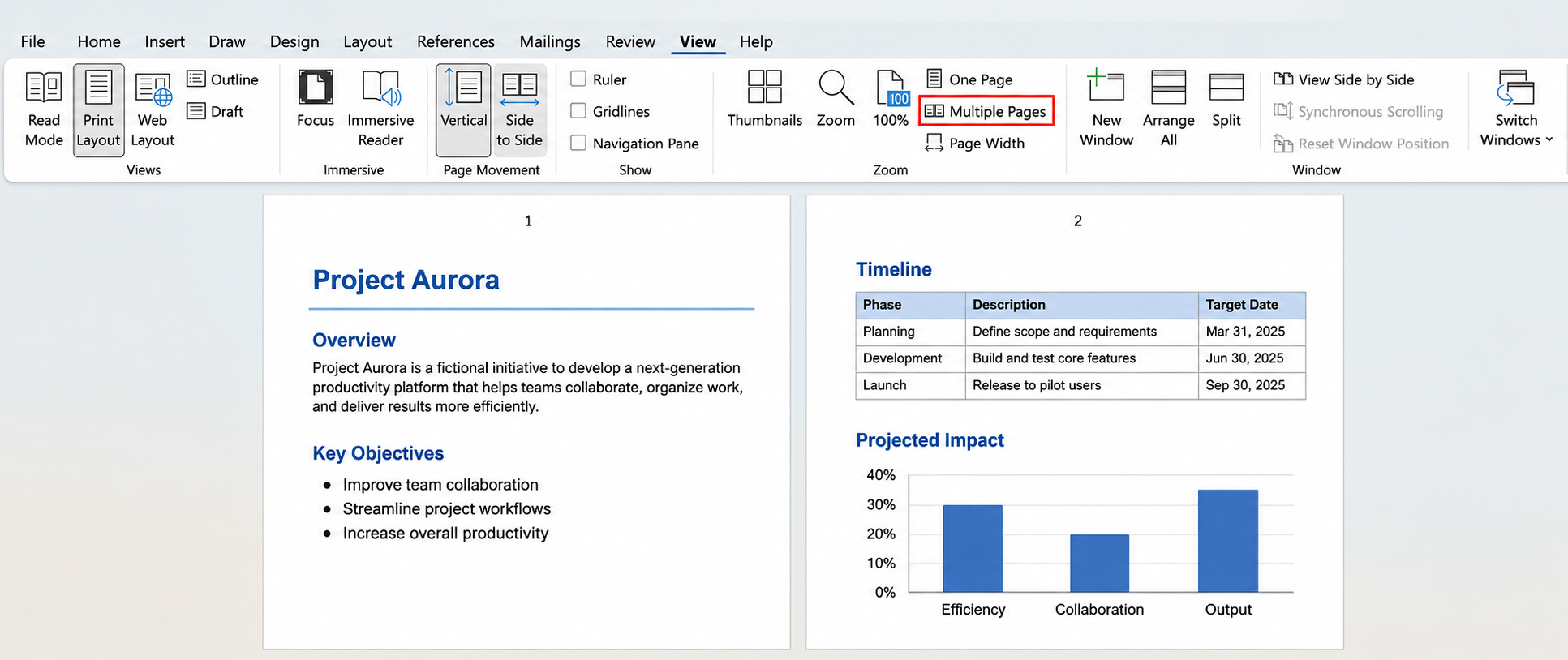
How many pages you get depends on the window width and the zoom level. A wide, maximized window at a lower zoom can fit more than two pages in a row; a narrow window or a high zoom drops back to one. If you only want two, nudge the zoom slider until two pages fill the width.
Word doesn’t store the zoom setting inside the file. According to Microsoft’s zoom instructions, documents open at the last zoom level you used, so a coworker who opens the same file sees it at their own setting.
Flip Through Pages With Side to Side
Side to Side shows pages next to each other and moves across them horizontally instead of scrolling down. It is the closest Word gets to the feel of an open book on screen.
- Select the View tab.
- In the Page Movement group, select Side to Side.
- Move through the document with the horizontal scroll bar, your mouse wheel, or a finger swipe on a touch screen.
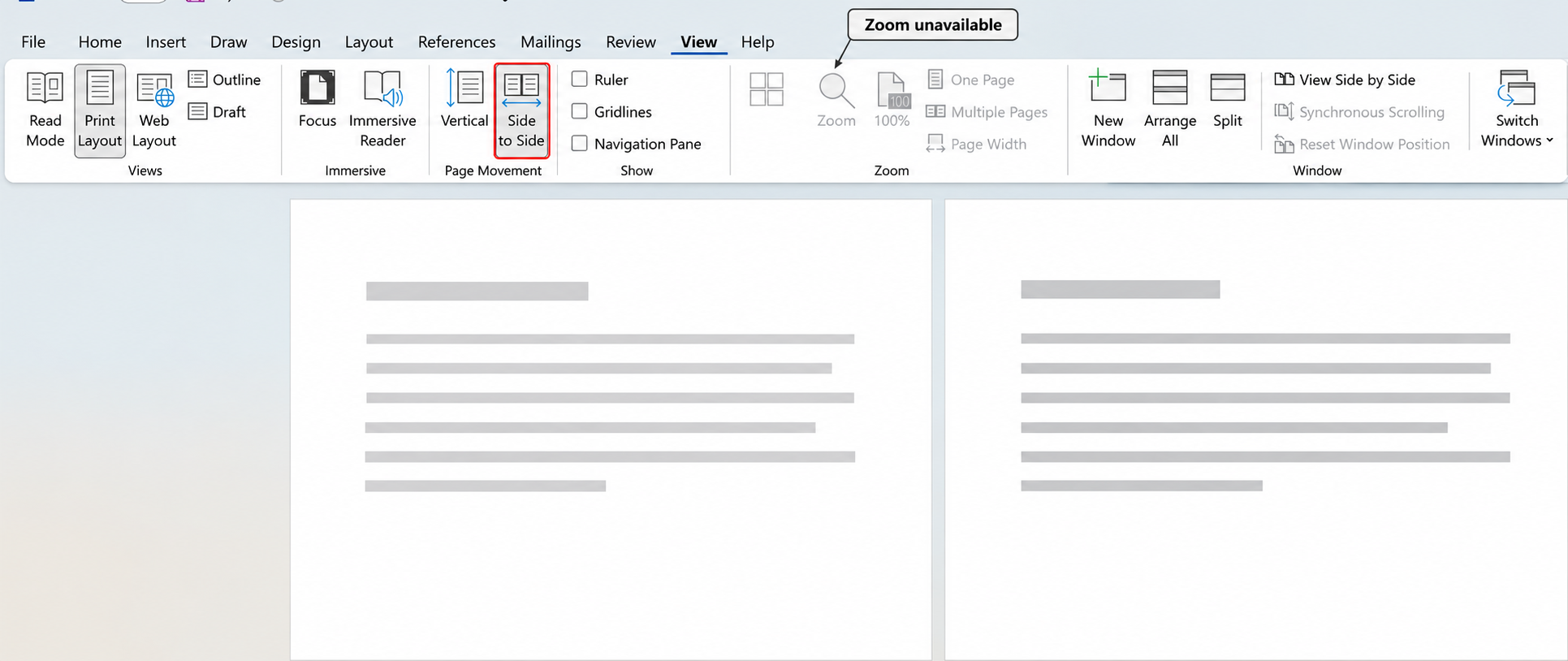
One trade-off catches people out: Microsoft notes that side-to-side page movement switches off the ability to pick a zoom setting. If the zoom buttons look unavailable or the text seems stuck at one size, that is why. Select Vertical in the Page Movement group to get zoom control back.
Side to Side is a good fit for a final read of a 40-page report: you see each spread, notice a heading stranded at the bottom of a page, and keep moving without scrolling past content.
Go Back to One Page at a Time
The return path depends on which view you turned on.
- If you used Side to Side, select View > Vertical in the Page Movement group first. This restores normal scrolling and zoom.
- In the Zoom group, select One Page to fit a single page, or 100% to return to the usual size.
- If the page still looks odd (no margins, no page breaks), check that the View tab shows Print Layout selected.
If the document still won’t look right after that, the walkthrough on getting a Word document back to normal view covers Draft, Read Mode, Focus and other views that can change the screen.
Read Two Columns in Read Mode
Read Mode is another way to see more text at once. Select View > Read Mode, and Word lays the document out in columns with larger text, hiding most of the editing tools. Per Microsoft’s page on reading documents in Word, some zoom features are limited there, and you leave by selecting View > Edit Document. Read Mode reflows text into screen columns, so it doesn’t show your real page breaks. Use it for reading, not for checking layout.
View Two Different Documents Side by Side
Comparing two files, such as last quarter’s budget memo and this quarter’s draft, is a separate feature called View Side by Side.
- Open both documents.
- In either one, select View > View Side by Side in the Window group.
- To scroll both files together, select Synchronous Scrolling in the Window group. Select it again to scroll each one on its own.
- To stop, select View Side by Side again.

These steps match Microsoft’s page on how to view and compare documents side by side. If the button is greyed out, the usual cause is that only one document is open; open the second file and try again.
View Two Parts of the Same Document
Sometimes you need page 3 and page 27 of the same file in view at once, for example to check that a summary table matches the detailed section. To see two parts of one file at once, open a second window of the same document:
- Select View > New Window. Word opens a second window showing the same document.
- Select View > View Side by Side so the two windows sit next to each other.
- Scroll each window to a different part. Edits in one window show up in the other because it is the same file.
You may also see a Split button in the Window group, which divides one window into panes. Split usually divides the window into an upper and a lower pane, so the two parts sit one above the other rather than left and right; the New Window method is the one that puts them beside each other.
Word for Mac and Word for the Web
The Microsoft support pages for Side to Side and View Side by Side list Windows versions of Word. On a Mac, the View tab’s Zoom group may still include Multiple Pages (look for it between One Page and Page Width), and the Window options there include New Window and Arrange All. On a Mac, Arrange All may stack the windows rather than placing them beside each other, and View Side by Side and Synchronous Scrolling may not be on the ribbon, since Microsoft documents those two only for Windows. Labels can change between updates, so check your own ribbon.
Word for the web offers fewer view options than the desktop app. If you don’t see a two-page view in your browser, open the file in the desktop app (look for an Open in Desktop App option under the Editing menu) and use the steps above.
When Word Won’t Show Two Pages
- The document has only one page. Word can’t show a second page that doesn’t exist yet.
- The window is too narrow. Maximize Word or drag the window wider, then select Multiple Pages again.
- The zoom is too high. Drag the zoom slider lower until a second page fits.
- You are in Draft, Web Layout or Outline view. Switch to Print Layout on the View tab.
- The text is too small to read. Two pages on a laptop screen means small type. Zoom in a little with Multiple Pages, or use a larger monitor.
- The zoom buttons don’t respond. Side to Side is probably on. Select Vertical first.
Two-Page View Questions
Does showing two pages change how the document prints?
No. Multiple Pages, Side to Side and Read Mode change only the screen display. Margins, page size and printing stay the same. If you want facing pages in the printed result, that is a page setup task (mirror margins or book fold), covered in the steps to make a book in Word, not a view setting.
Can I see more than two pages at once?
Yes. With Multiple Pages, lower the zoom and widen the window, and Word fits more pages in each row. This helps when you want to spot a blank page or check that chapter openings line up, before you decide to delete a page in Word that slipped in by accident.
Will others see my document in two-page view?
Probably not. Word doesn’t save the zoom level in the document; each person’s Word opens files at the last zoom level they used, so Multiple Pages on your screen doesn’t carry over to theirs.

Matthew Burleigh is the founder, head writer, and editor of Solve Your Tech, which he launched in 2012. He has written technology tutorials since 2008 and worked in IT since 2003, including small-business support, IT management, and consulting. He holds Bachelor’s and Master’s degrees in Computer Science from Arizona State University.
Matthew writes practical guides for Windows, iPhone and iPad, Microsoft Office, Outlook, Google apps, and Android. Solve Your Tech’s guides are checked step by step against the device or app maker’s own documentation and tested on his own devices whenever he has the hardware or software, with clear steps, sources, and update dates.
Read more about Matthew and how Solve Your Tech writes and updates its guides, or report a correction.