Yes, a Roku is wireless in the way that matters most: Roku streaming players and Roku TVs connect to the internet over Wi-Fi, so you don’t need to run a network cable to your TV. Some models also have an Ethernet port if you’d rather use a wired connection. A Roku isn’t completely cable-free, though. A player still connects to your TV with HDMI and needs to be plugged into power.
This answer is based on Roku’s support articles How to connect your Roku streaming device to the internet and advanced networking features, plus Roku’s streaming players page, with notes from other guides where Roku doesn’t cover a detail. It explains what is and isn’t wireless on a Roku, how to connect one to Wi-Fi, when a wired connection makes sense, and what works without internet.
What’s Wireless on a Roku (and What Isn’t)
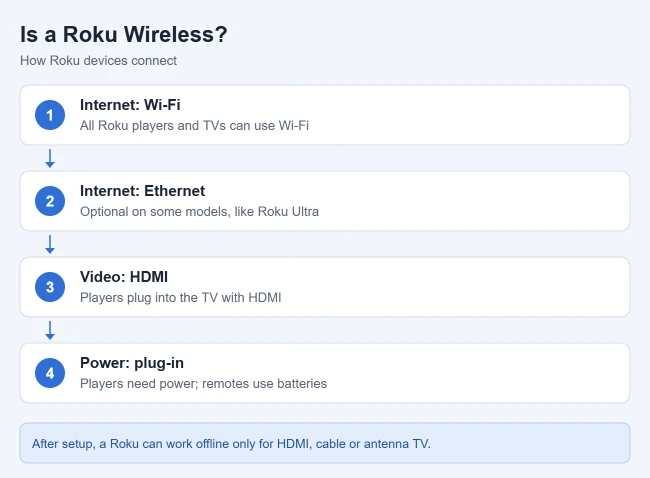
- Internet: wireless. Roku says that when you set up a Roku streaming player or Roku TV, you connect to the internet using Wi-Fi or an Ethernet cable.
- Ethernet (optional): Roku lists Ethernet as a feature of Roku Ultra. Roku also says some players support a wired connection with a USB adapter.
- Video to the TV: not wireless. Roku’s setup steps start with connecting the Roku device to an HDMI port on your TV. A Roku TV has Roku built in, so there’s no separate player.
- Power: not wireless. Roku’s setup steps say to plug in the power. There isn’t a Roku player that works without being plugged in.
- Remote: battery powered. Roku says to pull the battery tab or insert the batteries so the remote can pair. Roku Ultra comes with a rechargeable Voice Remote Pro.
How to Connect a Roku to Wi-Fi During Setup
When you turn on a new Roku for the first time, it asks you to connect to the internet. Roku’s steps are:
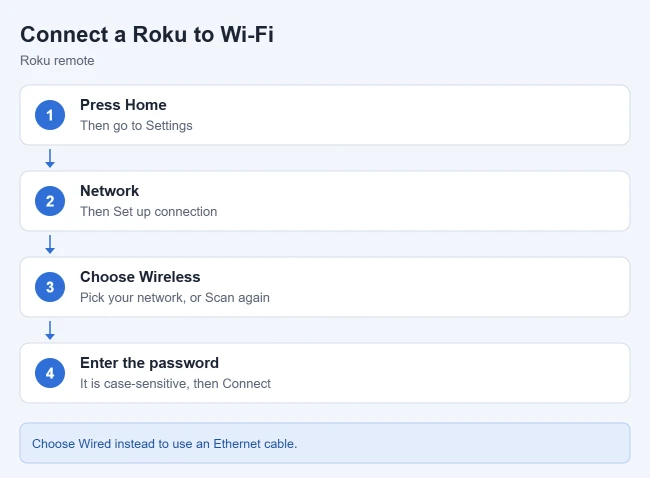
- Select Wireless when asked how to connect.
- Pick your Wi-Fi network from the list. If it’s missing, choose Scan again.
- Enter your Wi-Fi password. It’s case-sensitive.
- Select Connect and finish the on-screen steps.
Result: Your Roku is online and can stream apps and download updates. Roku says you need an internet connection to stream and to get updates.
How to Change Your Roku’s Wi-Fi Network Later
- Press Home on your Roku remote.
- Go to Settings > Network > Set up connection.
- Choose Wireless (or Wired).
- Pick your network and enter the password. Select Scan again if you don’t see it.
Result: The Roku connects to the new network and shows your network info.
No Wi-Fi? Use a Phone Hotspot
Roku says you can connect to your phone’s hotspot the same way. Turn on the hotspot in your phone’s settings, select Wireless on the Roku, choose the hotspot from the list, and enter its password. Roku warns that hotspots use mobile data, and streaming or updates can use a lot of it, so check your plan’s data limits.
Wi-Fi or Ethernet: Which Should You Use?
Wi-Fi is the easiest option and works for most homes. A wired connection can help if your TV is far from the router or your Wi-Fi is busy. Roku’s wired setup steps are:
- Plug one end of an Ethernet cable into your TV or player.
- Plug the other end into your router or modem.
- On screen, choose Wired and follow the steps.
Result: The Roku uses the cable instead of Wi-Fi. If your player has no Ethernet port, Roku says some players can use a USB adapter.
Roku’s product page describes the Roku Streaming Stick 4K as having long-range Wi-Fi for TVs farther from your router, and Roku Ultra as having Wi-Fi 6 and Ethernet. See how the Roku Streaming Stick, Stick Plus, and Stick 4K compare.
Tips for a Better Wi-Fi Connection
Roku’s advanced networking features article suggests these router changes if you’re comfortable with your networking equipment:
- Use 5GHz: if both your router and Roku support it, connect to the 5GHz network (for example, MyNetwork_5GHz). Mesh systems may combine 2.4GHz and 5GHz into one network name.
- Pick a wireless channel manually: automatic channel selection can cause slow or dropped connections. On 2.4GHz, Roku recommends channels 1, 6 or 11 in North America.
- Check your channel: press Home, go to Settings > Network > About, and look for the wireless channel number.
Roku also notes that some models don’t support DFS channels on 5GHz. If one of those models finds your network on a DFS channel, it connects to the 2.4GHz band instead.
Can a Roku Work Without Internet?
Only partly. Roku says that after setup, you can use your device offline, but only for HDMI, cable, or over-the-air broadcasts. That mostly applies to a Roku TV, where you can still switch to a game console, cable box or antenna. Streaming apps need an internet connection.
Frequently Asked Questions
Does a Roku need a cable box?
No. A Roku streams over the internet, so you only need Wi-Fi (or Ethernet) and a TV with an HDMI port. Roku says you can sign in to some network TV channels with a cable login if you have one.
Can I take my Roku to a hotel or a friend’s house?
Yes. Plug it into the TV’s HDMI port and power, then go to Settings > Network > Set up connection to join the new Wi-Fi network.
More Roku Guides
- Does a Roku work with old TVs?
- How to use your iPhone as a Roku remote
- How to connect a Roku to a different Wi-Fi network
- How to set up a Roku

Matthew Burleigh is the founder, head writer, and editor of Solve Your Tech, which he launched in 2012. He has written technology tutorials since 2008 and worked in IT since 2003, including small-business support, IT management, and consulting. He holds Bachelor’s and Master’s degrees in Computer Science from Arizona State University.
Matthew writes practical guides for Windows, iPhone and iPad, Microsoft Office, Outlook, Google apps, and Android. Solve Your Tech’s guides are tested on current devices or checked against official product documentation, with clear steps, sources, and update dates.
Read more about Matthew and how Solve Your Tech writes and updates its guides, or report a correction.