If Microsoft Word won’t open on Windows, restart the PC, then start Word in Safe Mode with winword /safe. If Safe Mode works, an add-in is the likely cause. If it doesn’t, repair Office. Open Word from Start, not by double-clicking a document, so you can tell whether Word or one file is the problem.
This guide is for desktop Word on Windows 11, in Microsoft 365 and Office 2016 through 2024. Most steps also work on Windows 10, which stopped getting security fixes on October 14, 2025. Save other work before restarting, and note any error message, since each one has a different fix.
Quick Guide: Match What You See to a Fix
| What happens | Most likely cause | Start here |
|---|---|---|
| Nothing happens, or Word flashes and closes | Stuck Word process or a bad add-in | Close stuck copies, then Safe Mode |
| Word says it couldn’t start correctly last time | Add-in or startup file | Safe Mode, then add-ins |
| “Microsoft Word has stopped working” | Add-in, damaged install, or old driver | Safe Mode, update, repair |
| Word fails even in Safe Mode | Damaged Office installation | Repair Office |
| Word opens, but one file won’t | Damaged or blocked document | One-document section |
| Word opens with “Unlicensed Product” | Activation problem | FAQ at the end |
Check Whether Word or One Document Is Failing
Open Start, search for Word, and open the app on its own. If it opens, try a blank document and then another file you know is fine. If only one file fails, go to the file-repair section below. If no Word window opens at all, keep going with the steps here.
Save your work in other apps and restart Windows, then try Word again. Click the Word icon once and give it a minute to start. Clicking it over and over can open several stuck copies. If Word still won’t open, note exactly what happens, such as an error message, a blank window, or nothing at all.
Close Stuck Copies of Word
Word sometimes keeps running in the background after a crash, and a new copy can’t start while the old one hangs. If you’d rather not restart Windows, end it in Task Manager.
- Press Ctrl + Shift + Esc to open Task Manager.
- On the Processes page, look for Microsoft Word (listed as WINWORD.EXE on the Details page).
- Select it and choose End task. The entry disappears from the list.
- Start Word again from Start.
Ending Word this way discards unsaved changes in any open document. Lost work may still be recoverable, as shown in recovering an unsaved Word document. There are other ways to open Task Manager in Windows 11 too.
Test Word in Office Safe Mode
Office Safe Mode starts Word without add-ins and customizations, which tells you whether one of them is the problem.
- Press Windows key + R to open Run.
- Type winword /safe, including the space before the slash, and select OK.
- Check the title bar for Safe Mode. Try a blank document and note whether Word stays open.
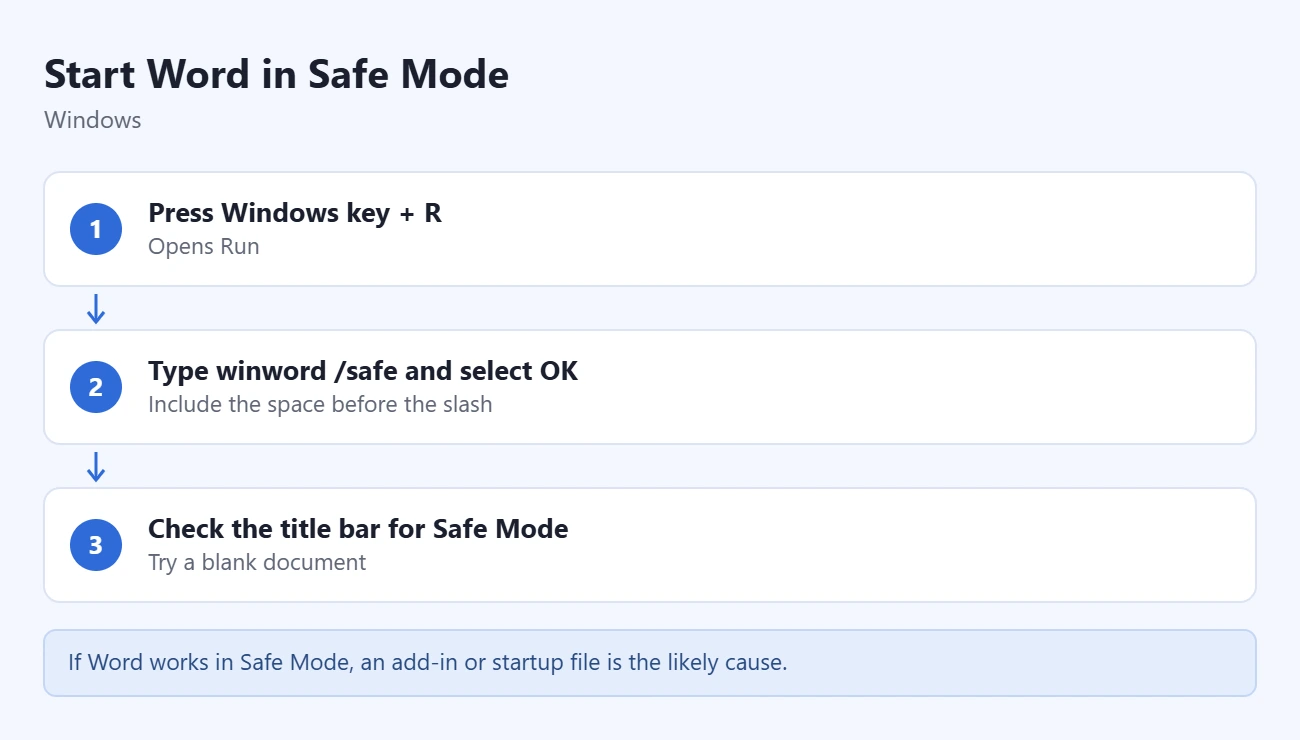
You can also hold Ctrl while you double-click a Word shortcut, then select Yes when Word asks whether to start in Safe Mode. Microsoft’s Office Safe Mode guide documents both methods. Office Safe Mode is separate from Windows Safe Mode; you do not need to restart Windows into a diagnostic boot mode for this test. Exit Word and launch it normally to leave Office Safe Mode.
Some features are off during the test. According to Microsoft, add-ins don’t load, toolbar customizations and the AutoCorrect list aren’t loaded, recovered documents don’t open automatically, and preferences and templates can’t be saved. That is expected, and everything comes back when you start Word normally.
If Windows says it can’t find winword, check the spelling and the space before the slash. If Word also fails in Safe Mode, add-ins aren’t the cause, so skip to the update and repair sections. If it opens fine in Safe Mode, check add-ins next.
If Safe Mode Works, Check Add-ins
An add-in is an extra tool that installs into Word, such as a PDF converter, a dictation tool, or a reference manager.
- In the Safe Mode window, choose File > Options > Add-ins.
- Next to Manage at the bottom of the window, choose COM Add-ins and select Go. You can check Word Add-ins the same way afterward.
- Uncheck one add-in and select OK. Record its name so you can reverse the change.
- Close Word and start it normally. If it still fails, open Word in Safe Mode again and turn off the next add-in. Repeat until Word starts or every add-in is off.
Microsoft’s Office startup-error guide recommends turning add-ins off one at a time. It names older versions of ABBYY FineReader and Dragon NaturallySpeaking, plus PowerWord, as add-ins to try first if you have them. When Word starts normally after you disable one, that add-in is the problem, so check its maker for an update or leave it off. To turn an add-in back on, return to the same list and check its box.
Outlook uses the same add-in test. If Outlook fails to start too, here’s what to do when Outlook won’t open.
Add-ins you got from the Office Store are listed in a different place. In Word, select Home > Add-ins, open My Add-ins, right-click the add-in, and choose Remove. On a work PC, check with IT before turning off required add-ins.
Clear Startup Files and Reset the Normal Template
If Word works in Safe Mode but still fails with every add-in off, a file that loads at startup may be the cause. Microsoft’s Word startup troubleshooting article lists two checks. Close all Office apps first.
Startup folder files
- Open File Explorer, paste %appdata%\Microsoft\Word\Startup into the address bar, and press Enter.
- If the folder has files, right-click one, choose Rename, and add .old to the end of its name.
- Start Word. If it opens, that file was the problem; contact its maker for an update. If not, rename it back and try the next file.
For most Microsoft 365 installs, a second Startup folder is at C:\Program Files\Microsoft Office\root\Office16\Startup. Check it the same way. An empty folder is normal.
The Normal template
Word stores your default styles, macros, and AutoText entries in a file called Normal.dotm. If it’s damaged, Word can hang while starting.
- Press Windows key + R, paste %appdata%\Microsoft\Templates, and select OK.
- Right-click Normal.dotm, choose Rename, and change the name to OldNormal.dotm.
- Start Word. It creates a fresh Normal.dotm with default settings.
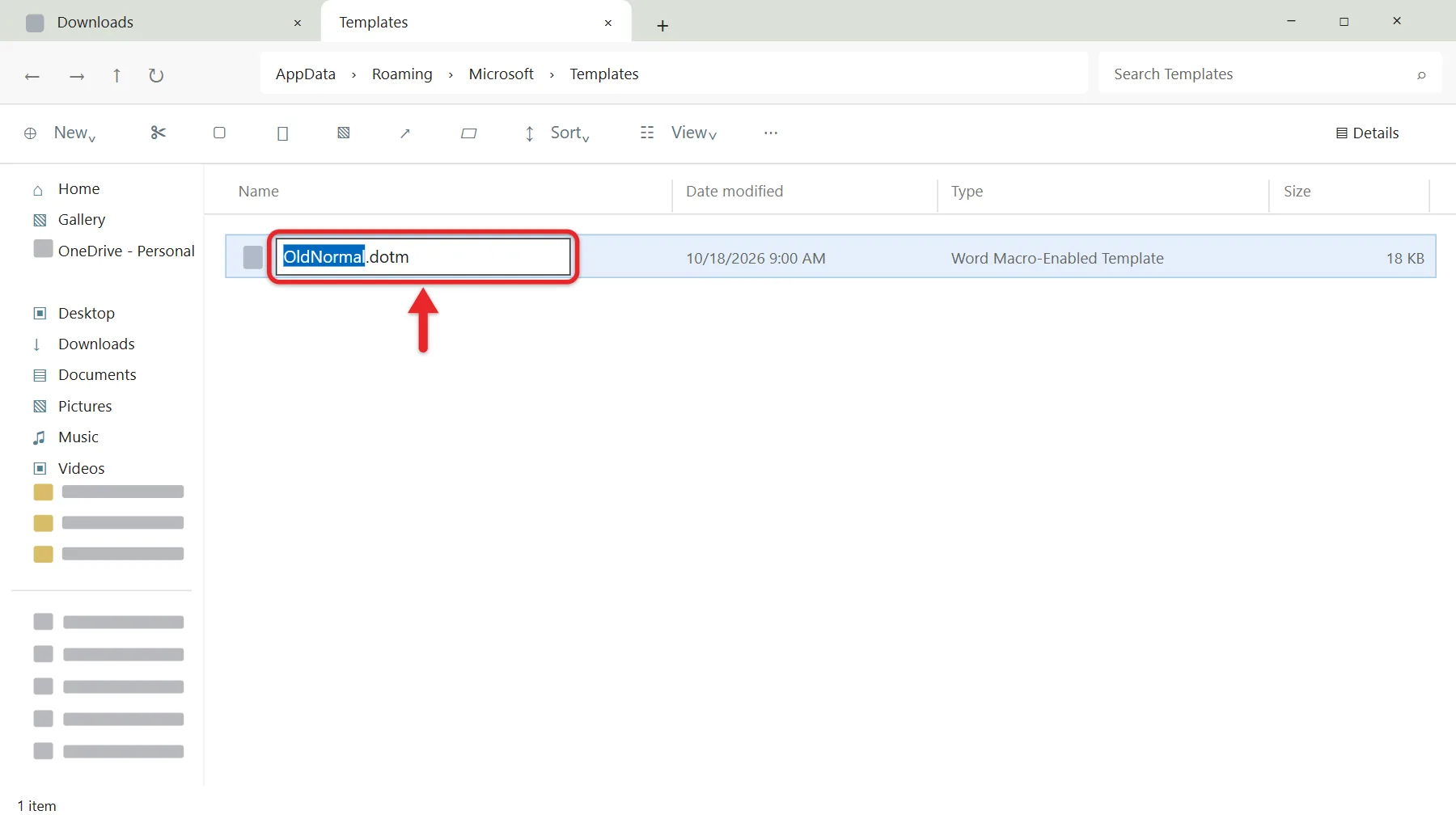
Renaming the file resets custom styles, macros, and AutoText, but it doesn’t touch your documents. If Word still fails, delete the new Normal.dotm and rename OldNormal.dotm back to Normal.dotm to keep your settings.
You can also start Word with winword /a in the Run box. Microsoft says this switch stops add-ins and global templates from loading automatically, so it’s another way to test whether they’re involved.
Update Office and Windows
If another desktop Office app opens, use it to check the shared Office installation. Open that app and choose File > Account > Update Options > Update Now. Microsoft’s Office update guide notes that Enable Updates may appear first. If Update Options is missing, updates may be controlled by an organization or a different installation type. After the update finishes, close all Office apps and try Word again.
Next, update Windows and your drivers. Open Settings > Windows Update and select Check for updates, install what it finds, and restart. Microsoft also suggests getting current video card, printer, mouse, and keyboard drivers from their makers if Word keeps crashing.
If Word crashes only when another program opens it, such as accounting software that creates a Word document, open Word first and then use the other program. Then install the latest Windows and Office updates.
Test a Different Default Printer
Word talks to your default printer as it starts, so a faulty printer driver can stop it. Here’s a quick test:
- Close all Office apps.
- Open Settings > Bluetooth & devices > Printers & scanners.
- If Let Windows manage my default printer is on, turn it off.
- Select Microsoft Print to PDF or Microsoft XPS Document Writer, and choose Set as default.
- Start Word.
If Word now opens, your usual printer’s driver is the likely cause. Get an updated driver from the printer maker, then set that printer as the default again.
Repair the Office Installation
- Close Office apps and save other work. Right-click Start and choose Installed apps in Windows 11.
- Find your Microsoft 365 or Office product, open its three-dot menu, and choose Modify. A separately installed Word app may appear under its own name.
- For a Click-to-Run installation, which covers most Microsoft 365 installs, choose Quick Repair and select Repair. If Word still won’t open, run it again and choose Online Repair. It needs an internet connection and takes longer.
- For an MSI installation, choose Repair and follow the dialog. Restart if requested, then test Word.
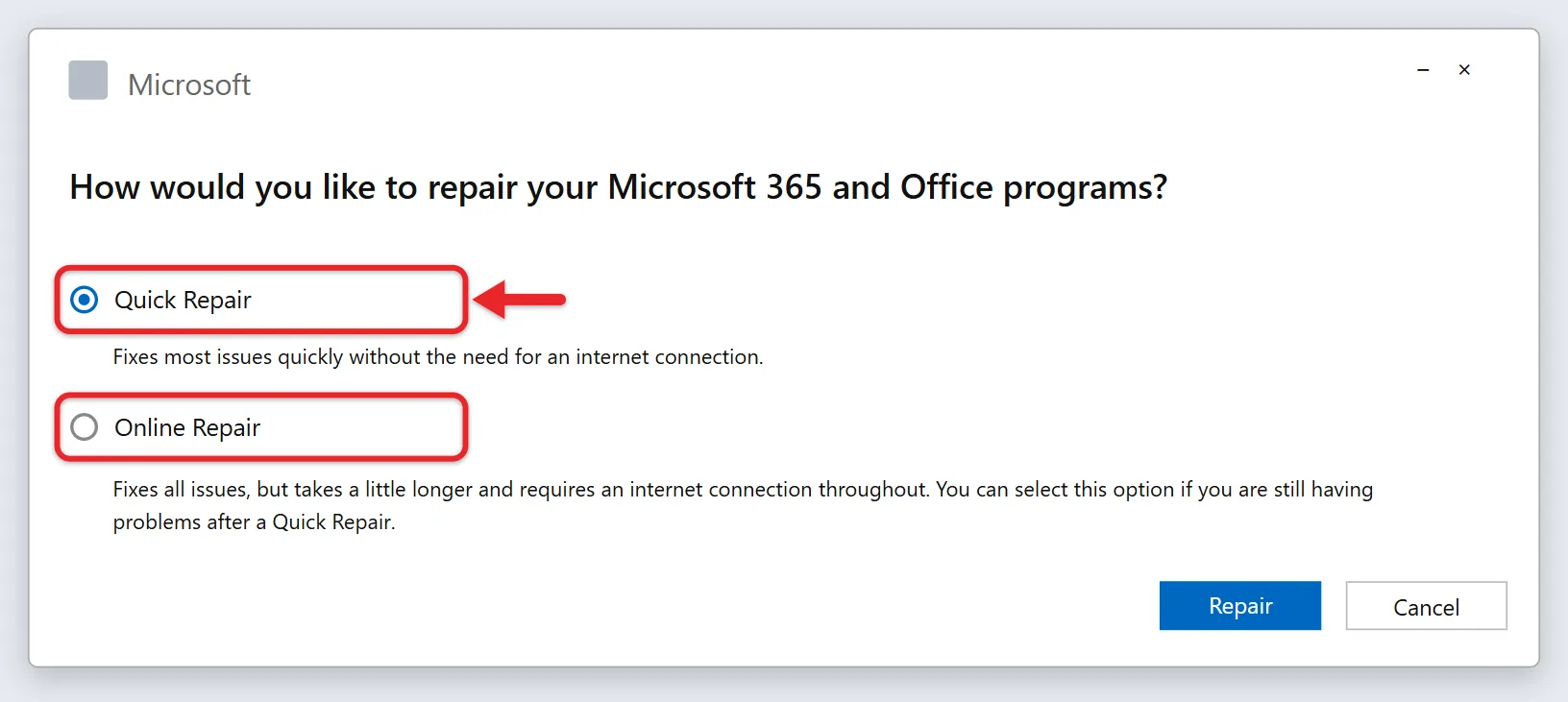
The choices depend on how Office was installed. Microsoft’s repair guide explains the Windows 11 path and both installation types. Repair affects the whole Office suite, even when only Word is failing. Quick Repair checks and replaces damaged files without going online; Online Repair is the broader option, designed to fix everything.
Repair doesn’t delete your documents or remove your license, though Office may ask you to sign in again afterward. Allow the operation to finish before testing again.
If Only One Document Will Not Open
Make a copy of the file first and work on the copy. If Word itself starts, use Microsoft’s Open and Repair tool: choose File > Open > Browse, select the file, click the arrow next to Open, and choose Open and Repair. Use Browse, because opening from Recent doesn’t show this option.
Open and Repair can’t save every damaged file. If it recovers yours, save it under a new name and compare the text, tables, and layout with a backup. If it fails, open a blank document, go to Insert > Object > Text from File, and pick the damaged file. This leaves behind the last paragraph mark, where damage often sits. You may lose some formatting.
A file can also look broken when it is only blocked or not fully downloaded:
- Downloaded or emailed files: Word may open them in Protected View, a read-only mode with a yellow bar. Select Enable Editing if you trust the sender. If Windows blocks the file, right-click it in File Explorer, choose Properties, check Unblock if it appears, and select OK.
- OneDrive files: Make sure the file has finished syncing, or copy it to your Documents folder and open the copy.
- Network folders: Copy the file to your PC. If you can’t, ask the folder’s owner whether your account can read it.
If the file is stored in OneDrive or SharePoint, you can also restore a previous version of the Word file from before the damage.
If Word Still Will Not Start
Create a new Windows user account in Settings > Accounts > Other users and sign in to it. If Word opens there, the problem is tied to your user profile’s settings, and you can move your files to the new account or ask support about resetting your settings.
If repair doesn’t help, uninstall Office and reinstall it from your Microsoft account page. Microsoft’s startup-error guide links to an uninstall tool that removes Office completely when a normal uninstall leaves pieces behind. Make sure you know which Microsoft account holds your license before you start. You don’t need to buy a new license because Word won’t open.
Write down the exact error, your Office and Windows versions, and what happened in Safe Mode and after the repair. Give these details to Microsoft support or your IT team. Don’t delete templates other than Normal.dotm, and don’t edit the registry unless support tells you to.
To confirm the fix worked, start Word from Start, open a blank document and one of your usual files, then close Word and start it once more. If you turned off add-ins, turn them back on one at a time so you keep the ones you need.
Word Startup Questions
Can I continue working while the desktop app is broken?
Yes. Sign in at office.com and open the file in Word for the web, or convert it to a Google Doc with these Word-to-Google-Docs steps. Check the formatting afterward, and follow your organization’s rules before you upload a work document.
Does this mean my documents are gone?
No. Word failing to start doesn’t delete your files. They’re still wherever you saved them, such as your Documents folder or OneDrive, and you can open them in Word for the web while you fix the desktop app. If Word crashed while you were typing, look for the Document Recovery pane the next time it opens.
What does “Microsoft Word has stopped working” mean?
Word crashed while starting or running. Microsoft’s stopped-working guide has you update Office, start in Safe Mode, turn off add-ins one at a time, repair Office, and then update drivers, which are the steps above.
Should I use Quick Repair or Online Repair?
Start with Quick Repair because it is faster and works offline. Use Online Repair if Word still fails. It takes longer, needs an internet connection, and replaces more of the installation.
What if Word opens but says “Unlicensed Product”?
That’s an activation problem, and most features are turned off until it’s fixed. Go to File > Account and sign in with the Microsoft account you used to buy Office, check that your Microsoft 365 subscription hasn’t expired, and remove any extra copies of Office. Microsoft’s activation errors guide covers the rest. The fix usually starts with signing in using the Microsoft account that bought Office, as shown in how to activate Microsoft Office.

Matthew Burleigh is the founder, head writer, and editor of Solve Your Tech, which he launched in 2012. He has written technology tutorials since 2008 and worked in IT since 2003, including small-business support, IT management, and consulting. He holds Bachelor’s and Master’s degrees in Computer Science from Arizona State University.
Matthew writes practical guides for Windows, iPhone and iPad, Microsoft Office, Outlook, Google apps, and Android. Solve Your Tech’s guides are checked step by step against the device or app maker’s own documentation and tested on his own devices whenever he has the hardware or software, with clear steps, sources, and update dates.
Read more about Matthew and how Solve Your Tech writes and updates its guides, or report a correction.