The Microsoft Office suite is Microsoft’s collection of productivity apps. The core apps are Word for documents, Excel for spreadsheets, PowerPoint for presentations, Outlook for email and calendars, and OneNote for notes. Today you can get them through a Microsoft 365 subscription, as a one-time purchase called Office 2024, or free in a web browser with fewer features.
People still say “Microsoft Office” or “MS Office,” but Microsoft now sells the subscription version under the Microsoft 365 name. If a school, job listing, or coworker asks whether you have Office, they almost always mean these apps.
This guide explains which apps are in Office, how Microsoft 365, Office 2024 and the free web apps differ, which older versions are out of support, how to check what you have, and the free alternatives. It covers home and student use, not business or enterprise plans. Details come from Microsoft Support pages, checked October 1, 2026.
What’s Included in the Microsoft Office Suite?
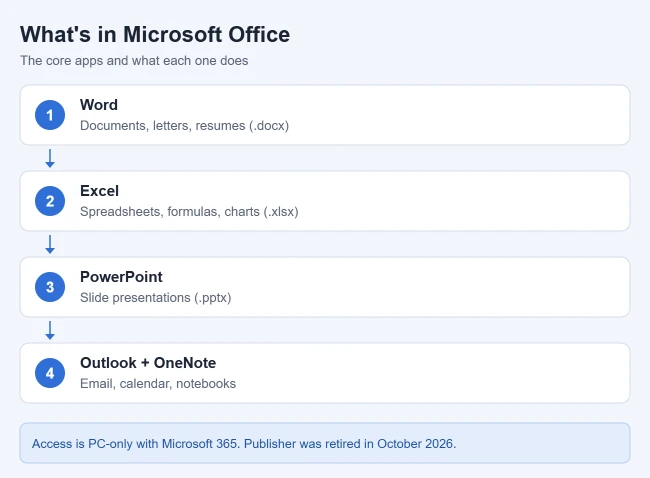
These are the apps most people mean when they talk about Office:
- Word: writes and formats documents like letters, reports, and resumes. Files save as .docx by default.
- Excel: organizes data in spreadsheets with formulas, charts, and tables. Files save as .xlsx. On a Mac, you can change the default save type in Excel if you need a different format. If someone sends you one, here’s how to open an XLSX file. To try a first chart, see how to make a pie chart in Excel.
- PowerPoint: builds slide presentations. Files save as .pptx.
- Outlook: handles email, calendars, and contacts.
- OneNote: keeps digital notebooks for notes, lists, and clippings.
Microsoft 365 subscribers on a Windows PC also get Access, a database app. Some plans include other apps and services, like Teams, OneDrive cloud storage, Clipchamp and Microsoft Defender.
Publisher has been retired. Microsoft says Microsoft 365 subscribers can no longer use Publisher as of October 1, 2026. Support for one-time-purchase copies ends October 13, 2026; those copies keep opening, but they stop getting security fixes. Microsoft suggests Word or PowerPoint for most Publisher tasks and recommends saving old .pub files as PDFs (File > Save As > PDF) while you still have a working copy.
Microsoft 365 vs. Office 2024: What’s the Difference?
The same core apps come in two main packages. The biggest differences are how you pay, how many devices you can use, and whether you get new features.
| Microsoft 365 (subscription) | Office 2024 (one-time purchase) | |
|---|---|---|
| How you pay | Monthly or yearly fee | One up-front payment |
| Apps | Word, Excel, PowerPoint, Outlook, and OneNote (plus Access on PC) | Word, Excel, PowerPoint, and OneNote; Home & Business adds Outlook |
| Devices | Install on PCs, Macs, tablets, and phones; signed in on 5 at once | One PC or Mac |
| Updates | Always gets new features and security fixes | Security updates only, no new features |
| Cloud storage | 1 TB of OneDrive storage | Not included |
| Sharing | Family, Premium, and Pro plans can share with up to 5 more people | Not included |
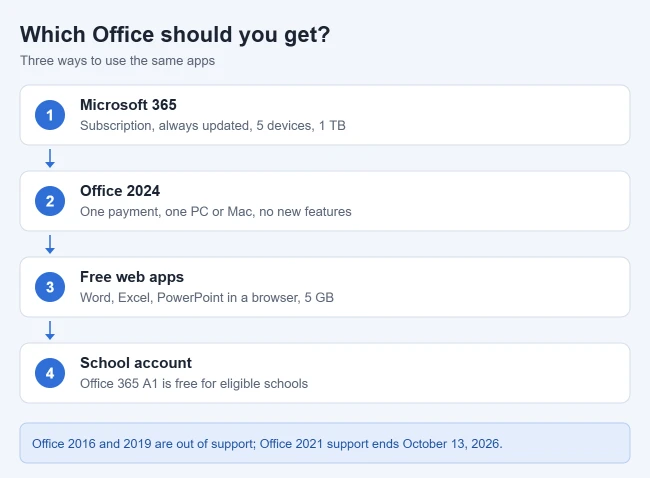
Office 2024 comes in two editions. Office Home 2024 includes Word, Excel, PowerPoint, and OneNote. Office Home & Business 2024 adds Outlook. Microsoft supports Office 2024 until October 9, 2029, and there’s no discounted upgrade to the next version.
Microsoft says that if you already have Microsoft 365, you don’t need Office 2024, because the subscription already includes every Office 2024 feature. Microsoft 365 plans also include Copilot AI features in the desktop apps. Prices change often, so check Microsoft’s comparison page for current plans.
Which Office Versions Are Still Supported?
Older one-time-purchase versions still open, but Microsoft no longer fixes security problems in them:
- Office 2016 and Office 2019: support ended October 14, 2025. Microsoft warns the apps may keep working but could expose you to security risks.
- Office 2021: support ends October 13, 2026.
- Office 2024: supported until October 9, 2029.
- Microsoft 365: stays supported as long as the subscription is active and the apps keep updating.
If you’re on Office 2016, 2019 or 2021, the safest choices are to move to Microsoft 365 or Office 2024, or to use the free web apps for light work.
How to Check Which Version of Office You Have
These steps are from Microsoft’s What version of Office am I using? page.
On Windows
- Open any Office app, such as Word or Excel.
- Select Account on the start screen. If a document is already open, select File, then Account (or Help).
- Look under Product Information. Result: you see the product name, such as Microsoft 365 or Office Home 2024, and usually the version number. Select About Word (or the app’s name) to see whether it’s 32-bit or 64-bit.
On a Mac
- Open any Office app, such as Word.
- Open the Word menu (the app’s name) and choose About Word. Result: a box shows the version number and license type, such as a Microsoft 365 subscription or a one-time purchase.
If neither screen exists, you probably have a much older version of Office. Microsoft’s page links to separate steps for those.
Can You Get Microsoft Office for Free?
Yes, with limits. Microsoft 365 for the web is free with a Microsoft account. Here’s how to start, following Microsoft’s free web apps guide:
- Go to Microsoft365.com in any web browser.
- Sign in with a Microsoft account, or create one with any email address. Result: the Microsoft 365 home page opens. A Free badge means you’re using the free apps; Subscribed means you already have a paid plan.
- Open the app launcher and choose Word, Excel or PowerPoint. Result: the app opens in your browser, and files save to OneDrive.
Free accounts get the web versions of Word, Excel, PowerPoint, Outlook and OneNote, 5 GB of OneDrive storage, and Teams group calls of up to 60 minutes. You don’t get desktop apps, Access, new premium features, or technical support.
The Word, Excel and PowerPoint mobile apps are also free to install. Without a subscription, you get basic editing on tablets and phones with screens under 10.1 inches.
Students and teachers: Microsoft donates Office 365 A1, the web versions of the core apps, to eligible schools. Check Microsoft Education or ask your school whether your school email address qualifies. Some schools pay for plans that also include the desktop apps.
Free Alternatives to Microsoft Office
- Google Docs, Sheets and Slides: free in a browser with a Google account, and they can open and save Word, Excel and PowerPoint files.
- LibreOffice: a free desktop suite for Windows, Mac and Linux that opens Office files.
Both work with .docx, .xlsx and .pptx files, but complex formatting, macros and some charts may not convert perfectly. For files you share with Office users, the free Microsoft web apps avoid conversion entirely.
Does Microsoft Office Work on Mac, iPhone, and Android?
Yes. Microsoft 365 and Office 2024 both install on Windows PCs and Macs. A Microsoft 365 subscription also covers tablets and phones, including iPhone, iPad, and Android devices. Office 2024 is limited to one computer.
Common Problems
- Office says “Unlicensed Product” or features are grayed out: sign in with the account that owns the subscription, under File > Account. Microsoft 365 apps also switch to reduced functionality if they haven’t gone online in about a month, so connect to the internet and reopen the app.
- Publisher is missing: it was removed from Microsoft 365 on October 1, 2026. Use Word or PowerPoint instead.
- Access won’t install on a Mac: Access is a Windows-only app.
- You can’t find Outlook in Office 2024: Office Home 2024 doesn’t include it. You need Office Home & Business 2024 or Microsoft 365, or you can use the free Outlook.com.
Frequently Asked Questions
Is Excel part of the Microsoft Office suite?
Yes. Excel is the spreadsheet app in every version of Office, including Microsoft 365, Office 2024, and the free web version. Not sure which one you have? Here’s how to check which version of Excel you’re using.
Can I buy just one Office app?
Yes. Microsoft sells standalone versions of Word, Excel, and PowerPoint for PC and Mac through the Microsoft Store.
Do I need the internet to use Office?
Only at certain times. You need a connection to install and activate the apps and to get updates. After that, the desktop apps work offline. Microsoft 365 apps need to go online at least once a month, or they switch to reduced functionality mode.
Is Office 365 the same as Microsoft 365?
For home users, yes. Office 365 was the earlier name for the subscription. Microsoft now calls it Microsoft 365.
Why do employers ask for Office skills?
Word, Excel, and Outlook are common workplace tools, so many employers expect you to know the basics. See our list of Excel skills to know when job hunting.
Is Microsoft Office the same as Microsoft 365?
Mostly. Microsoft 365 is the subscription that includes the Office apps plus cloud storage and other services. “Office” now usually refers to the apps themselves or the one-time-purchase versions like Office 2024.
Sources: Microsoft Support pages on Office suites, Microsoft 365 vs. Office 2024, the free web apps, the Office 2024 FAQ, Office 2016 and 2019 end of support, Publisher’s retirement, and Office file formats.

Matthew Burleigh has been writing tech tutorials since 2008. His writing has appeared on dozens of different websites and been read hundreds of millions of times.
After receiving his Bachelor’s and Master’s degrees in Computer Science he spent several years working in IT management for small businesses. However, he now works full time writing content online and creating websites.
His main writing topics include iPhones, Microsoft Office, Google Apps, Android, and Photoshop, but he has also written about many other tech topics as well.