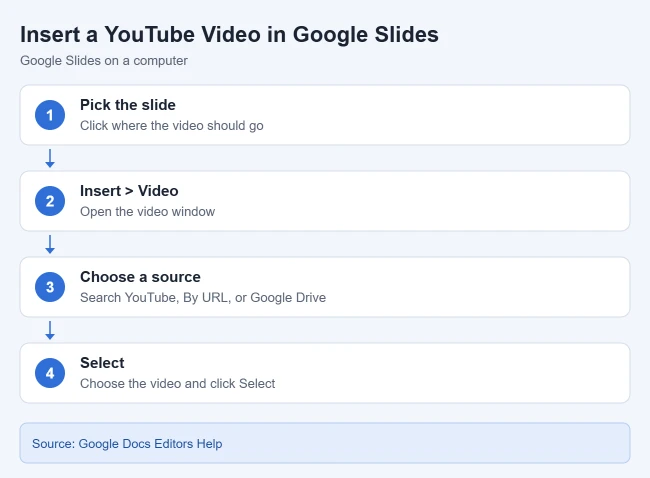
To insert a YouTube video into Google Slides, click the slide, then click Insert > Video. Search YouTube, paste a link under By URL, or pick a file from Google Drive, then choose the video and click Select. To make it play by itself, select the video, click Format options, and under Video playback choose Play (automatically).
These steps are for Google Slides on a computer and come from Google’s Docs Editors Help page Insert or delete images & videos. Details on trimming, muting, and resizing come from TechSmith’s guide to embedding video in Slides.
How to Insert a YouTube Video Into Google Slides
- Open the presentation in Google Slides.
- Click the slide where you want the video.
- Click Insert > Video.
- Choose where to get the video: Search YouTube, By URL, or Google Drive.
- Choose the video, then click Select.
Result: the video appears on the slide as a player. TechSmith suggests dragging a corner while holding Shift to resize it without stretching, and dragging the video to move it.
Paste a YouTube link
If you already have the video open in YouTube, copy its address, choose By URL in the video window, paste the link, and click Select. dadan notes that the video needs to be public or unlisted, since private videos won’t play inside Slides.
For a written document, use how to add a video link to Google Docs. It covers descriptive links, separate Drive permissions, preview limitations, and when to use a Slides presentation instead.
How to Make the Video Play Automatically
- Click the video to select it.
- In the toolbar, click Format options. You can also right-click the video and choose Format options.
- In the sidebar, under Video playback, choose Play (automatically).
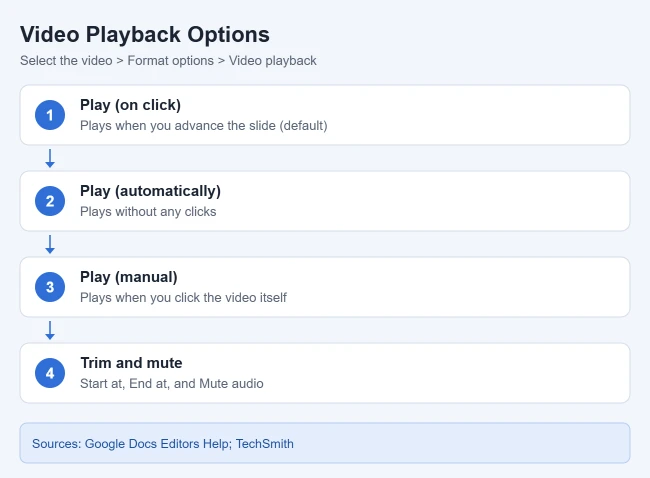
Result: the video starts without any clicks when you reach that slide in a presentation. Google lists three playback choices:
- Play (on click): the video plays when you advance the slide. This is the default.
- Play (automatically): the video plays without any clicks.
- Play (manual): the video plays only when you click the video itself. Google notes this used to be the default.
How to Trim or Mute the Video
TechSmith explains that the same Video playback section has Start at and End at boxes, so you can play only part of a long video, and a Mute audio box if you want to talk over it.
- Right-click the video and select Format options.
- Open Video playback.
- Type the start and end times in Start at and End at.
- Check Mute audio if you don’t want the sound.
Result: during the presentation, the video plays only the section you chose.
How Videos Play During a Presentation
Google says Slides now plays videos like other animations and slide transitions. To start a video and move on, press any key, click the mouse, or use a remote clicker. For presenting tips, see how to present in Google Slides. To put the finished slideshow on a website instead, see how to get the Google Slides embed code.
Troubleshooting
The video won’t play for other people
For videos from Google Drive, Google says Slides’ access checker may suggest sharing permissions so a presenter can play them. Click Share, add the people, choose Editor, Commenter, or Viewer, and confirm. For YouTube videos, make sure the video isn’t private.
You see the wrong part of the video
Check the Start at and End at times under Format options and clear them if you want the full video.
You want a Google Vids video
Google says to export it from Google Vids with File > Export to Drive, then insert it from Google Drive.
FAQs
Is there a keyboard shortcut?
TechSmith lists Alt + I + V on Windows and ChromeOS and Ctrl + Option + I + V on a Mac to open the video window.
Can I add videos from other sites, like Vimeo?
Google’s insert options are YouTube search, a URL, or Google Drive. TechSmith notes that for videos on other platforms, you can add a hyperlink instead.
Related Guides
- How to present in Google Slides
- How to add animations in Google Slides
- How to change the theme in Google Slides

Matthew Burleigh is the founder, head writer, and editor of Solve Your Tech, which he launched in 2012. He has written technology tutorials since 2008 and worked in IT since 2003, including small-business support, IT management, and consulting. He holds Bachelor’s and Master’s degrees in Computer Science from Arizona State University.
Matthew writes practical guides for Windows, iPhone and iPad, Microsoft Office, Outlook, Google apps, and Android. Solve Your Tech’s guides are tested on current devices or checked against official product documentation, with clear steps, sources, and update dates.
Read more about Matthew and how Solve Your Tech writes and updates its guides, or report a correction.