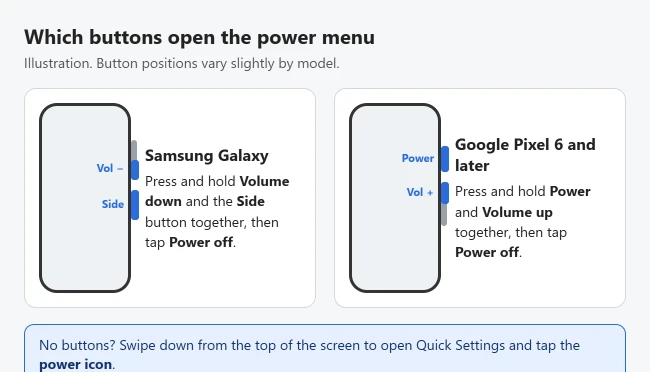
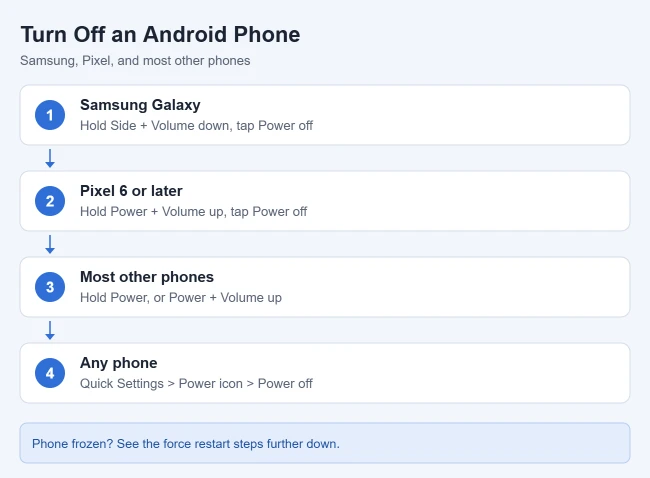
To turn off most Android phones, open the power menu and tap Power off. On a Samsung Galaxy, press and hold the Side button and Volume down together. On a Google Pixel 6 or later, press and hold the Power and Volume up buttons. You can also swipe down twice from the top of the screen and tap the power icon in Quick Settings.
Turn Off a Samsung Galaxy Phone
- Press and hold the Side button and the Volume down button at the same time.
- When the power menu appears, tap Power off.
- Tap Power off again to confirm.
You can also swipe down from the top of the screen with two fingers to open the Quick settings panel, tap the Power icon in the upper-right corner, and choose Power off. If Bixby Voice is set up, you can also press and hold the Side button and say “Turn off the phone.” If you only press and hold the Side button, many Galaxy phones open Bixby instead, because the old Power button was merged into the Side button. Samsung explains the options in Power your Galaxy phone or tablet on or off.
Turn Off a Google Pixel Phone
- On a Pixel 6 or later, press and hold the Power and Volume up buttons for a few seconds. On a Pixel 5a or earlier, press and hold just the Power button.
- Tap Power off on the screen.
To make the Power button alone open the power menu on a Pixel 6 or later, go to Settings > System > Gestures > Press and hold the power button and select Power menu. These steps come from Google’s Turn your Pixel phone on & off.
Other Android Phones
Most other Android phones, like Motorola and OnePlus, open the power menu when you press and hold the Power button, or the Power and Volume up buttons. You can also swipe down twice from the top of the screen and look for a power icon in Quick Settings. If a digital assistant opens instead, check your phone maker’s support site for the button combination.
How to Turn Off an Android Phone Without the Power Button
If a button is broken or stuck, you can reach the power menu from the screen.
Use Quick Settings
- Swipe down from the top of the screen twice, or once with two fingers, to open Quick Settings.
- Tap the Power icon. It’s usually near the top-right or bottom-right corner of the panel.
- Tap Power off, then confirm if asked.
Use the Accessibility Menu
On Android 12 and later, Google’s Accessibility Menu gives you big on-screen buttons, including one that opens Quick Settings.
- Open Settings and tap Accessibility, then Accessibility Menu.
- Turn on Accessibility Menu shortcut and tap Got it.
- Swipe up with two fingers, or tap the floating accessibility button, to open the menu.
- Tap Quick Settings, then tap the Power icon and choose Power off.
Google explains the menu in Use the Accessibility Menu. Menu names can vary a little on Samsung and other phones.
How to Restart an Android Phone
Open the power menu the same way, then tap Restart instead of Power off. If the phone is frozen and the screen won’t respond:
- Pixel: press and hold the Power button for up to 60 seconds, then release it when the “G” logo appears.
- Samsung Galaxy: press and hold the Side button and Volume down for several seconds until the phone restarts.
Frequently Asked Questions
How do I turn my phone off if the power button is broken?
Use the power icon in Quick Settings or the Accessibility Menu, as shown above. On a Samsung phone, you can also ask Bixby to power off the phone.
How do I turn the phone back on?
Press and hold the Power or Side button until the logo appears. If nothing happens, charge the phone for a while and try again.
Will I still get alarms when the phone is off?
Don’t count on it. Most Android phones don’t ring alarms while powered off, so leave the phone on if you need an alarm.
More Android help: how to move apps on Android, how to set up voicemail on Android, how to clear voicemail on Android, and where the clipboard is on Android. Waiting on a message? Here is how to check voicemail on Android. Want a quieter phone? See how to turn off dial pad tones on Android.

Matthew Burleigh has been writing tech tutorials since 2008. His writing has appeared on dozens of different websites and been read hundreds of millions of times.
After receiving his Bachelor’s and Master’s degrees in Computer Science he spent several years working in IT management for small businesses. However, he now works full time writing content online and creating websites.
His main writing topics include iPhones, Microsoft Office, Google Apps, Android, and Photoshop, but he has also written about many other tech topics as well.