To make the keyboard appear on iPad, tap inside any text field, like a search bar or message box. The onscreen keyboard opens automatically. If it doesn’t, a connected Bluetooth or Magic Keyboard is probably hiding it. Tap the keyboard button in the Shortcuts bar at the bottom of the screen, or disconnect the external keyboard and tap the text field again.
This guide covers iPadOS 26 and other recent versions. It shows how to open and hide the onscreen keyboard, how to bring it back when a hardware keyboard is connected, how to fix a keyboard that’s small, split or in the wrong place, and what to try when it still won’t show up. The steps come from Apple’s iPad User Guide, checked in October 2026.
How to Open the Onscreen Keyboard
Apple’s Type with the onscreen keyboard on iPad guide says the keyboard opens when you tap a text field in any app where you can type. There’s no separate “keyboard” app or button to launch it.
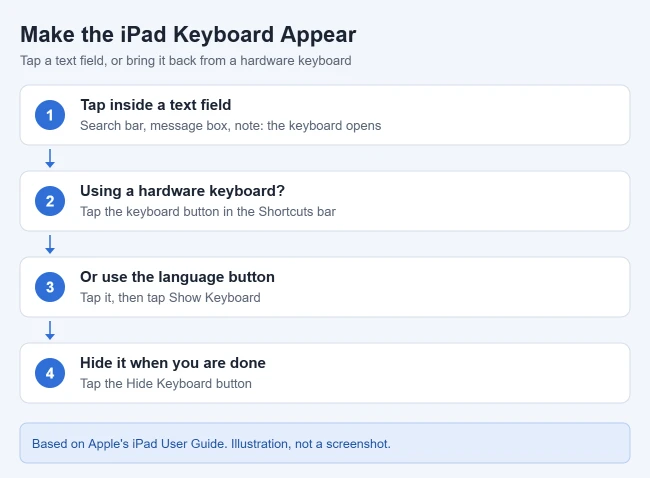
- Open an app where you can type, such as Notes, Messages or Safari. Result: the app opens.
- Tap the place where you want to type, such as the Safari address bar or the message box. Result: a blinking cursor appears and the keyboard slides up from the bottom.
- Start typing. Result: your text appears in the field.
If you tap and nothing happens, make sure you’re tapping an actual text field. Tapping a web page or a photo won’t open the keyboard. In some apps, you need to tap a button such as New Note or Compose first.
How to Hide the Keyboard
To put the keyboard away, tap the Hide Keyboard button in the bottom-right corner of the keyboard. Tap the text field again whenever you want it back.
Show the Keyboard When a Hardware Keyboard Is Connected
Your iPad hides the onscreen keyboard while a Magic Keyboard, Smart Keyboard or Bluetooth keyboard is connected, because it expects you to type on that. You’ll see a thin Shortcuts bar at the bottom of the screen instead. Apple’s Switch between keyboards guide gives two ways to bring up the onscreen keyboard anyway:
- Tap the keyboard button in the Shortcuts bar at the bottom of the screen.
- If you’ve added more than one language keyboard, tap the language button next to the predictive text suggestions, then tap Show Keyboard.
If you’d rather not use the hardware keyboard at all, disconnect it. Detach the keyboard case, turn the Bluetooth keyboard off, or turn off Bluetooth in Control Center. Then tap the text field again.
If the Keyboard Is Small, Split or in the Wrong Place
Sometimes the keyboard is open but doesn’t look right. Apple’s Move the iPad onscreen keyboard guide explains the layouts and how to undo them:
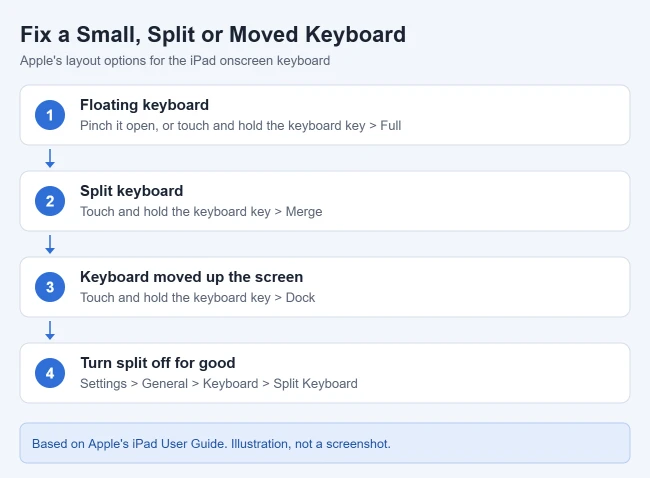
- Small, floating keyboard: Pinch it open with two fingers to return it to full size. You can also touch and hold the keyboard key, then tap Full. Apple says you make one by dragging the keyboard up from the bottom of the screen, which is easy to do by mistake.
- Keyboard split in two: In a text field, touch and hold the keyboard key, slide to Merge, then release. To stop it from happening again, go to Settings > General > Keyboard and turn off Split Keyboard. Split keyboards are only available on supported models.
- Keyboard floating in the middle of the screen: It’s undocked. Touch and hold the keyboard key, slide to Dock, then release.
For more on this, see why your iPad keyboard is split in two and how to fix it. If the keyboard looks wrong because the screen is stuck sideways, see why the iPad screen won’t rotate.
If the Keyboard Still Won’t Appear
- Check for a hardware keyboard you forgot about. A keyboard case left folded behind the iPad or a Bluetooth keyboard in another room can still be connected. Check Settings > Bluetooth to see what’s connected.
- Look for a floating keyboard. A tiny keyboard may be sitting in a corner of the screen. Pinch it open.
- Close and reopen the app. The app may be frozen. Swipe up from the bottom edge and pause to see your open apps, swipe the app up to close it, then open it again.
- Restart your iPad. This clears temporary glitches that stop the keyboard from showing.
- Switch away from a third-party keyboard. If you installed a keyboard app, touch and hold the globe or emoji key and pick the Apple keyboard. To remove a keyboard, go to Settings > General > Keyboard > Keyboards, swipe left on it, and tap Delete, as Apple’s Add or change keyboards guide explains.
- Update iPadOS. Go to Settings > General > Software Update and install any update.
Change Keyboard Settings
Go to Settings > General > Keyboard to add languages, turn on shortcuts, or change typing features like auto-correction and predictive text. Apple also notes you can turn on keyboard clicks in Settings > Sounds. To change suggestions above the keyboard, see how to turn off predictive text on iPad (and other keyboard settings).
Frequently Asked Questions
Why did my iPad keyboard disappear?
The most common reason is a connected hardware keyboard. The iPad hides the onscreen keyboard while one is connected. Tap the keyboard button in the Shortcuts bar or disconnect the keyboard.
How do I get the full-size keyboard back on iPad?
Pinch the small keyboard open with two fingers. Or touch and hold the keyboard key and tap Full.
Can I keep the onscreen keyboard open all the time?
No. It opens when a text field is selected and closes when you leave it or tap Hide Keyboard.
How do I type with one hand on iPad?
Use the floating keyboard. Apple says to drag the keyboard up from the bottom of the screen and move it where you want. Pinch it open to go back to full size.
On an iPhone, you can pair a physical keyboard too. Here’s how to use an Apple wireless keyboard with your iPhone.

Matthew Burleigh is the founder, head writer, and editor of Solve Your Tech, which he launched in 2012. He has written technology tutorials since 2008 and worked in IT since 2003, including small-business support, IT management, and consulting. He holds Bachelor’s and Master’s degrees in Computer Science from Arizona State University.
Matthew writes practical guides for Windows, iPhone and iPad, Microsoft Office, Outlook, Google apps, and Android. Solve Your Tech’s guides are tested on current devices or checked against official product documentation, with clear steps, sources, and update dates.
Read more about Matthew and how Solve Your Tech writes and updates its guides, or report a correction.