To make a picture fly in on Google Slides, click the picture, click Insert › Animation, and change the animation type to Fly in from left (or another direction). Choose when it starts, like On click or After previous, and drag the speed slider. To remove a slide transition, click Slide › Transition and choose None.
This guide covers adding a fly-in animation to a picture, making it fly out again, timing several animations, previewing them, and removing animations and slide transitions. It applies to Google Slides in a desktop browser. Steps follow Google’s Add or change animations and transitions help page, checked October 1, 2026.
How to Make a Picture Fly In
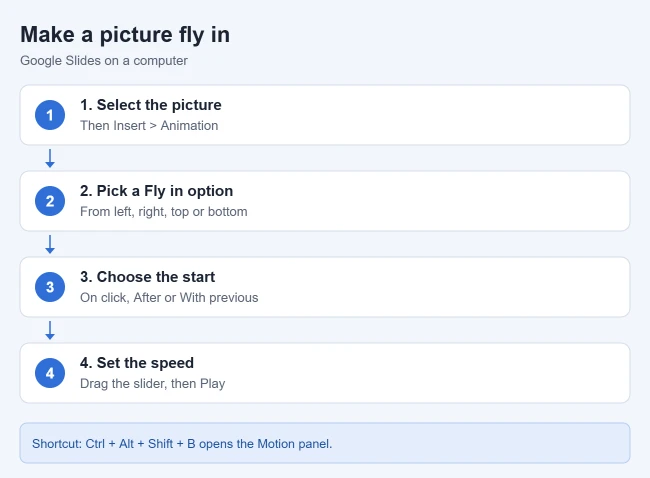
- Open your presentation and click the picture.
- Click Insert › Animation. You can also click View › Motion, or right-click the picture and choose Animation. Result: the Motion panel opens on the right, and Google says new animations start as Appear (On click).
- Under Object animations, open the first menu and choose Fly in from left, Fly in from right, Fly in from top or Fly in from bottom.
- In the second menu, choose when it starts: On click, After previous or With previous.
- Drag the slider to set the speed, then click Play to preview. Result: the picture slides onto the slide from the direction you picked.
The Motion panel also opens with Ctrl + Alt + Shift + B.
What the start options mean
- On click: the picture flies in when you click or press the space bar during the slide show.
- After previous: it flies in as soon as the previous animation finishes.
- With previous: it flies in at the same time as the previous animation.
Make the Picture Fly Out
- With the picture selected, click Add animation in the Motion panel.
- Choose a Fly out option, such as Fly out to right.
- Set it to On click or After previous. Result: the picture leaves the slide after it has flown in.
Animations play in the order they’re listed in the Motion panel. Drag them up or down to change the order.
How to Remove an Animation
- Click the picture, then open the Motion panel (View › Motion).
- Find the animation in the list and expand it.
- Click the trash icon. Result: the picture stays on the slide without moving.
How to Remove a Transition From a Slide
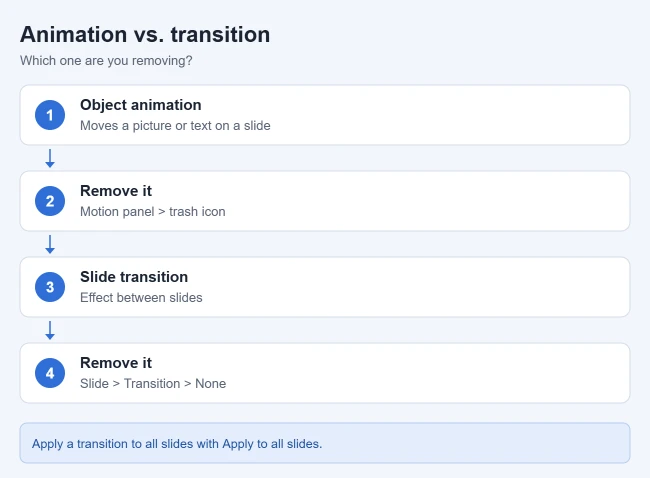
- Click the slide in the filmstrip on the left.
- Click Slide › Transition. Result: the Motion panel shows the Slide transition setting.
- Under Slide transition, choose None.
To remove transitions from the whole deck, choose None and then select Apply to all slides in the same panel.
Tips and Troubleshooting
- The picture fades as it flies: several Google Docs Editors Community questions ask how to remove the fade from fly animations. Google’s Motion panel only offers type, start and speed settings, so there’s no separate fade switch.
- Nothing moves when presenting: make sure the start option isn’t waiting for a click. Google also notes some animations may not work in every browser.
- Animations play in the wrong order: reorder them in the Motion panel.
- Too much motion: keep to one or two animations per slide so the content stays the focus.
Frequently Asked Questions
Can I animate text one line at a time?
Yes. Select the text box, add an animation, and check By paragraph in the Motion panel.
Do animations work on phones?
You can present on a phone or tablet, but Google’s steps for adding and editing animations are for the computer version of Slides.
Will animations carry over to PowerPoint?
Many do when you download the file as .pptx (File › Download), but effects can change, so check each slide in PowerPoint afterward.
Related Guides

Matthew Burleigh is the founder, head writer, and editor of Solve Your Tech, which he launched in 2012. He has written technology tutorials since 2008 and worked in IT since 2003, including small-business support, IT management, and consulting. He holds Bachelor’s and Master’s degrees in Computer Science from Arizona State University.
Matthew writes practical guides for Windows, iPhone and iPad, Microsoft Office, Outlook, Google apps, and Android. Solve Your Tech’s guides are tested on current devices or checked against official product documentation, with clear steps, sources, and update dates.
Read more about Matthew and how Solve Your Tech writes and updates its guides, or report a correction.