To fix an upside-down screen in Windows 11, open Settings > System > Display, select the affected monitor, and change Display orientation to Landscape. Select Keep changes when the picture is upright. If you intentionally use a vertical monitor, choose the portrait orientation that matches its physical position instead.
These steps cover Windows 11 on desktops, laptops, and 2-in-1s, and they follow Microsoft’s screen resolution and layout guide. Windows 10 uses the same Settings > System > Display path.
An upside-down desktop is different from oversized text, browser zoom, or a rotated photograph. If the taskbar, mouse pointer, and every open window are inverted, start with display orientation. If only a picture is inverted, rotate that picture in its editing app; changing Windows orientation would rotate everything else too.
Why the Screen Turned Upside Down
Windows doesn’t flip the screen on its own without a reason. The usual causes are:
- A keyboard shortcut. Some graphics drivers rotate the screen when you press Ctrl + Alt and an arrow key. A child, a pet, or a stray hand on the keyboard can trigger it.
- A 2-in-1 or tablet. These PCs rotate the screen to match how you hold them. Folding the screen back or laying the device flat can leave the picture upside down.
- A monitor change. Connecting, disconnecting, or rearranging monitors, or a graphics-driver update, can leave one display with the wrong orientation.
- A deliberate setting. Someone chose a flipped orientation, or a game or app changed it.
Whatever caused it, the fix is the same Display orientation setting.
Restore the Screen Orientation
When the screen is upside down, the mouse moves the opposite way you expect. Move slowly, or use the keyboard tips in the next section if the pointer is hard to control.
- Press Windows key + I to open Settings. You can also right-click an empty area of the desktop and select Display settings.
- In Settings, select System > Display.
- If you have multiple monitors, select the numbered display that is upside down. Use Identify to show each screen’s number if you are unsure.
- Under Scale & layout, open Display orientation and choose Landscape for a normal horizontal screen. Avoid Landscape (flipped), which turns it upside down.
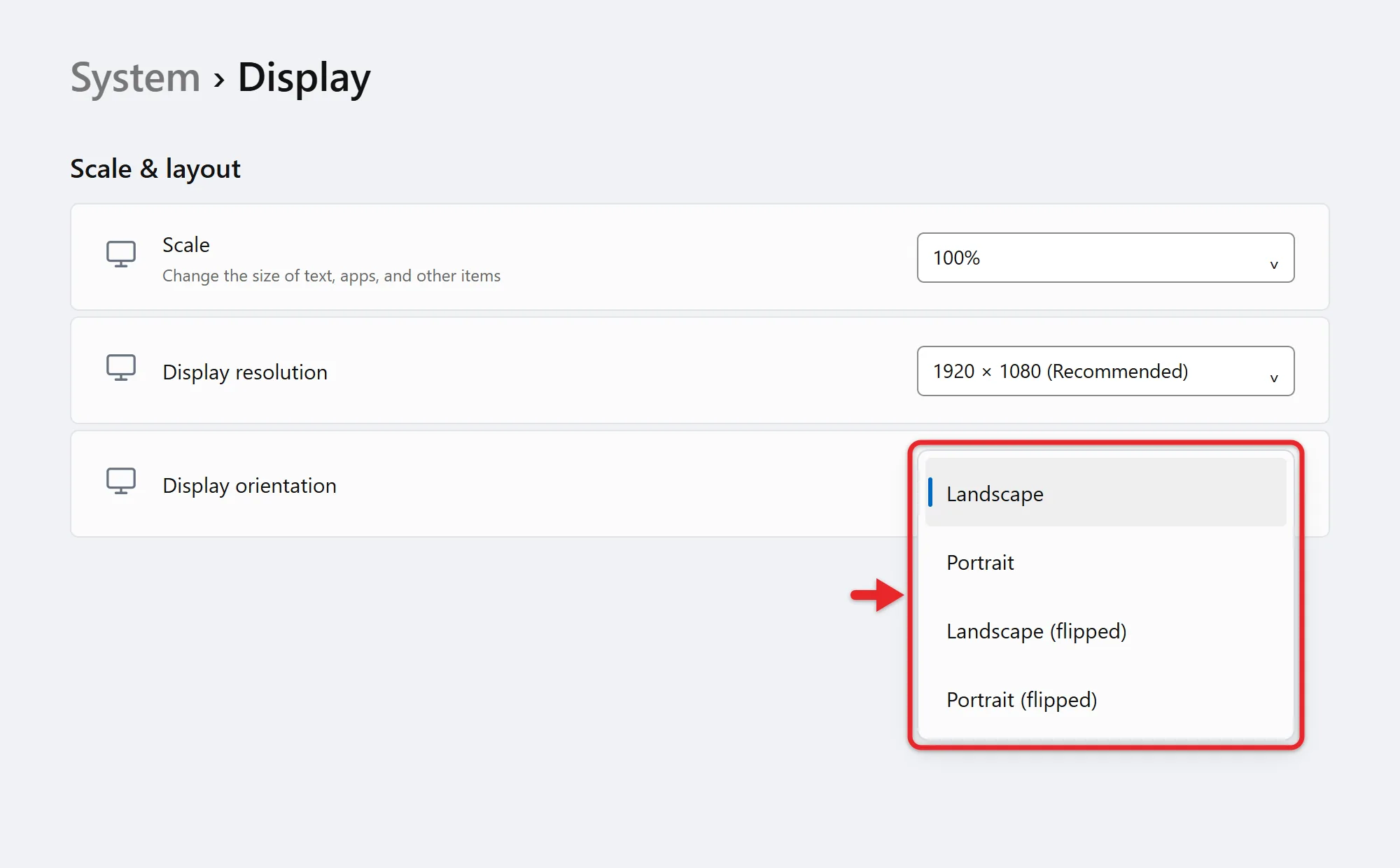
- If Windows presents an Apply button, select it. When the confirmation appears, select Keep changes only if the screen now looks correct.
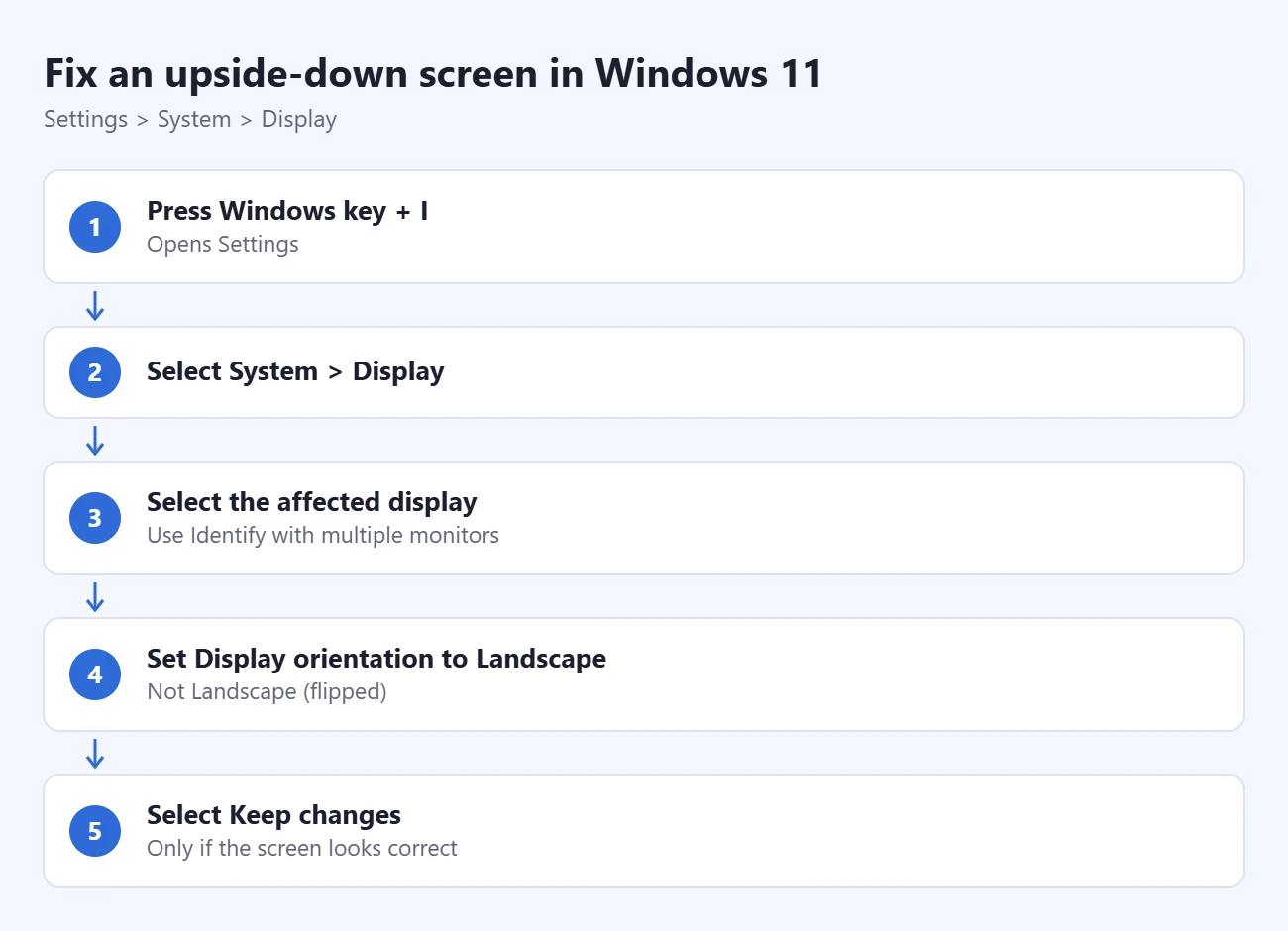
The desktop, taskbar, and pointer turn right side up, and the mouse moves normally again.
If you pick the wrong orientation, select Revert or let the on-screen confirmation countdown expire. The display returns to its previous setting. Do not keep an orientation you cannot read.
Use the Keyboard If the Mouse Is Hard to Control
An upside-down pointer is confusing, so the keyboard can be quicker:
- Press Windows key + I to open Settings.
- Type orientation in the search box at the top of Settings. Matching results appear as you type.
- Press the Down Arrow key to highlight the display orientation result, then press Enter. The Display page opens.
- Press Tab until the Display orientation list is highlighted, then press Enter or Alt + Down Arrow to open it.
- Use the arrow keys to highlight Landscape, then press Enter.
- When the confirmation appears, press Tab until Keep changes is highlighted, then press Enter.
Choose the Right Orientation for Your Monitor
Use the monitor’s actual mounting position to decide which option fits. You do not need to physically turn a normal horizontal monitor over to correct an accidental software rotation.
| Display orientation | Typical use |
|---|---|
| Landscape | Normal horizontal desktop or laptop screen |
| Landscape (flipped) | Horizontal display mounted upside down |
| Portrait | Display physically turned upright |
| Portrait (flipped) | Vertical display turned the other way |
For a vertical monitor, try the portrait option that makes text upright, then keep it. If the text runs sideways in the wrong direction, choose the other portrait option. Microsoft notes that if you rotate an external monitor in Windows, you also need to physically turn the screen to match. With two monitors, change the affected display instead of assuming that both need the same orientation. Microsoft’s multiple-monitor guide explains how to identify and arrange your screens.
Stop a 2-in-1 or Tablet From Rotating
If your laptop folds into a tablet, Windows may keep turning the screen as you move it. Rotation lock holds the current orientation.
- Hold the device the way you want the screen to face, then fix the orientation with the steps above.
- Open Settings > System > Display.
- Under Scale & layout, turn Rotation lock on.
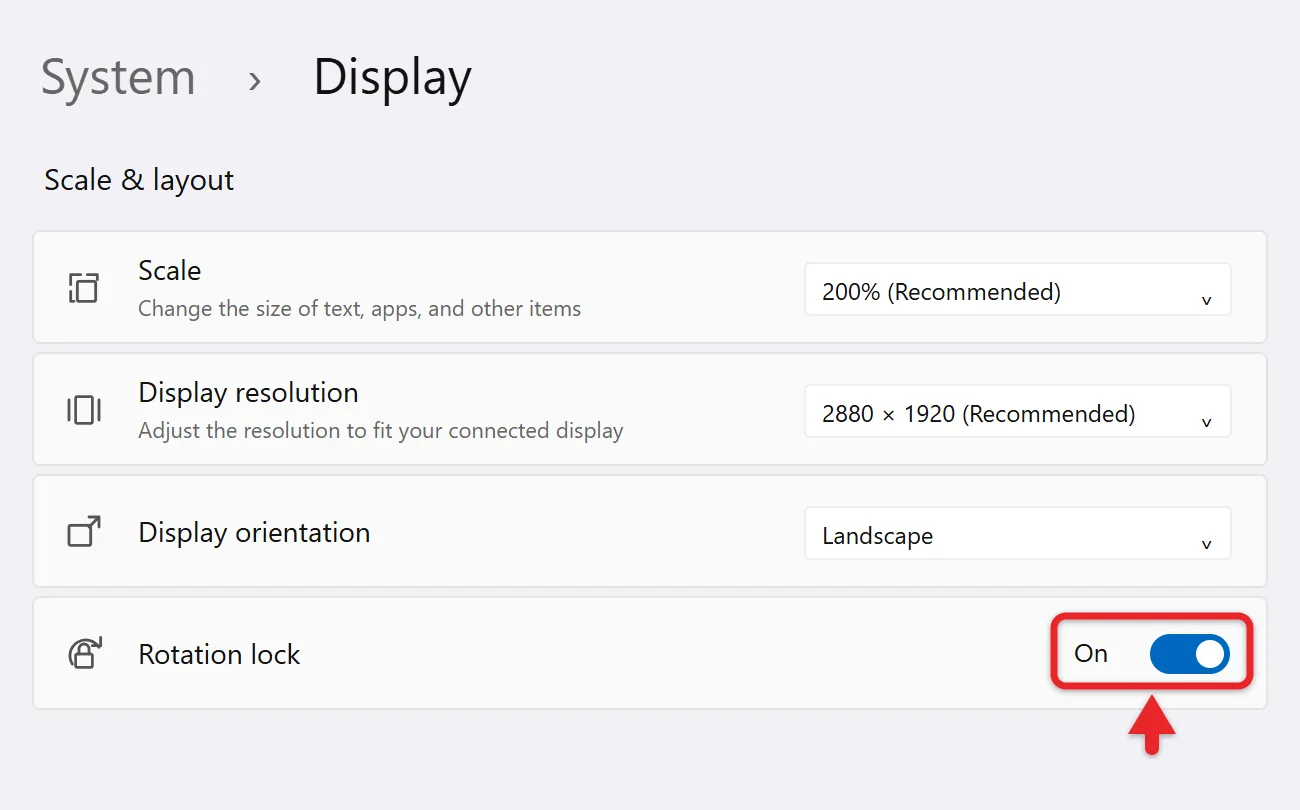
The screen stays put when you tilt or fold the device. Turn Rotation lock off when you want automatic rotation back. Many 2-in-1s also show a Rotation lock button in Quick Settings (press Windows key + A).
Rotation lock appears only on devices with a rotation sensor, so most desktops and ordinary laptops don’t have it. If it’s greyed out, fold the device into tablet position and check again, since some 2-in-1s offer it only in that position. Acer’s rotation lock steps show the same Settings location.
Why Ctrl + Alt + Up Arrow May Not Work
Some older graphics-driver utilities use Ctrl + Alt + Up Arrow to restore landscape orientation. It isn’t a built-in Windows 11 shortcut, so if nothing happens, your keyboard is fine. Use the Settings steps above instead.
Rotation controls and rotation hotkeys were removed from Intel Graphics Command Center starting with version 1.100.4779.0 of its lite edition. Intel’s recommended alternative is changing orientation in Windows Settings. You do not need to install a beta graphics utility just to straighten the screen.
If your PC still has a graphics utility with rotation hotkeys and they keep getting pressed by accident, turn the hotkeys off in that utility’s settings. Look for a hotkey or keyboard shortcut section; the name depends on the graphics maker and version.
If the Wrong Monitor Rotates
Return to Settings > System > Display, select Identify, then choose the numbered rectangle for the screen you actually want to change. Restore the other display to its previous orientation if you changed it accidentally. In graphics software that still provides rotation hotkeys, those shortcuts may apply only to the main display. Selecting the monitor explicitly in Windows avoids that ambiguity, and you can change the main display in Windows 11 if the wrong screen is set as main.
First make sure you’re changing the right display. Save your work and restart Windows, then check Settings > Windows Update for updates. If the problem started after a graphics-driver change, update your graphics driver in Windows 11 or roll it back, and follow the PC or graphics card maker’s support instructions for your model. Don’t download a random rotation tool or edit the registry to force an option to appear.
If the screen flips back after every restart, a graphics app may be applying its own rotation setting. Open the graphics app that came with your PC and set its rotation to normal or 0 degrees, or remove its rotation hotkeys.
If text is upright but too large, too small, or surrounded by black space, orientation is probably not the setting you need. Instead, read about changing screen resolution in Windows, which also covers Windows 11 and separates resolution from scaling. To start over with several display settings at once, reset display settings in Windows 11.
On a Windows 10 PC, use these scale, resolution, and Magnifier fixes for getting the screen back to normal size.
Frequently Asked Questions
Does rotating the display change my files?
Changing display orientation changes how the desktop appears. It does not rotate the image files saved on the computer or edit your documents.
Is an upside-down screen a sign of a virus?
Almost never. A pressed shortcut, a tablet sensor, or a display change is far more likely. If the screen keeps flipping along with other strange behavior, run a scan in Windows Security to rule out a problem.
Can I prevent an accidental keyboard rotation?
If your graphics utility offers rotation hotkeys, disable those hotkeys in that utility. There is no general Windows switch that enables or disables every manufacturer’s rotation shortcut. Automatic rotation on a convertible or tablet is a separate feature that Rotation lock controls.
What if the screen is upside down before Windows starts?
Windows Display settings affect the Windows desktop. If the startup logo or a monitor’s own menu is also upside down, check the monitor’s physical mounting and its manufacturer’s instructions. That symptom requires a different check from correcting an accidentally rotated Windows desktop.
Can I use a monitor sideways on purpose?
Yes. A vertical monitor is useful for reading long documents, code, or web pages. Turn the monitor on its stand, then choose Portrait or Portrait (flipped) for that display so the text reads upright.

Matthew Burleigh is the founder, head writer, and editor of Solve Your Tech, which he launched in 2012. He has written technology tutorials since 2008 and worked in IT since 2003, including small-business support, IT management, and consulting. He holds Bachelor’s and Master’s degrees in Computer Science from Arizona State University.
Matthew writes practical guides for Windows, iPhone and iPad, Microsoft Office, Outlook, Google apps, and Android. Solve Your Tech’s guides are checked step by step against the device or app maker’s own documentation and tested on his own devices whenever he has the hardware or software, with clear steps, sources, and update dates.
Read more about Matthew and how Solve Your Tech writes and updates its guides, or report a correction.