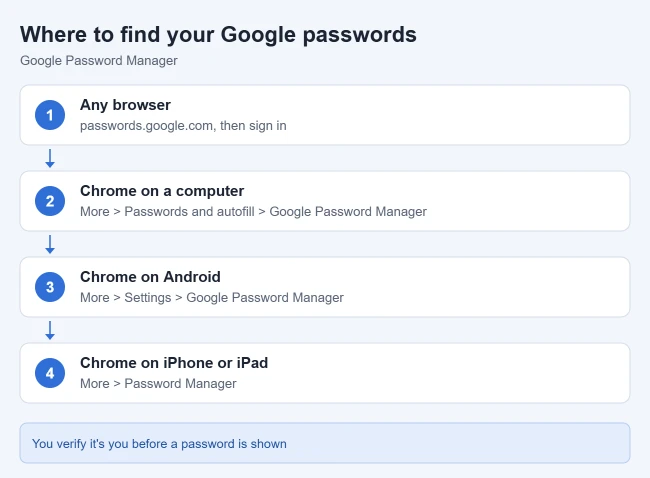
To see passwords saved to your Google Account, go to passwords.google.com and sign in, or in Chrome select the three-dot menu, then Passwords and autofill > Google Password Manager. Select a site and verify it’s you to see the password.
This guide covers Google Password Manager on the web, in Chrome on Windows and Mac, and in Chrome on Android, iPhone and iPad. It also shows how to edit, delete, export and check your passwords, and what to do when a password isn’t listed. Steps follow Google’s Chrome Help pages, checked in October 2026. It doesn’t cover recovering your Google Account password itself; for that, use Google’s account recovery page.
Where Google Saves Your Passwords
Google’s Manage passwords in Chrome page explains that Chrome saves passwords in two places. When you’re signed in to Chrome, they’re saved to your Google Account and sync across your devices. When you’re not signed in, Chrome stores them only on that device. Passwords in your Google Account can be viewed from any browser at passwords.google.com; device-only passwords appear only in Chrome on that device.
Find Saved Passwords on Any Browser
- Go to passwords.google.com. Result: Google asks you to sign in if you aren’t already.
- Sign in with the Google Account that saved the passwords. Result: a list of sites with saved passwords appears.
- Select a site, or use the search box at the top. Result: Google asks you to verify it’s you.
- Enter your Google password or confirm with your device. Result: the username appears, and the eye icon shows the password.
This works on a phone, a Mac, or a computer that doesn’t have Chrome.
Find Saved Passwords in Chrome on a Computer
- Open Chrome and select the three-dot menu (More) at the top right. Result: the menu opens.
- Select Passwords and autofill > Google Password Manager. You can also type chrome://password-manager in the address bar. Result: the Passwords list opens.
- Select the site you want. Result: Chrome may ask for your computer’s password, PIN or Windows Hello.
- Select Show password (the eye icon) next to the password. Result: the password appears. The copy icon next to it copies it.
Find Saved Passwords on Android
- Open Chrome and tap the three-dot menu (More) at the top right. Result: the menu opens.
- Tap Settings > Google Password Manager. Result: your saved passwords are listed.
- Tap a site, then Show password. Result: after you unlock with your fingerprint, face or PIN, the password appears.
Many Android phones also open the same list from the phone’s Settings > Google menu, under Autofill or Password Manager. Menu names vary by phone and Android version.
Find Saved Passwords on iPhone or iPad
- Open the Chrome app and tap More (three dots). Result: the menu opens.
- Tap Password Manager. Result: your saved passwords are listed.
- Tap a site, then Show password. Result: after Face ID, Touch ID or your passcode, the password appears.
These steps are from Google’s iPhone & iPad version of the Chrome Help page. Passwords saved in Safari aren’t in Google Password Manager; they’re in Apple’s Passwords app. See how to view saved passwords on iPhone.
Edit, Delete or Export Saved Passwords

- Edit: select the password, select Edit, change it, and select Save. This only updates what Google stores; change the password on the website too.
- Delete: select the password and select Delete.
- Export on a computer: in Google Password Manager, select Settings on the left, then Download file next to Export passwords.
- Export on Android: tap Settings > Export passwords. On iPhone, tap Settings > Export data.
An exported file is a plain-text CSV, so anyone who opens it can read your passwords. Import it into your new password manager, then delete it.
Check Whether Your Passwords Are Safe
Google Password Manager includes Checkup. On a computer, select Checkup on the left; on Android, tap Google Password Manager > Checkup. Google says it reports any password exposed in a data breach, and on a computer, weak passwords that are easy to guess. Change any flagged password on the site itself.
On a computer you can also turn on Use Windows Hello when filling passwords (or Use your screen lock on a Mac) in Google Password Manager settings, so Chrome asks for biometrics before revealing or filling passwords. Google notes it’s off by default.
If a Password Isn’t Listed
- Wrong account: check which Google Account you’re signed in to. Each account has its own list.
- Saved only on another device: passwords saved while you weren’t signed in to Chrome stay on that device. Google says you can import them into your Google Account from Chrome on that device.
- Saved somewhere else: the password may be in another browser, such as Edge or Safari, or a separate password manager. If you keep logins in another manager, you can stop Chrome from offering to save passwords. For Windows, see how to find saved passwords on Windows 11.
- Different web address: some sites sign you in on a different domain, so search for the company name rather than the exact address.
Frequently Asked Questions
Is it safe to save passwords in Google?
Google encrypts saved passwords and asks you to verify your identity before showing them. Protect your Google Account with a strong password and 2-Step Verification, since anyone with access to it can see your saved passwords.
Can I see my passwords without Chrome?
Yes. Passwords saved to your Google Account are at passwords.google.com in any browser.
Can I share a saved password?
Google says you can share a copy with members of your Google family group from Google Password Manager.
How do I delete all my saved passwords?
In Google Password Manager, open Settings and choose Delete data next to “Delete all Google Password Manager data.” This removes saved passwords and passkeys and can’t be undone, so export first if you want a copy.

Matthew Burleigh has been writing tech tutorials since 2008. His writing has appeared on dozens of different websites and been read hundreds of millions of times.
After receiving his Bachelor’s and Master’s degrees in Computer Science he spent several years working in IT management for small businesses. However, he now works full time writing content online and creating websites.
His main writing topics include iPhones, Microsoft Office, Google Apps, Android, and Photoshop, but he has also written about many other tech topics as well.