You type one-handed on your iPad and wish you could glide a finger across the letters the way you can on an iPhone. On iPadOS 26 and earlier, Apple documents swipe typing (QuickPath) on the smaller floating keyboard: pinch the keyboard inward, then slide your finger from letter to letter. In iPadOS 27, Apple’s guide describes sliding to type on the onscreen keyboard without that limit, so try swiping first and float the keyboard if it doesn’t work.
When iPad Swipe Typing Needs the Floating Keyboard
The floating keyboard is a smaller, phone-sized version of the onscreen keyboard that you can drag anywhere on the screen. Apple’s floating keyboard support page describes typing with one hand on it using QuickPath by swiping from letter to letter. Whether you need it for swiping depends on your iPadOS version:
- iPadOS 26 and earlier: Apple’s iPadOS 26 typing guide says to pinch the keyboard smaller to use QuickPath, and that on the full-size keyboard you tap keys to type. The iPadOS 18 version of the guide says the same.
- iPadOS 27: Apple’s iPadOS 27 typing guide says you can tap keys or slide from one letter to the next on the onscreen keyboard, and mentions the smaller keyboard only as a tip for one-handed typing.
To check your version, open Settings > General > About.
That explains the most common confusion on iPadOS 26 and earlier. Many people turn on a slide-to-type setting, go back to the regular keyboard, try to swipe, and nothing happens. The setting is fine; the keyboard is simply in the wrong mode. On those versions, swipe on the floating keyboard and tap on the full one. On iPadOS 27, try the regular keyboard first, and float it if swiping still doesn’t respond.
A few terms used below:
- Floating keyboard: the small onscreen keyboard you can move around the screen.
- QuickPath or slide to type: entering a word by dragging one finger across its letters without lifting it.
- Hide Keyboard button: the keyboard key, usually at the bottom right, that dismisses the keyboard or opens its layout options.
Make the Keyboard Floating
Apple documents two ways to do this. Both start the same way.
Pinch the Keyboard
- Open an app that uses the onscreen keyboard, such as Notes or Messages, and tap in a text field so the keyboard appears.
- Place two fingers on the keyboard, spread a little apart.
- Pinch them together. The keyboard shrinks to a small floating version.
Use the Hide Keyboard Button
- With the keyboard showing, touch and hold the Hide Keyboard button.
- Slide your finger to Floating, then release. On some iPadOS versions, a tap on the button shows the same options.
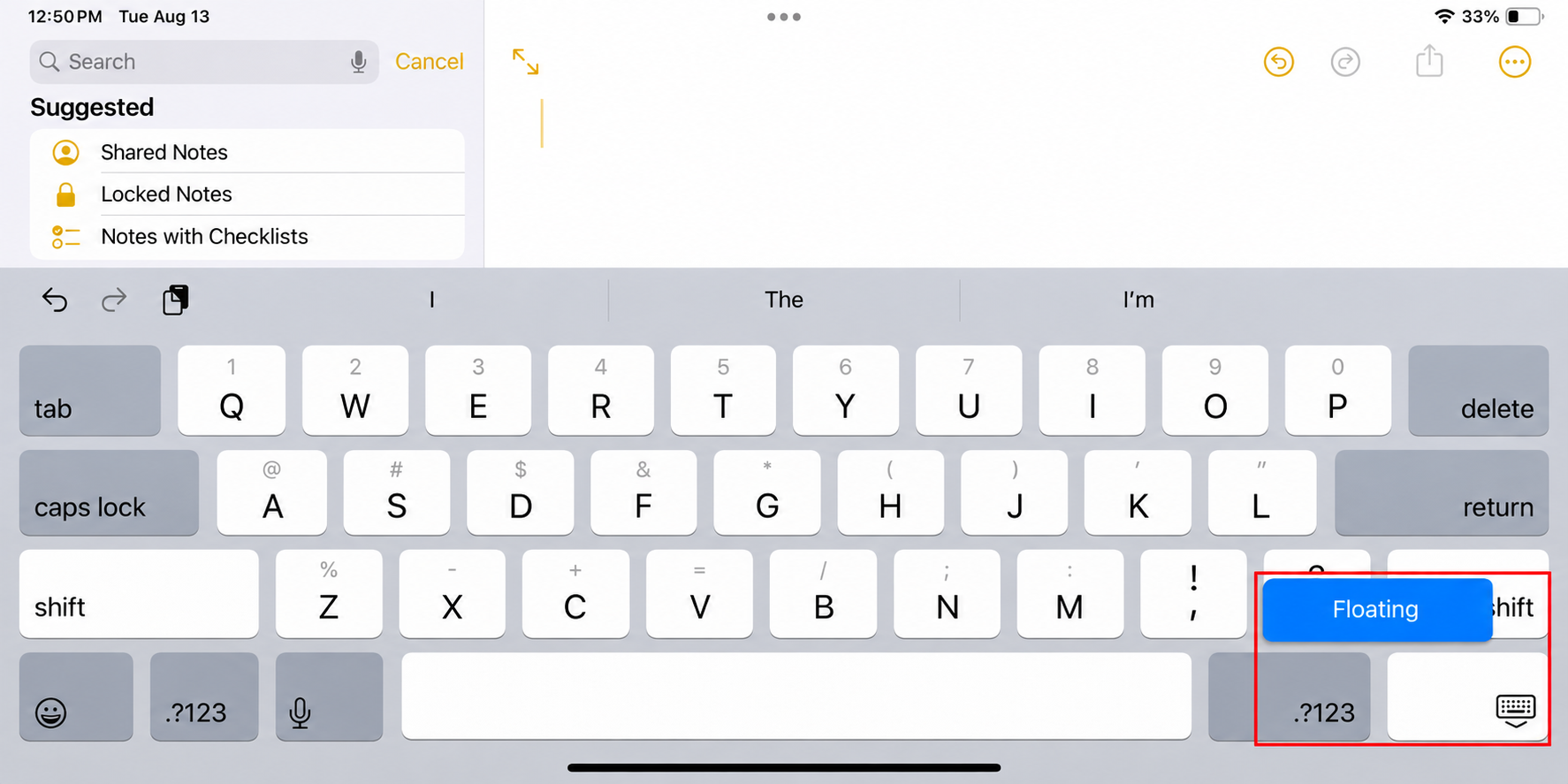
If you don’t see the keyboard at all, start with getting the iPad keyboard to appear. Note that if you only see the key options and not Floating, a hardware keyboard or keyboard case may be connected.
Check the Slide to Type Setting
Swipe typing is often on by default. If it doesn’t respond on a keyboard where your iPadOS version supports it, check the setting:
- Open Settings.
- Tap General, then Keyboard.
- Scroll through the list of switches and look for one with “slide” in its name. On some versions it may read something like Slide on Floating Keyboard to Type, and the wording may differ on iPadOS 27.
- Turn it on (green), then go back to your app and try swiping. On iPadOS 26 and earlier, float the keyboard first.
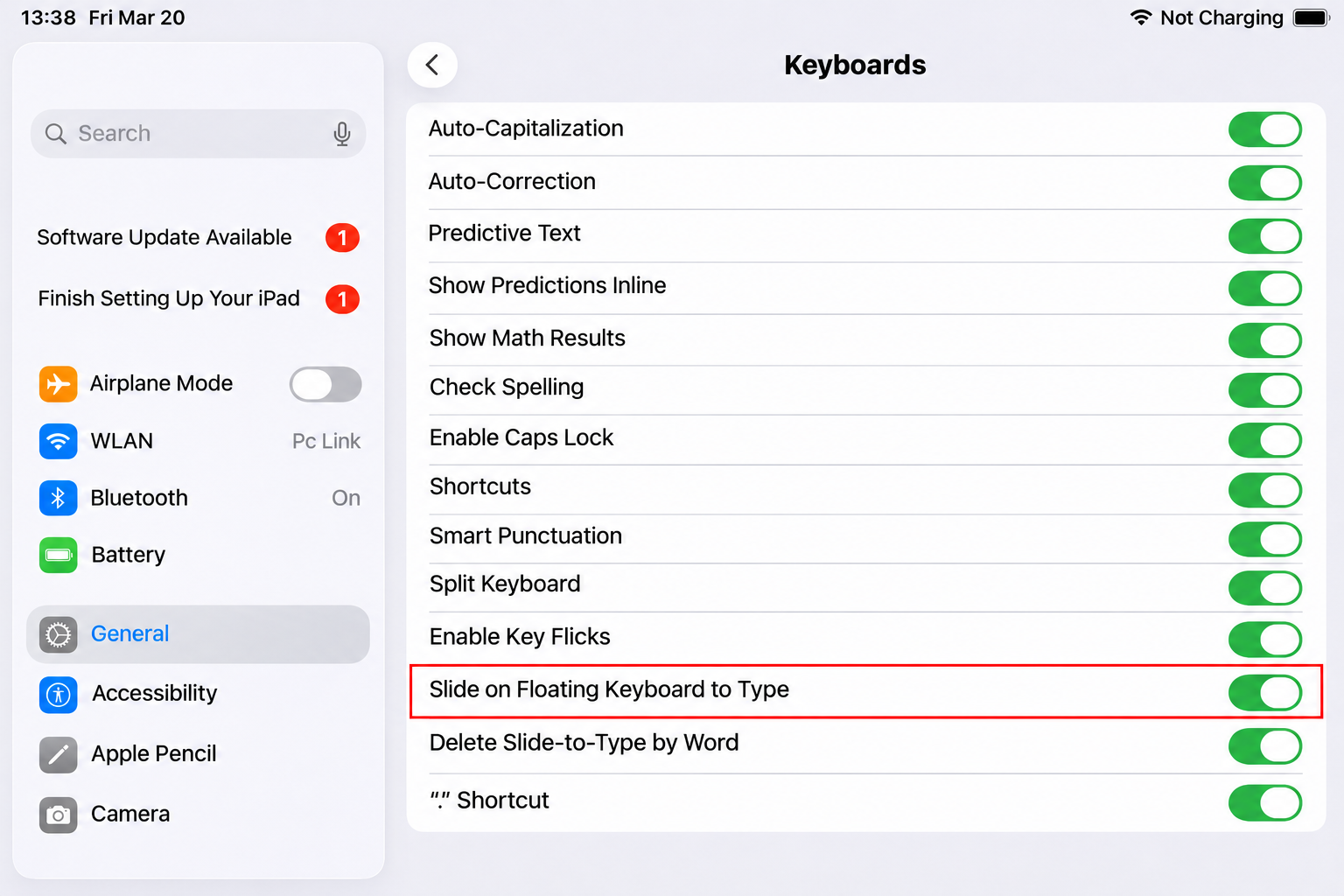
Apple’s guide says only that the typing features sit on this screen below All Keyboards, and doesn’t name this switch, so the exact wording on your iPad may differ between iPadOS versions. The same screen holds the predictive text, auto-correction and capitalization switches, which affect what swipe typing produces. If you want to change those, see how to turn off predictive text and other iPad typing settings.
How to Swipe Type a Word
- Open the keyboard. On iPadOS 26 and earlier, make sure the floating keyboard is showing. On iPadOS 27, you can start on the regular keyboard.
- Put a finger on the first letter of the word.
- Without lifting, slide to each following letter in order. You don’t need to stop precisely on every key; the keyboard works out the word from the shape of your path.
- Lift your finger after the last letter. The word appears in the text field.
- Start the next word. The keyboard usually adds the space between swiped words for you.
Here is a worked example. Lena holds her iPad in her left hand while she cooks and wants to send “running late tonight.” She pinches the keyboard into floating mode and drags it to the lower left corner. She swipes r, u, n, i, n, g in one stroke, lifts, then swipes “late” and “tonight.” Three strokes produce the whole phrase. For a double letter like the n in “running,” a single pass over the key is usually enough.
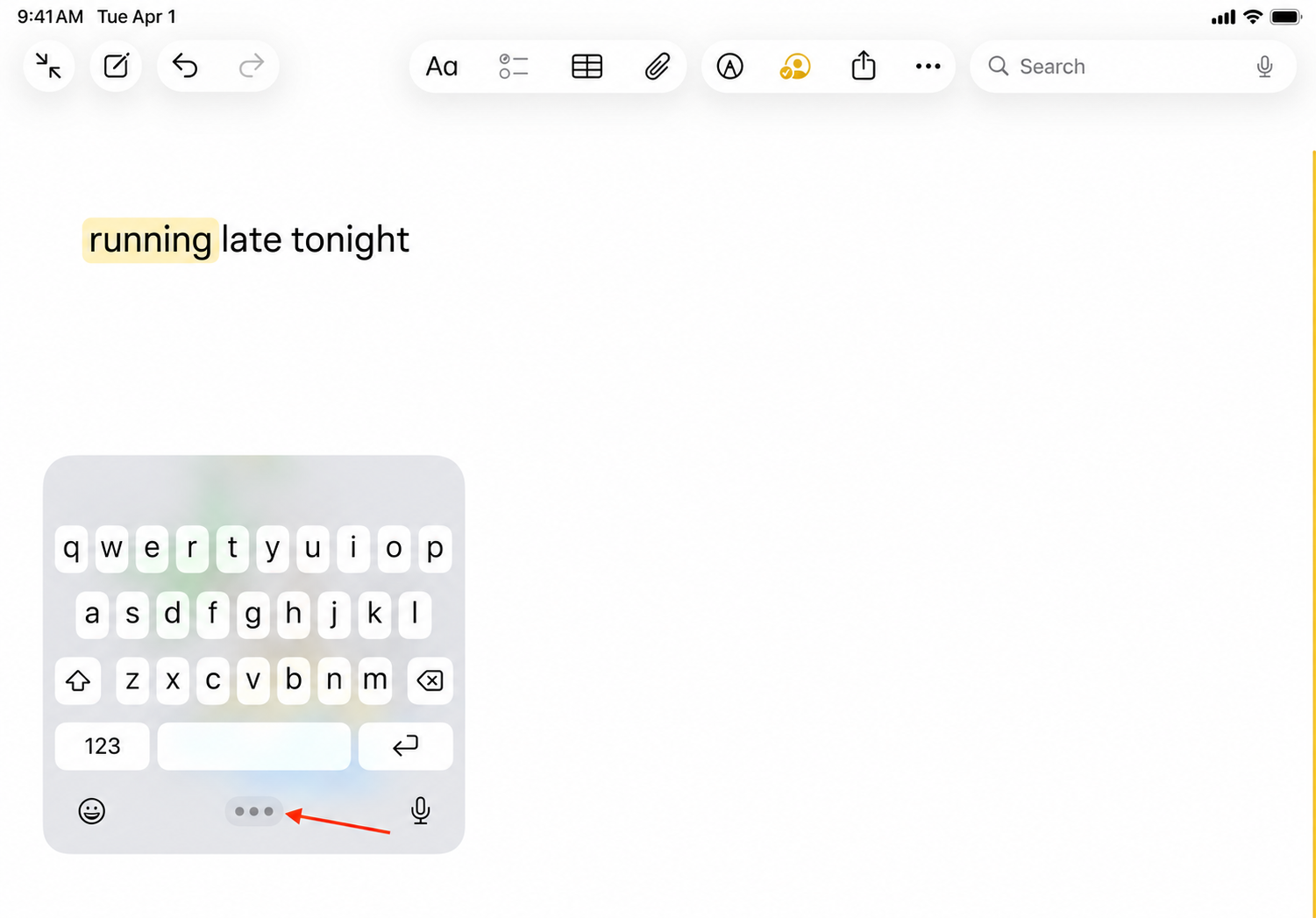
You can mix swiping and tapping freely. Tap in names, numbers, passwords and short words like “a” or “I,” and swipe the longer everyday words where the time savings add up.
Fix a Word That Came Out Wrong
Swipe typing guesses, and similar paths (for example “tip” and “top”) can trip it up. A few ways to correct it:
- Check the suggestions: after a swipe, the predictive bar above the keys may show other possible words. Tap the right one to swap it in.
- Delete and retry: tap Delete right after a swiped word. Apple’s iPadOS 18 and 26 guides say this deletes the whole word, not just the last letter.
- Slow down on short words: deliberate paths through the corners of the keyboard help it tell apart words with similar shapes.
- Tap the hard ones: unusual names or slang are often quicker to tap once than to swipe twice.
Move the Floating Keyboard or Go Back to Full Size
To move the floating keyboard, touch and hold the More button (the three-dot icon) and drag the keyboard where you want it. Placing it near the edge your thumb rests on makes one-handed swiping much more comfortable.
To return to the full-size keyboard, use either method Apple documents:
- Place two fingers on the floating keyboard and spread them apart, or
- Tap the More button and tap Full.
If your keyboard ends up split into two halves or stuck halfway up the screen instead, see how to split, merge or move the iPad keyboard. Apple notes that the split and undocked layouts are available on supported models only, and a split keyboard is not the same as the floating one.
Which Keyboard Layout to Use
The iPad can show its onscreen keyboard in a few layouts, and Apple’s swiping guidance for them depends on the iPadOS version. Use this to pick the right one for what you’re doing:
| Layout | How to get it | Best for | Swipe typing |
|---|---|---|---|
| Full size | Spread two fingers on the floating keyboard, or More > Full | Two-handed typing with the iPad on a table or in your lap | iPadOS 26 and earlier: tap only. iPadOS 27: Apple’s guide describes sliding to type on the onscreen keyboard |
| Floating | Pinch the keyboard, or Hide Keyboard button > Floating | One-handed typing while holding the iPad | Yes, with QuickPath |
| Split or undocked | Keyboard layout options on supported models | Thumb typing with both hands while holding the iPad | Not described by Apple for swiping; switch to Floating to swipe |
A practical rule: if both hands are free, stay on the full keyboard (on iPadOS 27 you can also try swiping there). If one hand is holding the iPad, or you’re replying to a quick message on the couch, pinch to float and swipe. Switching back and forth takes one gesture, so you don’t have to commit to either.
If Swiping Doesn’t Work
Work through these checks in order:
- Is the keyboard floating? On iPadOS 26 and earlier, this is the usual cause: Apple says you tap keys on the full-size keyboard, so float the keyboard to swipe. In iPadOS 27, Apple’s guide describes sliding on the onscreen keyboard without that limit, but if swiping on the full keyboard does nothing, float it and try again.
- Is the setting on? Recheck Settings > General > Keyboard for the slide-to-type switch.
- Which keyboard is active? If you’ve added a keyboard for another language or a keyboard app, switch back with the globe key and try again. Apple notes that QuickPath isn’t available for every language.
- Is a hardware keyboard connected? With a keyboard case or Bluetooth keyboard in use, the onscreen keyboard may be hidden or reduced to a small toolbar. Disconnect it, or fold the case keyboard away, to bring back the onscreen keyboard.
- Does the app support it? Some fields, such as password boxes, may not accept swiping. Test in Notes to rule the app out.
- Restart and update. Restart the iPad, then check Settings > General > Software Update. See how to install an iPad software update if one is waiting.
To confirm the fix, open Notes (float the keyboard first on iPadOS 26 and earlier) and swipe a simple word like “hello.” If it appears as a full word in one stroke, swipe typing is working.
Other Ways to Type Faster on iPad
Swiping is one option. Depending on how you hold the iPad, one of these may suit you better:
- Scribble with Apple Pencil: on iPad, you can use a compatible Apple Pencil and Scribble to convert handwriting into text, as Apple’s Scribble user guide page describes. Pencil and iPad compatibility varies by model; this Apple Pencil walkthrough covers pairing and setup.
- Dictation: if dictation is turned on, the microphone key on the keyboard lets you speak instead of type.
- A hardware keyboard: for long documents, a Bluetooth keyboard or keyboard case beats any onscreen method.
- Keyboard apps: the App Store has third-party keyboards, some with their own swipe features, which you add from the Keyboard settings. Read what access each one asks for before you allow it.
Questions About Slide to Type on iPad
Can I swipe on the full-size iPad keyboard?
It depends on your iPadOS version. In iPadOS 26 and earlier, Apple documents QuickPath on the smaller floating keyboard, and on the full-size keyboard you tap. In iPadOS 27, Apple’s guide describes sliding to type on the onscreen keyboard without that limit, so try it, and float the keyboard if it doesn’t work.
How do I turn swipe typing off?
Turn off the slide-to-type switch in Settings > General > Keyboard. On iPadOS 26 and earlier, leaving the keyboard at full size also keeps you tapping.
Why does my keyboard keep shrinking by itself?
A two-finger pinch on the keyboard is the gesture that turns it into the floating keyboard, so resting two fingers on the keys and drawing them together can trigger it by accident. Spread two fingers on the small keyboard, or tap More and then Full, to get the full keyboard back.
Does it work in every app?
The floating keyboard is part of the standard iPadOS keyboard, so it appears in apps that use that keyboard, like Notes, Messages, Mail and Safari. Apps that show their own custom keyboard, and some secure fields, may behave differently.
Will the floating keyboard stay small next time?
It may stay floating in the next app you type in until you spread it back to full size. If the keyboard looks tiny and you didn’t mean it to, that is usually the reason, and spreading two fingers on it fixes it.
Try it now: open Notes, pinch the keyboard, drag it to the side your thumb rests on, and swipe a short message. Spread two fingers when you want the full keyboard back.

Matthew Burleigh is the founder, head writer, and editor of Solve Your Tech, which he launched in 2012. He has written technology tutorials since 2008 and worked in IT since 2003, including small-business support, IT management, and consulting. He holds Bachelor’s and Master’s degrees in Computer Science from Arizona State University.
Matthew writes practical guides for Windows, iPhone and iPad, Microsoft Office, Outlook, Google apps, and Android. Solve Your Tech’s guides are checked step by step against the device or app maker’s own documentation and tested on his own devices whenever he has the hardware or software, with clear steps, sources, and update dates.
Read more about Matthew and how Solve Your Tech writes and updates its guides, or report a correction.